The makings of a media mogul: Michael Arrington of TechCrunch

After recognising in my previous post that Michael Arrington has successfully captured the dynamic of the mass media to pioneer new media, my mind asked how did this guy do it. With some time on my hands, I looked into what I think is one of the most remarkable stories to occur in the recent tech boom that was Web 2.0 (yep, that’s past tense – it’s an innovation era that now has closed). How "a nobody ‚Äî a former attorney and entrepreneur who, at 35, looked as if he might never hit it big " became one of Time’s 100 most influential people in the world. I’ve never interacted with Arrington, although I know plenty of people that know him well (through the Aussie mafia that grace the Valley). So this is coming from a completely objective but aware view. An outside view with purely the public record to track his success. Let’s see what the evidence tells us.

The accidental start-up
Reading through the archives of his main blog TechCrunch.com and his companion blog CrunchNotes.com, I came to realise his success could be identified as early as his first five months from the first post written. He launched TechCrunch.com on the 11th June 2005 with posts released daily if not multiple times per day. The blog averaged 5 posts every two days in its first year, with 879 posts (it was actually more, but a half dozen or so have since been removed).
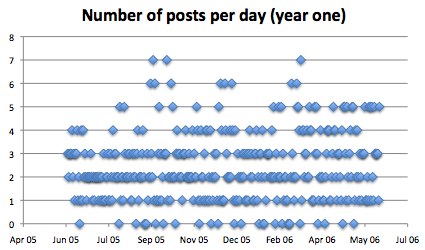
TechCrunch posts per day (year one)

His first post, which has since been removed (God bless the Internet archive), gives an insight into motivations for starting the blog.

TechCrunch is edited by Michael Arrington and Keith Teare, with frequent input from guest editors. It is part of the Archimedes Ventures network of companies.

Archimedes Ventures was at the time a two partner firm that specialised in the "development of companies focused on Web 2.0 technologies and solutions." The fact the page listed Teare and is marked as part of Archimedes Ventures network of companies suggests this was a conscious business development effort on the part of Arrington. As he would later reveal, he was inspired by Dave Winer who said: ‚Äúif you are going to build a new company, go to the trouble of actually researching what other companies have already done." Several months later in October, he posted an announcement that his startup Edgeio would be live soon, validating that TechCrunch wasn’t so much a "hobby" but a need to understand your market. Indeed, it seems TechCrunch just became a more formalised affair as he had been posting research into potential competitors on his personal blog publicly from March 2005 – and by the time he launched TechCrunch there were already four employees at Edgeio. No doubt, exposure and networking like any smart businessman was part of his agenda as well, which perhaps is why we saw a transition from a personal site to a TechCrunch brand (more on community building later).

On October 2005, TechCrunch was ranked the 566th blog by Technorati based on the amount of links it received from other websites. In December of that year, its ranking had climbed to 96th. One year on, in June 2006, it became the 4th most linked-to blog and has subsequently maintained its status as number 2 (not being able to beat another new media mogul Arianna Huffington who dominates the table, but that’s a story for another time).
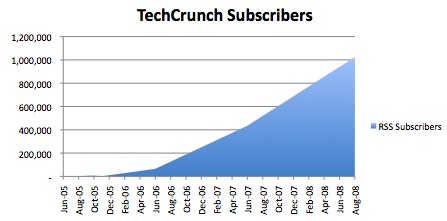
TechCrunch subscribers

The above graph shows an explosion, but it’s the first year that tells the story which forms the basis of this post:

Over that first year, 23,713 comments had been left, with around 1-2 million page views per month. However as the figures show, it was the first six months where this research turned into a prospective business ("help "), with subsequent months and years simply consolidating his growth: by year two, there were 2,000 more posts (double the output of the previous year); 115,608 comments and trackbacks in total (an average of 40 per post); and 435,000 RSS subscribers. Pages views in the month leading up to the 24th month in operation were 4.5 million, twice what it was the previous year. In September 2008, over a million people subscribed to the blog.

So how did he do it?
Compared to his peers/competitors, he joined the game quite late, and yet he is absolutely smashing them. Same software in some cases and same focus. The question is, what did Arrington do that others didn’t?

Whilst the metrics might track his growth, they don’t track how he did it, which has less to do with Search Engine Optimisation and more to do with hyping up a boom. Below I describe what I think are the Critical Success Factors that made TechCrunch what it is today.

1) Events.
TechCrunch wasn’t just a blog; it was a host. Early on, there were events hosted at Arrington’s house where people could network and mingle. It would be a mistake to think that TechCrunch later on got into the conference business as an alternative revenue stream, but the reality is, social networking was being organised in the real world in parallel to the online blog from as early as August 2005. To create a new blog and have 63 people subscribed to it within a week indicates a lot of offline activity to get those subscribers. The social meet ups reinforced his readership base.

2) Web2.0.
Arrington saw a tide building for a second tech boom and formed a loose group of allies promoting this tide. Add to the mix some existing high profile personal brands like Dave Winer and Robert Scoble – and in the process, you build your own personal brand. To use his words, he saw a parade and got in front of it.

When Tim O’Reily coined “Web 2.0″, it was a buzz-speak marketing word. What Arrington did was successfully exploit this dynamic by recognising the rising investment trend occurring. He built a community around Web 2.0 by being its tireless champion and channeling existing energies. And as the community grew, so did he. He realised that what goes down, goes back up again – and by tapping into this growth, he could grow with it. If this second boom was anything like the first, being at the front of it would be such a good career move that it probably didn’t even need to be said.

3) Excellent content.
Don’t underestimate the difference quality content has. Arrington has an analytical mind and is a clear communicator – he is a lawyer after all. Intelligence and an ability to communicate will beat even the most experienced journalist. I‚Äôve been told that Arrington doesn‚Äôt understand tech, or at least makes a convincing image of not getting it, which probably explains the why he writes in plain English – even in the conversational style of writing that blogging is associated with, good clear English is rare to find. More importantly, he understood what all publishers have long known: good content is not just about the words. As Scoble highlighted long ago, one of the reasons that made Arrington such a popular writer is the simple use of images to break up the text.

No doubt, Arrington’s previous staff writers, ones I am familiar with like Nik Cubrilovic, Duncan Riley and Marshall Kirkpatrick, made a big difference in TechCrunch’s growth: Kirkpatrick’s ground-breaking RSS and research skills to find news, Cubrilovic’s Arrington-style writing ability, and Riley’s industry relationships to often break news – is how they made compelling content. However, Arrington quite uniquely stands out and it‚Äôs why when he tried to take a break and to focus on the business side, he was pulled back in to raise the quality. TechCrunch is Mike Arrington: it’s been proven you can’t separate the two (at least, yet).

4) The media dynamic.
As I recently argued, the mass media at its core is about playing a game, but in the context of web 2.0 it is about understanding the dynamics of a market place. He had access to Venture Capitalists (VCs) as he was a corporate lawyer as well as an entrepreneur with experience to boot – access that other entrepreneurs quite simply didn‚Äôt have.

He was able to successfully take advantage of the VC paranoia that they might miss the next Google or Facebook. They literally were desperate to hear about the next big thing. For them, Arrington was a deal-type lawyer who would review things in plain English and present it with pretty pictures. On the flip side, you had entrepreneurs dying to get in front of these VCs as well as general exposure for their start-up. When Arrington decided to put advertising on the blog, it was a natural progression: entrepreneurs wanted to get exposure to VCs, future employees, and buzz amongst their peers. People on the other hand, are willing to consume this content because it’s free market research for them – catering in the audience for both investor and the entrepreneur. Powerful stuff? God yeah – that’s the kind of captive audience that’s addicted to crack cocaine.

To give you an idea of impact, I was told by an entrepreneur whose company was profiled in that first six months, that they got something like 30 VC calls and e-mails over a holiday period. After less than three weeks, they had Kleiner Perkins Caufield & Byers email, say "Hi, just another VC here. Can we meet next Thursday?". They had a list of meetings that kept them going for weeks. My own personal experience this year through the DataPortability Project saw first hand what exposure and support from TechCrunch could do, and suffice to say, it’s impressive. We had VCs wanting to talk to us about data portability, even though we‚Äôre non-profit!

This offline social networking is key to what ultimately became an online social media business. What’s very telling is a comment left by Valley legend Dave Winer, a man Arrington repeatedly showed admiration for and I am sure his relationship is what gave him a boost at the start. It reflects several things, but foremost, Arrington had a lot of goodwill in the community as a leader of the industry by existing heavy weights. He connected the various participants in what ultimately is a marketplace. Forget about Edgeio – this was the making of a new media business that would show the dying mass media what the future looks like for their industry. TechCrunch became the channel of choice for so many people to get their voice heard for competitive, strategic and ego reasons.

Concluding thoughts
TechCrunch started as a hobby and research project to test a bunch of the stuff he’d been reading about in the Web2.0 space. After the crash, he pretty much dropped out and watched a lot of college football – he needed a way to get back into it. Arrington probably knew he could write well, but I don’t think he realised how much of an impact his ability could have. The use of images in content, and the frequency of his posts made TechCrunch in the first six months, combined with offline social networking, the positioning as a champion of the Web 2.0 community, and exploiting the dynamic of a marketplace is what made him what he is. By the end of 2006, I don’t think Edgeio got much of Arrington’s attention at all – he’d been hooked by the excitement of writing, leading opinion and eventually, the power that attracts people to positions of note and influence, whether it be media, celebrity, business or politics.

This post only touches on the surface, as the Critical Success Factors in that first year do not give a full picture. Arrington‚Äôs involvement with the presidential primaries process, his disruptive influence with DEMO through the TC40/50, the Crunchies and even the people who keep trying to take him down add a further dimension to the TechCrunch story. He’s a man with more haters than Murdoch, but that’s doesn’t make him any less brilliant.

Arrington can get right up the nose of people with massive vested interests, and he loves to stir the pot – like the traditional press practice, controversy sells. Living in a massive rented house with all but a big dog, he can pretty much operate without fear. If it all exploded tomorrow, he’d probably have a beer, and enjoy a good long holiday and another season of college football. That’s what makes a journalist fearless, and that, combined with his obvious passion for the sector and the power he wields makes for a pretty dynamic combo.

He’s made no secret of his desire to be bigger than C|Net (without having to cop the overheads of their business model). Take out download.com, and I think it safe to say he’s reached that: maybe it’s time he puts his eyes on something a bit bigger. Although I doubt he needs to be told that – he’s already making history along with another select few, who through raw talent are pioneering “new media”, ready to replace the financially bankrupt mass media as the influencers in our society.
56 Responses to “The makings of a media mogul: Michael Arrington of TechCrunch”


  • Posts about Entrepre

    [...] professional should understand that he is an entrepreneur in independent capacity. The assets The makings of a media mogul: Michael Arrington of TechCrunch – liako.biz 12/25/2008 After recognising in my previous post that Michael Arrington has [...]

  • Elias,

    I've forgotten much of this, but it was really cool to go back and read some of the old posts in the early days (which really wasn't that long ago). Thanks for writing this.

  • Great article man. As you can see if you write enough quality posts and know what you are talking about, people will come and visit your blog.

  • ..and Michaels twet just sent me here. Excellent post, fun to hear how he got started.

  • Dang dude! It's not enough that you are tireless with Data Portability, but it turns our you are an awesomely insightful author too! Great article.

  • This is the best article I've read on how Michael Arrington developed TechCrunch into what it is today. Thanks for putting this together. Also, great analysis and use of images yourself!

  • It's the assumption or illusion of insider information that created the large audience.

  • I appreciate the research that went into this, esp digging up the first blog post.

  • Elias,

    I’ve forgotten much of this, but it was really cool to go back and read some of the old posts in the early days (which really wasn’t that long ago). Thanks for writing this.

  • Great article man. As you can see if you write enough quality posts and know what you are talking about, people will come and visit your blog.

  • ..and Michaels twet just sent me here. Excellent post, fun to hear how he got started.

  • Dang dude! It’s not enough that you are tireless with Data Portability, but it turns our you are an awesomely insightful author too! Great article.

  • This is the best article I’ve read on how Michael Arrington developed TechCrunch into what it is today. Thanks for putting this together. Also, great analysis and use of images yourself!

  • Excellent piece, nice analysis. Question is, wehat now – as you say, the Web 2.0 ballon is not rising any more. It will be interesting to see how TC transitions.

    • Thanks for the kind comments everyone!

      Alan P: That was actually one of the themes I wanted to explore, but I decided the post was long enough and cut it. I think the requirements to grow are different from the requirements to maintain. TechCrunch is now like what Scoble or Winer was before Arrington got started: he's an established influencer and Web 2.0 might have got him there but he no longer needs it (look at how Scoble rose with Microsoft and evolved once he left). Arringon's challenge now is more about defending revenue streams and evolving the new media approach into the Better Way of doing media in our world. And to do that, just like any business he needs to evolve and adapt – and the TechCrunch team are already light years ahead with the multiple products and brand synergies created. What fascinates me, is how can you use Arrington's model in other verticals which have a different dynamic – but I'm thinking I might need to do a few more case studies for that however because there are no easy answers.

  • It’s the assumption or illusion of insider information that created the large audience.

  • I appreciate the research that went into this, esp digging up the first blog post.

  • Excellent article. Well worth the time spent reading it.

    Which tool did you use to generate the number of posts/day image? How much time did you spend on that one? :-)

  • Excellent piece, nice analysis. Question is, wehat now – as you say, the Web 2.0 ballon is not rising any more. It will be interesting to see how TC transitions.

  • Thanks for the kind comments everyone!

    Alan P: That was actually one of the themes I wanted to explore, but I decided the post was long enough and cut it. I think the requirements to grow are different from the requirements to maintain. TechCrunch is now like what Scoble or Winer was before Arrington got started: he’s an established influencer and Web 2.0 might have got him there but he no longer needs it (look at how Scoble rose with Microsoft and evolved once he left). Arringon’s challenge now is more about defending revenue streams and evolving the new media approach into the Better Way of doing media in our world. And to do that, just like any business he needs to evolve and adapt – and the TechCrunch team are already light years ahead with the multiple products and brand synergies created. What fascinates me, is how can you use Arrington’s model in other verticals which have a different dynamic – but I’m thinking I might need to do a few more case studies for that however because there are no easy answers.

  • I did unsubscribe from his blog 6 month ago. He is loosing grip.

  • Nice analysis of TechCrunch and Arrington – as a reader with mixed feelings about Arrington's 'attitude', it turns out that it doesn't matter: TC is still an essential read: THAT is what matters! And, yes, the attitude undoubtedly helped create the phenomenon.

    By the way, I notice you're using Feedjit, which is great for real-time/recent traffic, but why not show off to your audience a quick gestalt of your longer-term visitor traffic in a highly compact yet massively scalable manner: ClustrMaps. You might be interested in our posting about why others use it either instead of or in addition to Feedjit. Naturally we'll give you free upgrade to ClustrMaps+ (better maps, no ads). /shameless-plug ;-)

    Thanks again for the insightful analysis of TC & MA

    -Marc

  • Excellent article. Well worth the time spent reading it.

    Which tool did you use to generate the number of posts/day image? How much time did you spend on that one? :-)

  • i remember discovering techcrunch in summer 2005 and thinking "man, this guy must do nothing but review websites & blog all day long!!!".

    (little did i know, that was exactly correct ;)

    anyway, i was a total fan right from the start:
    http://500hats.typepad.com/500blogs/2005/08/web_2

    amazingly, he still hasn't slowed down much… altho i worry a bit for his health, the dude is unbelievably hard-working & prolific.

  • lovely story about a good guy and a good site …. and ….

    the same velocity that carried techcrunch from nothing to greatness in 3.5 years has continued, and turned techcrunch into a very lovely filing cabinet with nothing new to offer …

    if it wants to play in the new world of transformation, if it wants to be proactive, rather than merely a cool recorder of effort, something new needs to happen …

    it is of the past, already …

    life moves even more quickly now … new visions needed daily …

    enjoy, gregory lent

  • Great piece, Elias.
    "How can you use Arrington's model in other verticals"?
    One thought is that you need a highly buzzable market………a purple oow.
    Paul said the "assumption or illusion of insider information" was a key factor, and I agree.
    The vital question here is: inside WHAT?
    And the answer, of course, is that any market – vertical or otherwise – that has a strong-enough 'insider' dimension also has a chance of creating a vortex of interest in the way the web 2.0 'market' did for Arrington.
    There's another characteristic that's inextricably linked to this idea of 'insider' information……..
    and that's the value of the information.

    It wasn't just idle gossip that bonded the VCs and entrepreneurs together in the TechCrunch web. It was that the information was of immense value to both, for obvious reasons.

    So I'd say an important consideration in applying Arrington's approach to other markets are to look for purple cows where the information being circulated is much more than just 'nice to have' industry news.

  • I did unsubscribe from his blog 6 month ago. He is loosing grip.

  • @Andrew,
    you mean "He is LOSING grip".

  • lovely story about a good guy and a good site …. and ….

    the same velocity that carried techcrunch from nothing to greatness in 3.5 years has continued, and turned techcrunch into a very lovely filing cabinet with nothing new to offer …

    if it wants to play in the new world of transformation, if it wants to be proactive, rather than merely a cool recorder of effort, something new needs to happen …

    it is of the past, already …

    life moves even more quickly now … new visions needed daily …

    enjoy, gregory lent

  • Hi Elias,
    Great article! This is some solid research and insight. I blogged about this post on my Allbusiness.com blog at http://www.allbusiness.com/technology/4969348-1.h

    Take care,
    Matt

  • Enjoyed the detailed perspective! Answering my question in a video interview two weeks ago at LeWeb08, Michael Arrington summed it up as plain media know-how: "I don't think I am one of the most influential people on the Internet. I think what I do is I try to report on interesting people on the Internet … You know, I am just a journalist."

  • I would put Excellent Content at no. 1 from no. 3, even if it's not a ranking list. By far the strongest headlines, with the strongest and boldest articles

  • Hey Elias, great article! I think you should take more days off in the future to write such articles :-)

  • @Andrew,
    you mean “He is LOSING grip”.

  • Enjoyed the detailed perspective! Answering my question in a video interview two weeks ago at LeWeb08, Michael Arrington summed it up as plain media know-how: “I don’t think I am one of the most influential people on the Internet. I think what I do is I try to report on interesting people on the Internet … You know, I am just a journalist.”

  • I would put Excellent Content at no. 1 from no. 3, even if it’s not a ranking list. By far the strongest headlines, with the strongest and boldest articles

  • Nice analysis of TechCrunch and Arrington – as a reader with mixed feelings about Arrington's 'attitude', it turns out that it doesn't matter: TC is still an essential read: THAT is what matters! And, yes, the attitude undoubtedly helped create the phenomenon.

    By the way, I notice you're using Feedjit, which is great for real-time/recent traffic, but why not show off to your audience a quick gestalt of your longer-term visitor traffic in a highly compact yet massively scalable manner: ClustrMaps. You might be interested in our posting about why others use it either instead of or in addition to Feedjit. Naturally we'll give you free upgrade to ClustrMaps+ (better maps, no ads). /shameless-plug ;-)

    Thanks again for the insightful analysis of TC & MA

    -Marc

  • i remember discovering techcrunch in summer 2005 and thinking "man, this guy must do nothing but review websites & blog all day long!!!".

    (little did i know, that was exactly correct ;)

    anyway, i was a total fan right from the start:
    http://500hats.typepad.com/500blogs/2005/08/web_2

    amazingly, he still hasn't slowed down much… altho i worry a bit for his health, the dude is unbelievably hard-working & prolific.

  • Great piece, Elias.
    "How can you use Arrington's model in other verticals"?
    One thought is that you need a highly buzzable market………a purple oow.
    Paul said the "assumption or illusion of insider information" was a key factor, and I agree.
    The vital question here is: inside WHAT?
    And the answer, of course, is that any market – vertical or otherwise – that has a strong-enough 'insider' dimension also has a chance of creating a vortex of interest in the way the web 2.0 'market' did for Arrington.
    There's another characteristic that's inextricably linked to this idea of 'insider' information……..
    and that's the value of the information.

    It wasn't just idle gossip that bonded the VCs and entrepreneurs together in the TechCrunch web. It was that the information was of immense value to both, for obvious reasons.

    So I'd say an important consideration in applying Arrington's approach to other markets are to look for purple cows where the information being circulated is much more than just 'nice to have' industry news.

  • Hey Elias, great article! I think you should take more days off in the future to write such articles :-)

  • Hi Elias,
    Great article! This is some solid research and insight. I blogged about this post on my Allbusiness.com blog at http://www.allbusiness.com/technology/4969348-1.h

    Take care,
    Matt

  • hey, nice article – the real issue is journalistic integrity…techcrunch lacks quite a bit when it comes to information reliability and credibility, and more importantly, they've been busted a number of times for reviewing (for example) products or services which have not even been taken through testing (as in, they visit the web site home page and do a write-up)

    eventually they will find their happy medium number, lost readership to aggregators and find that a general lack of interest in chronicling the tales of the same 300 startups tires a portion of their audience…they won't go away, just predict a contraction in the coming 12 months…

  • Great article i was sent on twitter! Love the blog and plan on adding it to my feeds.

  • hey, nice article – the real issue is journalistic integrity…techcrunch lacks quite a bit when it comes to information reliability and credibility, and more importantly, they’ve been busted a number of times for reviewing (for example) products or services which have not even been taken through testing (as in, they visit the web site home page and do a write-up)

    eventually they will find their happy medium number, lost readership to aggregators and find that a general lack of interest in chronicling the tales of the same 300 startups tires a portion of their audience…they won’t go away, just predict a contraction in the coming 12 months…

  • Wow, great article! I so appreciate the time you put into this… It's a great how to example for all of us!

  • Great article i was sent on twitter! Love the blog and plan on adding it to my feeds.

  • Wow, great article! I so appreciate the time you put into this… It’s a great how to example for all of us!

  • The last paragraph really resonated with me. What will be done with all that latent social capital?

    This was a really incredible read, thanks!

  • The last paragraph really resonated with me. What will be done with all that latent social capital?

    This was a really incredible read, thanks!

Leave a Reply