Archive for the 'Business' Category

Page 2 of 7

The secret to effective people management

I've been doing a lot of thinking, talking and reflecting these last few months on a broad cross section of things. One of them is people management, which actually has been a competency I've spent years trying to understand: whether it was managing volunteers at non-profits, coaching junior staff in a work environment, or observing how other people interact with others and the impact it had. Today I came across something on Quora that Ben Pieratt wrote and which I think is very wise. He reflects on the work ethic:

I think it comes down to the fact that, for some people, work is personal. Personal in the same way that singing or playing the piano or painting is personal.

As a creative person, you've been given the ability to build things from nothing by way of hard work over long periods of time. Creation is a deeply personal and rewarding activity, which means that your Work should also be deeply personal and rewarding. If it's not, then something is amiss.

Creation is entirely dependent on ownership.

Ownership not as a percentage of equity, but as a measure of your ability to change things for the better. To build and grow and fail and learn. This is no small thing. Creativity is the manifestation of lateral thinking, and without tangible results, it becomes stunted. We have to see the fruits of our labors, good or bad, or there's no motivation to proceed, nothing to learn from to inform the next decision. States of approval and decisions-by-committee and constant compromises are third-party interruptions of an internal dialog that needs to come to its own conclusions.

Worth reading is also this interview with the CEO of Zynga (one of the fastest growing companies in Silicon Valley). He says what he does to motivate staff, which put words to what I've seen in my own observations of effective (and ineffective management).

You can manage 50 people through the strength of your personality and lack of sleep. You can touch them all in a week and make sure they’re all pointed in the right direction. By 150, it’s clear that that’s not going to scale, and you’ve got to find some way to keep everybody going in productive directions when you’re not in the room...

...I’d turn people into C.E.O.’s. One thing I did at my second company was to put white sticky sheets on the wall, and I put everyone’s name on one of the sheets, and I said, “By the end of the week, everybody needs to write what you’re C.E.O. of, and it needs to be something really meaningful.” And that way, everyone knows who’s C.E.O. of what and they know whom to ask instead of me. And it was really effective. People liked it. And there was nowhere to hide.

In case you miss the point, this is it: giving ownership is a powerful emotional state that can literally transform the perception someone has of their work.

Update 11 October 2010: My good friend Alisdair Faulkner -- an experienced technology entrepreneur and executive -- explains the spirit of the term "ownership" better with a clarification. Alisdair says it's less so about  'ownership' than it is 'creative control', which he says means "Authority and Accountability vested in the same individual".

How to build a billion dollar company

Matt Mullenweg made an excellent comment on a topic I've often thought about. The comment was made in the context of the anniversary of wordpress.

Has it really been seven years since the first release of WordPress? It seems like just yesterday we were fresh to the world, a new entrant to a market everyone said was already saturated. (As a side note, if the common perception is that a market is finished and that everything interesting has been done already, it's probably a really good time to enter it.)

WordPress not only has become the most popular blog software and one of the most amazing content management systems around, but its become an amazing platform for innovation. (For example, Ron Kurti and I the other day tried to think outside-of-the-box for employee expense reports at Vast. So we hacked a wordpress blog to do so - and we could do it in minutes of effort.) Not only that, but the wordpress.org founder built a company around the software and it's become a very successful company on the web. Thank God he entered at a time of market saturation.

But it doesn't stop there. Consider the following stories as well, which highlight lessons in building amazing companies.

  • When Google launched as a search engine, everyone though the space had matured and had little opportunity. Google has now become one of the most influential companies in history.
  • When Apple launched the iPod, the MP3 player market had been well established. No one at the time would have thought another product from this yesteryear company, would be the product that help it reinvent the company to become the second largest US company today.
  • When Facebook launched, it was yet another social network well after Friendster (the inventor) and MySpace (the populariser). In fact, I remember analysts calling 2003 the year of the social network - a year before Facebook was even invented. And now, Mark Zuckerberg has created a company that will transform online advertising, has helped contribute to the new billion dollar virtual goods industry, and is going to lead the charge for the semantic web.
  • In 1990, hyptertext systems had saturated the market since the 1960s when Ted Nelson coined the term. That didn't stop Tim Berners-Lee, who that year invented the web - yet another hyptertext system. The Web is not a company like the ones above, but the Web is in league that few inventions in the history of the humanity have ever achieved.

Naval Ravikant has told me that in the consumer web space, the first mover advantage is so great that a company can own the space - the logic being they are so far ahead in execution and their brand is synonymous with the industry, that they become impossible to topple. This fact is why I think a lot of entrepreneurs in the Internet space seem consumed with creating a business that introduces a new concept product, as opposed to a better product - which is what the above companies did..

I think there is something to be to be said about the last mover advantage: monitor the patterns of something new, innovate on the implementation, and then out-execute the guys that invented the concept. And out execute you can easily, as the inventors are probably caught up in organisational inertia due to conflicting innovations, not to mention a misunderstanding of what actually made them successful in the first place.

As it was said once: the guy who invented the first wheel was an idiot; but the guy who invented the other three was a genius.

Is Twitter giving stock options to celebrities?

I've just watched Dick Costolo, COO at Twitter, at the Real-Time CrunchUp (on Nov 20th 2009). twitter-logo-smallMichael Arrington's excellent cross-examination skills and subtle pokes make it a thoroughly enjoyable interview (if not comedic) and in the process reveal some interesting challenges facing the Twitter team. The key one internally is about on-boarding, which makes me wonder: why are they incentivising celebrities and how are they doing it?

Let's take step back first and break this down.

"On-boarding" is a Twitter management term, which is to convert a new user that signs up onto the service into a persistent and return user. With all the hype by the Ashton Kutcher/CNN race and the subsequent Oprahfication of Twitter, we've seen this little startup transform from an early adopter tool into a mass culture icon. The key to the transition, was the sudden onslaught of celebrities using it. And if you closely examine the Twitter documents, it's clear there is a very strong relationship with celebrities and the management team.

Why do people start using Twitter?
I first used Twitter on April 15th 2007, which was about 4-6 weeks after I started meeting people in the tech industry. And then six weeks later, I gave it another ago and made a remark implying I didn't get it. I subsequently starting using it because at a meetup in May 2007, Mick Liubinskas and Marty Wells both urged me to get on Twitter as everyone in tech was on it. I essentially forced myself because two people I highly respected in the industry and who held the most status, told me it was crucial for working in tech.

So that's why I started using it. But what about my sister? She doesn't get it. Neither does my brother. Both don't use it. I look at my friends who have signed up and their girlfriends, and the people they follow are all celebrities. They Tweet status updates and don't really engage in discussions which is where the real value of Twitter is. Facebook's a much better environment to post your status with friends, which means watching the flow of Tweets is the only reason why non-techies would use it initially.

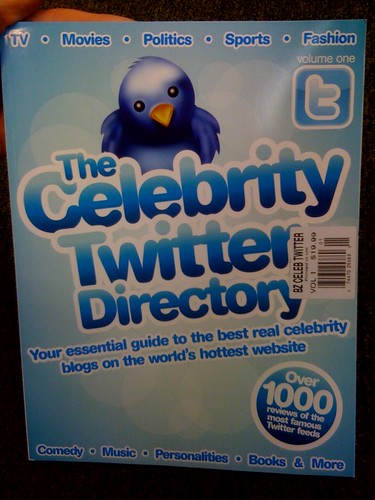
Twitter magazine
So it's quite logical to assume the sole reason they are using it is to "stalk" these celebrities. This may be anecdotal evidence, but it surely makes sense: celebrities are key to the growth of Twitter.

Why are celebrities using Twitter?
I can understand it from a broader trend in society where many-to-many communication is how our world is evolving into. I can understand why brands are using it - what started as a defensive PR strategy is now evolving to this broader trend of personal relationships with customers ala Project VRM. But celebrities - really? Do they really want more attention?

Aren't celebrities battling the paparazzi to give them some privacy in their lives? Of all the people who benefit from the trend that is lifestreaming, what do established celebrities have to gain from it? When Kutcher did his one million follower stunt, my Luddite sister claimed it was simply a way for him to re-emerge in the world (as pop culture she gets). But I don't buy that - as that only explains Kutcher - something else is happening. And that something has to be a financial incentive, because giving up privacy is not something celebrities do.

So Twitter, who exactly has stock or options in your company? I know the answer to how you made yourself mainstream, but what did it cost you to get there?