When it comes to my blog, I love using regions. Updating it, whilst is valuable in retrospect, is an absolute pain in the arse when I have to write them. For that reason, I have created a new region of the last three countries on my trip. Poland, Czech Republic, and Hungary – I dub thee the "Visegr?ɬ°d Three" (Slovakia, you be quiet now). Thinking back on those nearly three weeks, the memory is a bit scant, as it was just one big drinking binge. But it turns out I have an audience on this blog, so I’ll pretend I learnt something. I spent about 11 days in Poland ?¢‚Ǩ‚Äú although I regard three of those days as ‘bad hangover’ days so I don’t think they should count. Of those 11 days, four were in the capital Warsaw, four in Krakow (with a day trip to Auschwitz-Birkenau), and another three days in Wroclaw (pronounced VROTZ-wahf). In the Czech Republic, I spent four days in Prague, and in Hungary about three days in Budapest.
All three of these countries are very different from each other: the Hungarians are descendants of the Magyar tribes that swept across Europe terrorising the continent until they settled there, and later ?¢‚Ǩ‚Äú the Hapsburg Empire (which became the Austro-Hungarian Empire), a dominant force in central Europe during the late Middle Ages that lasted until WWI. The Poles are Western Slavs, and together with the Lithuanians after a Royal marriage that sealed the deal, had an empire that stretched from the Baltic and Black seas. The people of the Czech Republic, inhabiting the ancient lands of Bohemia and Moravia, are linguistically and to a lesser extent ethnically related to the Poles. The Czech people have been invaded by Hapsburg’s, Nazis, Soviets and tour groups. They may not have dominated Europe like Hungary or Poland, but they have always been valuable territory for the empires that held them.
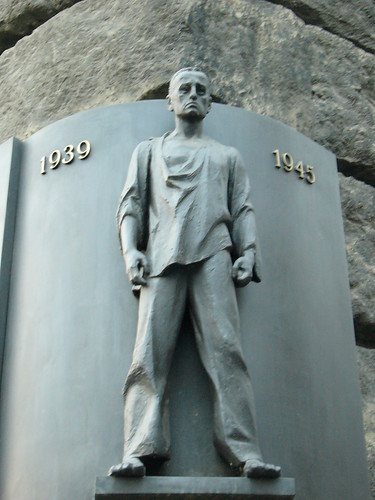
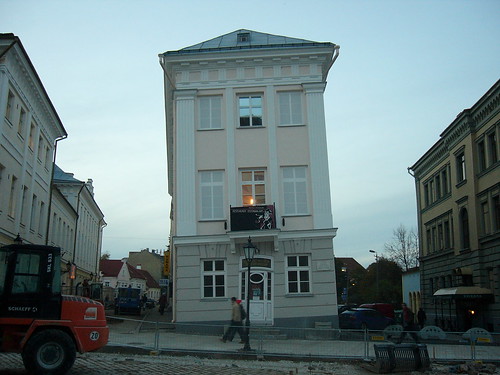
Corner of a building in Prague
What makes these three very different countries so similar however, is their location. The Czech Republic is smack-bang in the middle of Europe, and together with Hungary and Poland, are a large component of Central Europe. The significance of this is that Europe has a very rich history, and heck, if you are in the middle, it means you’ve been involved in almost everything that has touched the continent. For example, their locations has meant that none of the local problems have remained local: when Czechs rejection of the Roman Catholic Church in 1418 resulted in the Hussite Wars; the revolt against the Hapsburg’s in 1618 started the horrible Thirty Years’ War; the annexation of the Sudetenland in 1938 was the opening scene to WWII; the reforms of the 1968 Prague Spring, led to tanks and soldiers from all over the Eastern Bloc to suppress it; and the peaceful overthrow of the government during the Velvet revolution stands as a model for freedom-seekers, such as the recent revolutions of Georgia, Ukraine, and Armenia. Lets also not forget that before Franz Ferdinand was the name of a band, it was also the name of the Hungarian prince that was assassinated by a Bosnian-Serb in Sarajevo – and is what sparked World War I; whilst Poland experienced the brunt of one of the greatest and most horrific wars of our history (WWII) – evident to the modern traveller by visiting Warsaw and Auschwitz-Birkenau . These three countries play no small role in the European story.
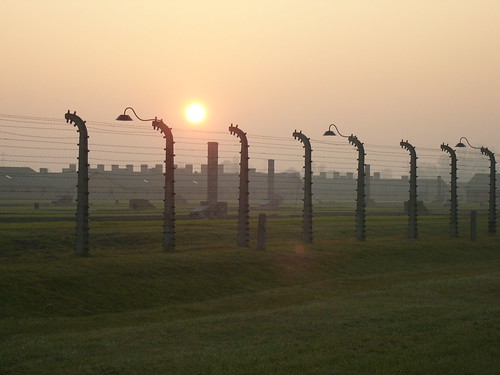
"The one who does not remember history is bound to live it through again" – George Santayana
Something that striked me about Poland was the law enforcement, and the observance of the law. A simple example is the pedestrian crossings ?¢‚Ǩ‚Äú in most cities I have visited, you get either one of three types of driver attitude towards them: the type that will stop once you have started crossing (Sydney); the type that won’t stop, but swerve around you as you cross (Tehran) and the type that make you wet your pants, as you run across like a headless chicken to avoid being hit (Athens ?¢‚Ǩ‚Äú with the complimentary verbal abuse whilst you run). In Poland however, I merely had to look at a crossing, and a car would slam on the breaks! Another example was when I visited the Russian markets in Warsaw, and my friends and I were going through some pirated CD’s to buy (which may I add, looked more professional than a CD in a record store). As we were looking, the men and women quickly hustled us, and in two seconds, had the CD’s completely out of view. A few seconds later, a police officer strolled by. When he was out of sight, we were able to resume our commerce. Turns out, as they showed us later, they have a sophisticated monitoring network, where they know the exact movements of police near them so they won’t get in trouble. Whilst the funky headsets and organisational skills impressed my two companion friends, I was more stunned by the event itself: copyright enforcement to me is a sign that a country is very well developed. For these guys to sweat when the police officer walked by, tells me you’ve got a very well functioning government enforcing the law. That is the basis for a strong economy ?¢‚Ǩ‚Äú especially for something as abstract as intellectual property, which is the basis of a certain buzz word that will solve all our problems like your paycheck and grandpa’s erectile problems.
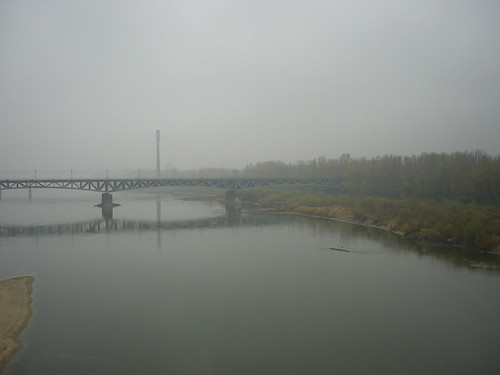
On the right bank, the Soviet army sat there at they watched the Nazi’s burn Warsaw to the ground – the Soviet’s were meant to be on the same side as the Poles. People speculate that Stalin let the Nazi’s do all the hard work, and crush any resistance, so that he would have a clean slate when he occupied the city.
Unfortunately the only "New Economy" thing about Poland, is that they actual have a free market now. And it’s not going down to well: unemployment is high. One of the most talked about backpacker stories, is the Krakow-Prague overnight train ride, where you get gassed while you sleep, only to find all your valuables missing in the morning. A Polish guy in Wroclaw, told me that the worst line of them all, was the Wroclaw-Prague line I was about to get on in one hour (needless to say, I didn’t get much sleep that night). The theft of course, is because of the high unemployment ?¢‚Ǩ‚Äú estimated at 18 percent by this guy I talked to.
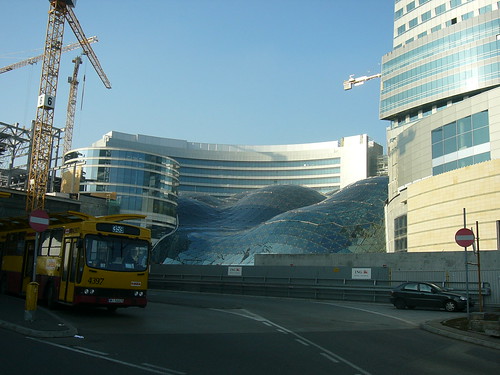
Right next to the Warsaw train station: a funky new building
I found Polish people to be one of the highlights of my trip there. Watching the people in a Polish nightclub became one of my favourite pastimes, as the way Poles dance amused me. I am not saying they are bad dancers, but simply, different from other places. Women for example, seem to have an inbuilt hip-shaking movement which is incredibly sexy, but also seems just a natural as someone breathing. The men on the other hand, are so enthusiastic ?¢‚Ǩ‚Äúwith a big cheesy grin, and they dance like they are skiing a ski-slope. Very amusing.
Without resorting to specific examples, the general vibe of the place was very positive. When you travel, you create a lot of theories, my most recent one was that countries that were formally oppressed, have very grumpy locals. But the Poles shut that theory down in flames, as I found everyone to be smiling, laughing, and generally happy. Possibly also a little smart-alec ?¢‚Ǩ‚Äú in Warsaw, all the strip clubs are located on (Pope) John Paul II Street.
Despite the positive feeling I had from the place, at the back of my mind, I could not forget the atrocities these people had to face. Warsaw is a city that was razed to the ground by the Nazis (as the Soviet’s sat watching) ?¢‚Ǩ‚Äú travellers visiting the city moan how ordinary it is, but when you think of its history, you see things differently, and appreciate the Polish spirit. For example, they painstakingly rebuilt their Old Town, with only pre-war pictures and paintings to guide them. The city felt eerie for me. Krakow is a much more beautiful and vibrant city than Warsaw, for obvious reasons (it wasn’t bombed). But everyone visits Krakow, so you probably knew that already. I had a friend that I used to work with in Sydney, that lives in Wroclaw, and I really liked that city as well. Both cities have amazing Market Squares (Krakow’s is the largest in Europe ?¢‚Ǩ‚Äú Wroclaw not far behind) and they both have an atmosphere in their old towns which I really liked (locals strolling by, entertainers, tacky shops and restaurants). I arrived in Wroclaw at 11pm, and my friend dumped my bags at the local hostel so we could party: Wroclaw and Krakow, like any other university town, is a bit of fun as well. All the Poles I met in Wroclaw, had come from other cities in Poland, and would tell me how much they loved the city and how it is the best one in Poland (Krakow comes close, according to them).
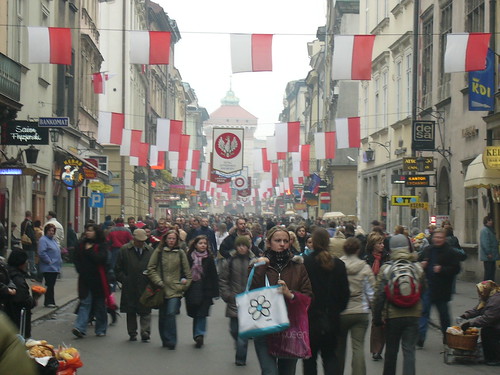
Krakow during Independence Day, also known to us as Remembrance day (November 11)
Auschwitz and Birkenau are something else ?¢‚Ǩ‚Äú where it is estimated estimated that between 1,100,000 and 1,500,000 people were murdered by the Nazi’s. I ended up touring the sites on my own, missing my friend’s group tour, but which instead turning into a more powerful experience for me as I did it on my own. I was surprised I didn’t get as emotionally affected as I thought I would, but then again, I consider wanting to punch a wall on two separate occasions as minor outbursts. What made be sick was the evidence of children being killed ?¢‚Ǩ‚Äú as 12 years old children were treated just like the adults. What really got to me, was seeing a presentation of children shoes. That is, children aged no more than five years old. Walking around Birkenau, which was where most of the exterminations took place, was chilling (and it was a lot of walking ?¢‚Ǩ‚Äú the site is 171 hectares large). It became very dark when I was touring the huge site, and visiting the compounds of the prisoners and seeing their living conditions, was something that made it hard for me to swallow. Seeing the ruins of the furnaces and gas chambers on Birkenau, as the Nazi’s attempted to cover their crimes on their retreat, just reminds you how recent all of this was.
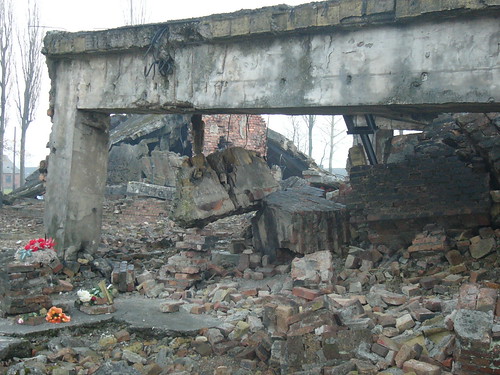
The Nazi’s tried to cover up evidence of the killings that occured, by blowing up the gas chambers and furnaces
When I met up with my friends later that night and shared our experiences, they told me how angry they were to see the Jewish children fly the Israeli flag around ?¢‚Ǩ‚Äú their point being, it is that nationalism that created conflicts like this. That is usually something I would say, but I don’t really share that sentiment. Sitting in on a Jewish memorial service where the furnaces were in the dark as I wound up my tour on Birkenau, was definitely an experience I am glad I had.
Half the reason I went to Prague was to visit Veronika and Pete ?¢‚Ǩ‚Äú two old friends and workmates. The rest of the reason was because I just had to see what the fuss was about. Just as I suspected, not much ?¢‚Ǩ‚Äú a great city, but way too much hype. It has one of the best integrated transport systems I have been on, and the buildings are very pretty. But that’s exactly the problem with Prague: it’s pretty. It’s a place you visit with your girlfriend, on a weekend away. Having said that though, as my friend Petr showed me, it’s way too much fun for the single (and not single) man.
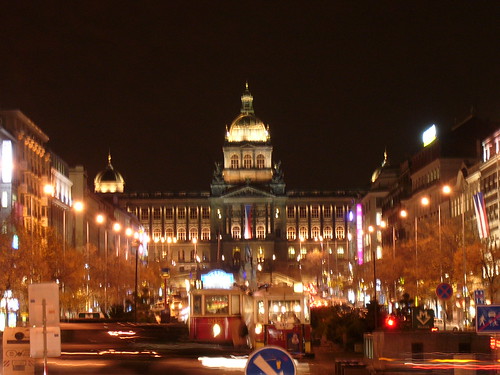
Prague’s city centre – the big building is the national library, me thinks
Veronika and Pete miss Australia because of the friendliness of ordinary people. As a contrast, Veronika would complain how clique and rude Czech people were. She reckons, and she is by no means an ugly girl, how hard it is to meet people at a club ?¢‚Ǩ‚Äú everyone goes out with their groups of people, and refuse to socialise with other people, because you just don’t do that. Foreigners provide a breath of fresh air to Czech people, because they can break out of that clique.
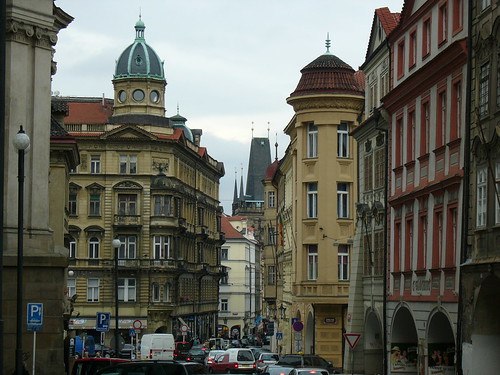
Prague: pretty.
Pete also reckons the emphasis on looks here has created a bulimic culture amongst women. He puts the figure at every second or third girl – and a quick look around the club proved him right, as all the girls looked unrealistically thin. On a related conversation I had with this American I met at the hostel who was about to start teaching English, he says how back in the States, everyone raves on about how beautiful Czech women are. However he says they are not beautiful but just skinny! "Everyone is so fat in America", he was saying, "that they see a skinny girl and they go gaga here".
The Soviet museum in Prague deserves a mention. Seeing the communist posters to inspire workers, made me realise how similar communism is to capitalism, with slogans talking about ‘efficiency’ and ‘output’. It was funny to see words I had always associated with capitalism, on a communist poster.
Watching a video about the failed 1968 revolution left me feeling mellow. A pop group mentioned in the video called the Plastic Group of the universe (I am sure it sounds better in Czech) used these lyrics: "Throw away your brains, throw away your hearts. Throw away everything that makes you human, and become pigs". For me, those words really help sum up the things I have learnt about communism and Nazism in the last month. Having just read Stalin’s biography, a quote on the wall helped sum up what took me 500 pages to find out as to how he could do what he did: "One death is a tragedy; one million a statistic". Like a spoilt seven year old with divorced parents, the Stalin’s of the world can get away with murder, because they don’t feel the consequences of their actions as no one will reprimand or tell them. And yet even Stalin was capable of breaking down, when his son was captured by the Nazis ?¢‚Ǩ‚Äú because the suffering of the war then became personified with a familiar face. There is no such thing as monsters in history ?¢‚Ǩ‚Äú only people detached from reality. It’s not hard to smack them back, it’s just that some need to be smacked harder than others.
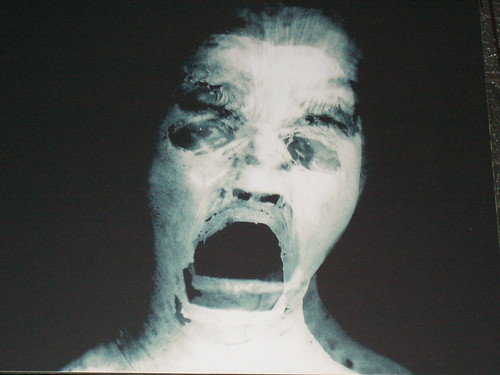
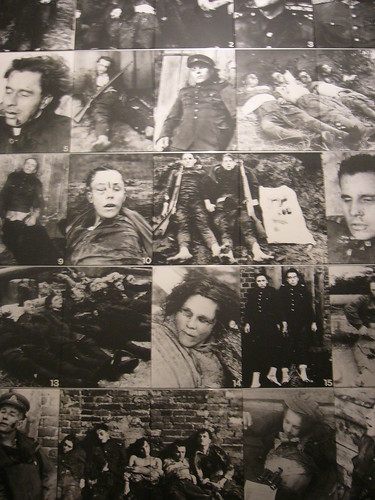
Budapest’s House of Horrors on the other hand, annoyed me. Of all the museums I have seen detailing atrocities of the Nazis and communists, this was the most extravagant of them all, but also the worst. It was too fabricated, and too glossy. When you are talking about horror, take the gloss out.And while we are on it – Budapest as well, was very different from Prague, and as a city I much preferred it as it had more character. Although a girl that helped me at the train station, said she hated it: good for a few days, bad for living here.
My experience with Hungarian people was something else as well. Whenever I was with a group of friends/travel companions, I always saw the rudeness of Hungarians. But in the few times I was alone, I found Hungarian people to be very nice and friendly. Even though I regard Hungarians as friendly, the incidents of rudeness really stuck in my mind ?¢‚Ǩ‚Äú like for example, a guy at the ice-rink, literally shooing this woman away, like she was some intruder to a military base, when she inquired when it re-opened.
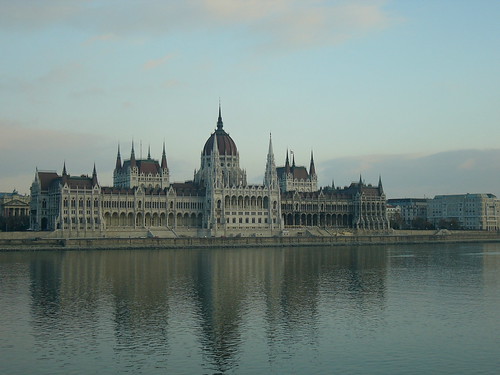
Budapest’s parliament
Hungarian’s also just look different. Maybe it’s my historical knowledge that helps colour my perceptions, but if there was one word to describe them it would be "warriors". The men looked very different, very rough and tough. They were also weird: when I went to the baths with some of my female friends, there were incidents when men would just stare. Sure, my friends were pretty, but no one stares like that unless you are a psychotic.
Budapest definitely ranks as one of the most memorable cities I’ve been to, and one which I would put top on the list to visit again. The city has a character which I think all the former Ottoman Empire lands have, like Belgrade and Sarajevo. The baths are an amazing experience, and I really wished I had more time to do the rock-climbing tour underneath the city. It is hard to talk about cities as to why you like them, and it can be done, but this blog posting is getting way to long.
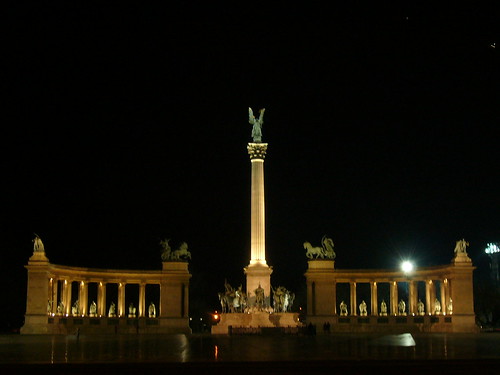
Budapest’s Heroes square
Something I didn’t mention at the beginning of this posting, was one other similarity the three before-mentioned cities have in common: the are all new members of the European Union. And rising stars whilst they are at it. According to a study published by The Economist Intelligence Unit, the Czech Republic ranks as the third most attractive country in the world for off-shoring, after China and India. Whilst cheap labour has something to do with it, the location of the country and its relatively well developed telecommunications and educated workforce help contribute to this.
But notice I said location was an important factor. Like before, the location of these three countries at the centre of Europe’s next big empire (the EU) means that they are again in the spotlight. Expect to hear about these three countries a lot more in the future, as the Visegr?ɬ°d group play catch up to the rest of the developed world.