Blog of Elias Bizannes

Frequent thinker, occasional writer, constant smart-arse

Page 8 of 27

How the super angels are saving Silicon Valley

Michael Arrington has written about the current bubble in Silicon Valley: the angel investor. He suggests a war is occurring with this new class of investor, and that entrepreneurs need to pick their faction. I don’t doubt the politics is real, and I’m sure it exists between the angels themselves – let’s hope they realise that united they stand, but divided they will all fall.

But I think this “conflict” is really about a change in times. Much like how the traditional gatekeepers of information – the newspaper industry – are battling the process-journalism innovators that we call ‘bloggers’. (Like, ahem, TechCrunch.) No one appointed the Venture Capital industry as the gatekeeper for technology innovation, which is similar to the arrogance of the newspapers that think they ‘own’ the news and deserve special protection because of it. Maybe these over-sized funds should take a lesson from the newspapers and realise the times have changed and their model needs to change as well.

But where I differ with Arrington’s perspective is his prognosis that this is bad for innovation. Conflating this with ‘bigger ideas not getting funded’ is wrong. The point is, is that more innovation can get funded, more veterans are being developed, and more value is being created in the long run. This should be analysed not by the growth of a single tree, but the overall development of the entire forest.

We need more seed-accelerators, more super-angels, and more incubators – because inevitably, it will lead to more startups. And whilst not all will hit a home run, the odds of ‘the next big idea’ happening will improve dramatically.

Why I like angel list

Feedback is now coming out about Angel list, a new service from the blog Venturehacks. It’s a simple concept: get a group of angel investors and promise you will send quality deal flow to them that’s been vetted; likewise say to entrepreneurs that all they need to do is fill out a form and they will get access to some of the smartest investors in Silicon Valley. It’s so simple that is hurts, and yet only people like Naval Ravikant and Babak “Nivi” Nivi would be able to pull it off as it takes serious credibility to get both groups involved. Venturehacks in my opinion is the number two blog on venture and investment in technology, after Fred Wilson’s blog.

Angel list is a special thing that I believe will transform Silicon Valley. Much like how Michael Arrington exploited the market dynamic to make TechCrunch the success it was, Ravikant and Nivi is doing the same thing by connecting entrepreneurs with investors. And not just any investors: the early stage investors that startups really need. Simply put, it’s reducing the costs of innovation in Silicon Valley – the ‘thing’ that has changed the world.

I really hope the industry rallies around this and collaboration opportunities with other high profile angels continue. Jason Calacanis for example is doing something equally impressive with the Open Angel forum, and I sense they both have equal motivations due to their annoyance at how other investor groups have abused their position in the industry. Even though I see them adding different value to the startup scene (they’re similar but different – and should stay different for maximum value creation), all I can say is “awesome – I want more”.

Announcing the Portability Policy

TechCrunch have been a big supporter of the DataPortability Project, which shows today with their encouragement for me to write a guest post on the Portability Policy, an initiative we announced today.

It’s exciting to see after all these years we are finally now reaching out to the world again, with something solid that people can rally behind. For years, we’ve been getting asked what people can do to show support for the philosophy of data portabiliy, but we’ve¬† been putting our heads down focussed on (necessary) things that made us fall off the map – like developing a sophisticated new governance model that is an innovation in itself (as virtual companies are still a new concept); the legal structure to become a non-profit; as well as the Portability Policy work itself which required hundreds of hours of research, discussion, and reflection.

If you’re interested in adopting a Portability Policy (read the above linked posts for more), you can do so very easily with a generator we are releasing today. Phil Wolff from the workgroup that developed this effort, also has a briefing pack and can help you understand what it is. Post a message on the community mailing list and we’ll respond to any issues you have.

Manipulating numbers that don’t mean anything

Erick Schonfeld wrote a post today saying all the hoopla over Facebook’s privacy isn’t justified. I disagree for two reasons.

1) Awareness.
When Facebook announced their new changes, I tweeted why the hell no one was complaining. Chris Saad and I then wrote one of the first (if not the first) posts that criticised the Facebook move. CNN referenced our post and the entire industry has now gone over the top complaining.

Why didn’t anyone from the major blogs critique the announcement immediately? Why the time lag? For the simple fact there wasn’t awareness – people hadn’t thought about it deeply. And to validate my point, check this recent exchange with a friend in Iran when I asked him how the people of Iran felt about the changes. He had no idea, and when he found out – he got annoyed.

2) The monopoly effect
I love Facebook as a service. But I will also admit, nothing compares to it – I love it for the sole fact it’s the best at what it does. If there was genuine competition with the company, that offered a compelling alternative – I wouldn’t feel as compelled to use it. They win me over due to great technology and user experience, but I’m not loyal to them because of that.

I think Facebook has some security right now because no one is in their class. But they will be matched one day, and I think the reaction would be very different. Rather than tolerate it, people would move away. And whilst Facebook can lock my data and think they own me like I’m their slave, the reality is my data is useless with time – what they need is permanent access to me, and to have that, they need to ensure my relationships with them is permanently ahead of the curve.

Guest post on TechCrunch

I wrote my first ever guest post. And to think only a few months ago, I was getting high fives from everyone on the surprise coverage on the startup bus from TechCrunch. You can read it here: http://techcrunch.com/2010/06/05/privacy-failures-facebook-dna/

As for the bus, I’m really sorry for the lack of posting – I hope to correct that. In better news, I’ve got some exciting plans for next year that will take it to the next level (feedback so far: “you’re crazy” which is the first idea – by the fifth one people are laughing at how crazy I am).

Looking forward to sharing that once I start moving ahead on that, which I will announce at the end of my series on the startup bus (as I promised).

My media consumption – three years on

I was reflecting on a conversation the other day where I said I no longer read the news, a bizarre fact given as a teenager and young adult I was a newspaper junkie. Certainly, things have changed – even since three years ago when I wrote about my media consumption.

And it’s true – I don’t read newspapers or many news sites anymore. But I’m actually better informed about the world now.

How so?

– My iPhone has improved my productivity. I’m reading things constantly off it. It’s an important distribution tool worth pointing out, which is why I consume information like I do now.
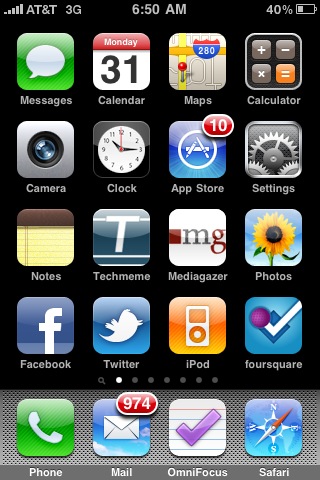
Current homescreen
– Like I did in 2007, Techmeme is something I religiously check every day and increasingly Mediagazer. Both are icons on my iPhones’s homescreen.
Twitter and Facebook are a huge source of how I find out about things or come across interesting content. (Also both on my phone’s homescreen.)
– I am a subscriber to the geopolitical thinktank Stratfor, which tells me where the US navy is on weekly basis, breaks news to me for major political news or dramatic calamities, and gives me essays filled with complete perspective. I don’t have the ability to read all the emails, but like Techmeme, merely reading the headlines is enough to keep me on top of things. And the interesting point to note about this, is that this is premium analysis – the stuff the intelligence community and government policy makers subscribe to. It’s seems like I’ve cut the middleman out (the newspaper journalists) and gone closer to the source of the original analysis. By implication, I’ve chosen the better analyser and that has now become my default news provider.
– I have BNO news and the Associated Press applications on my iPhone, which send me alerts to news items through the day via push notification. I also have the NY Times and WSJ journal apps and which I used to use religiously a year ago, but for some reason I no longer do. (Maybe because they are now buried in my iPhone’s menu.)
– Recently, I changed my homepage from Techmeme to be three homepages: my company’s internal blog, OneRiot which flags the top news shared through Twitter, and Techmeme. The addition of OneRiot has got me hooked these last few weeks: its given me a great source of headline news and useless news, like celebrity gossip that I don’t normally seek. That’s not to say I like celebrity gossip, but it completes my knowledge gaps of what’s happening in the world and that other people are talking about.
– I no longer listen to the radio, the prime reason being I don’t have a car here in San Francisco. If the iPhone had a radio, I probably would – I have my headset in my ears usually every day at work, to help me focus.
– I am a paying subscriber to Pandora, the online music discovery service. (I’m listening to it right now as I write this post!) I prefer it not because my music collection is weak, but because I like being introduced to songs I might not normally know about.
– I have cable TV in my apartment (Comcast), but I never watch it. And when I do, it’s when I want to just switch off for a bit.

My current approach has gaps: for example, I am detached from Australian news. Regardless, its proved an interesting point: I no longer have time to read newspapers like I used to as a teenager. What’s changed is the way I consume information, which allows me to consume more with less effort. I’m one of the busiest guys I know, but thanks to technology, I can be efficient with my time.

How to build a billion dollar company

Matt Mullenweg made an excellent comment on a topic I’ve often thought about. The comment was made in the context of the anniversary of wordpress.

Has it really been seven years since the first release of WordPress? It seems like just yesterday we were fresh to the world, a new entrant to a market everyone said was already saturated. (As a side note, if the common perception is that a market is finished and that everything interesting has been done already, it’s probably a really good time to enter it.)

WordPress not only has become the most popular blog software and one of the most amazing content management systems around, but its become an amazing platform for innovation. (For example, Ron Kurti and I the other day tried to think outside-of-the-box for employee expense reports at Vast. So we hacked a wordpress blog to do so – and we could do it in minutes of effort.) Not only that, but the wordpress.org founder built a company around the software and it’s become a very successful company on the web. Thank God he entered at a time of market saturation.

But it doesn’t stop there. Consider the following stories as well, which highlight lessons in building amazing companies.

  • When Google launched as a search engine, everyone though the space had matured and had little opportunity. Google has now become one of the most influential companies in history.
  • When Apple launched the iPod, the MP3 player market had been well established. No one at the time would have thought another product from this yesteryear company, would be the product that help it reinvent the company to become the second largest US company today.
  • When Facebook launched, it was yet another social network well after Friendster (the inventor) and MySpace (the populariser). In fact, I remember analysts calling 2003 the year of the social network – a year before Facebook was even invented. And now, Mark Zuckerberg has created a company that will transform online advertising, has helped contribute to the new billion dollar virtual goods industry, and is going to lead the charge for the semantic web.
  • In 1990, hyptertext systems had saturated the market since the 1960s when Ted Nelson coined the term. That didn’t stop Tim Berners-Lee, who that year invented the web – yet another hyptertext system. The Web is not a company like the ones above, but the Web is in league that few inventions in the history of the humanity have ever achieved.

Naval Ravikant has told me that in the consumer web space, the first mover advantage is so great that a company can own the space – the logic being they are so far ahead in execution and their brand is synonymous with the industry, that they become impossible to topple. This fact is why I think a lot of entrepreneurs in the Internet space seem consumed with creating a business that introduces a new concept product, as opposed to a better product – which is what the above companies did..

I think there is something to be to be said about the last mover advantage: monitor the patterns of something new, innovate on the implementation, and then out-execute the guys that invented the concept. And out execute you can easily, as the inventors are probably caught up in organisational inertia due to conflicting innovations, not to mention a misunderstanding of what actually made them successful in the first place.

As it was said once: the guy who invented the first wheel was an idiot; but the guy who invented the other three was a genius.

The Startup Bus on failure

Hard to believe it’s been two months since the event. A lot’s happened since then which had me pause this blog series, but I’m now going to restart it and share the lessons during and after the experience.

Pollenizer is an agency that helps startup’s grow, run by my good friend Mick Liubinskas and his superstar business partner Phil Morle. They sponsored the bus, with the request an important lesson be shared, which was related to failure.

Below is a short video of Brandon Leonardo – a superstar that I think is going to go very far in his career. He however, had a very unfortunate incident that nearly threw off the entire operation of the bus. The incident revealed an important lesson for Brandon about how you deal with failure. Watch the video the find out what.

This blog post was done in honour of our proud sponsor Pollenizer. This post is part of a series on the Startup Bus, an event that occurred in March 2010 that was powered by Alassian, mentored by the eStrategy Group and supported by several other very generous sponsors.

Phil McKinney talks innovation to the Startup Bus

With all the hype now on the iPad (and the proposed HP slate), I thought it was timely to mention the personal session with HP’s head of innovation a few weeks ago. As part of the Startup Bus, Phil McKinney gave us a one-hour session on innovation, which we are fortunate enough to have recorded and have permission to share to the world.

Hewlett Packard was the company that started Silicon Valley, and Phil is one of the three divisional CTO’s at the company, focused on personal systems (meaning a lot of the innovative things that we will see come out are under his watch). So it was a no-brainer to start our experience there. He shared secrets of innovation, including some insight into yet-to-be released products by HP, like it’s electronic-ink paper that kills anything else in its class and the proposed Slate device itself (an iPad competitor soon to be released).

You can watch the entire presentation as part of this playlist. Or, click on the videos below which are in ten minute blocks.

Part one: Introduction
Part two: The Rules of the Bus
Part three: The Challenge of Innovation
Part four: The Secret Sauce – FIRE
Part five: The Secret Sauce – PO
Part six: Show and Tell
Part seven: Q & A
Part eight: Q & A (continued)
Part nine: (continued)

This blog post is a series on the Startup Bus, an event that occurred in March 2010 that was powered by Alassian, mentored by the eStrategy Group and supported by several other very generous sponsors.

The Startup Bus – looking into this crazy experiment in innovation

What happens when you put 25 entrepreneurs on a bus from San Francisco to Austin? Well duh – six new startups of course! Since TechCrunch announced to the world about my crazy experiment, I frantically organised what has one of the more memorable experiences in my life. It was hard work to get sponsors, get people, get the bus – and even down to the wire, have WIFI. But I pulled it off, and now I’m ready to share to the world what happened.

I’m going to write a blog series that will answer the following questions:
* What worked?
* What didn’t work?
* What were all the ideas?
* What ideas got rejected?
* Who was on all the teams and what were there roles?
* Did people flake out before/during/after (and if so how did that get addressed)?
* What are the state of the projects now?
* Are we planning to do something like this again?
* Did anything crazy happen during the trip?

Below you’ll find links to posts I will write on the event (as I write them). Above the links, you will find a video of me explaining to the “buspreneurs” why I think this experiment is valuable, regardless of the outcome.

Relate blog posts:
Phil McKinney talks innovation to the Startup Bus/

This blog post is a series on the Startup Bus, an event that occurred in March 2010 that was powered by Alassian, mentored by the eStrategy Group and supported by several other very generous sponsors.

« Older posts Newer posts »