Archive for May, 2008

Advertising on the Internet needs innovation

On the weekend, I caught up with Cameron Reilly of the Podcast network , and he was telling me about his views on monetising podcasts. It got me thinking again about those things I like to think about: how content can be monetised. Despite the growth in online advertising which is tipped to be $80 billion, I think we still have a lot more innovation to go with revenue models, especially ones that help content creators.

Advertising is a revenue stream that has traditionally enabled content-creators to monetise their products, in the absence of people paying a fee or subscription. With the Internet, content has undergone a radical changing of what it is - digital, abundant, easily copied - whilst the Internet has offered new opportunities for how advertising is done. However, the Internet has identified the fundamental weaknesses of advertising , as consumers can now control their content consumption, which allows them to ignore embedded advertising altogether. Content on the other hand, still remains in demand, but means of monetising it are slipping into a free economy which is not sustainable. I make that point to illustrate not that professional content creation is a sunset industry - but rather there's a big market opportunity as this massive industry needs better options.
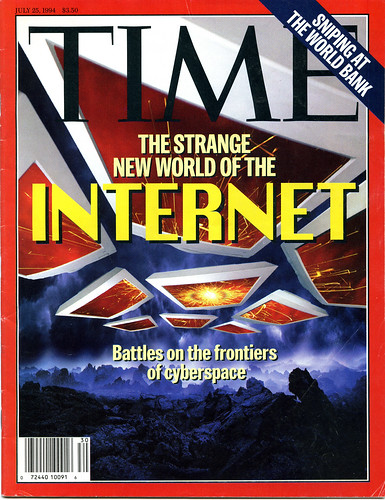
time mag

"Hey man, there's this new thing called the Internet. Sounds pretty cool"

One of the biggest innovations in advertising (and enabled by the Internet) is of contextual search advertising. This has been popularised by Google, which now makes 98% of its $17 billion revenue from these units. This advertising dominates online advertising (40% of total) because of its pull nature, whereby key-words stated by a consumer in effect state their intention of what they are interested or would like to purchase. Whilst this is a highly efficient form of advertising, it also has its weaknesses - for example, it is not as effective outside of the search engine environment. Google makes 35% of its revenue from the adSense network , where these contextual ads are placed on peoples personal websites. Evidence from high traffic bloggers suggests they barely make enough money through this type of advertising. Another point to consider is that aspects of the Google network include significant partnership agreements like the one with AOL which accounts for 10% of Googles revenue (this is a 2005 figure which has likely changed, but Google does state in their 2007 report "Our agreements with a few of the largest Google Network members account for a significant portion of revenues derived from our AdSense program. If our relationship with one or more large Google Network members were terminated or renegotiated on terms less favorable to us, our business could be adversely affected.". AOL most recently reported for Q1 2008 half a billion dollars largely from search advertising ).

Other attempts at creating more efficient advertising which have existed for over a decade, have come in the form of profiling or behavioural tracking. However, these forms of advertising has also highlighted the growing awareness of consumer privacy being eroded, and is under heavy scrutiny by activist groups and government. Facebook is a company that is best posed to deliver new forms of advertising because of the rich profiling data it has, but it itself has faced massive backlash .

My view is that the majority of online advertising for successful individual publishers at least, has largely come from traditional approaches to advertising - a masthead blog with a sales team that uses display advertising. How effective this display advertising is is debateable with widespread banner blindness and consumer control over their content, but it would appear that this is more a case of advertisers seeing this as the least bad on the overall scale of opportunities. The fact it replicates the mass media approach of number of unique consumers viewing the content, and not the types of users, means this isn't anything new other than being done in a digital environment.

Digital content is in need of a better monetisation system.
Targeted advertising is the most efficient form, yet consumer privacy is a growing force preventing this. What we need, is not a new advertising technology, but a new way of thinking about advertising - in a way that can help the content economy rather than riding on it without giving benefit. Contextual advertising sounds great in theory as it calculates key-word frequency of words on a website, to match it to a key word ad - but it's proving in practice these ads are not very relevant. Yet trying to think of a smarter way to advertise, may be the wrong question - perhaps half the problem itself is advertising as a concept?

perspective

Are we running down a tunnel, only to find there is nothing there?

Content which comes in the form of news (historical and breaking), analysis, and entertainment can be monetised via a persons attention or through a transaction (ie, subscription, fee, etc). Both this approaches have different barriers.

- Attention: The key driver is increased dollars per unique person, over a period of time. The barriers to this approach is the challenge of identifying the individual in a way that gives advertising that is highly relevant and will result in a conversion. In other words, privacy privacy privacy.

- Alternative payment: Requiring consumers to pay for content is a barrier due to the paid wall. What is more problematic for digital content, is that the ability to replicate it freely makes it not just easy to do for the masses but has created a culture of if it's not free, it's not worth purchasing unless its really necessary. There needs to be a strong value proposition for a consumer to purchase content, and in the absense of a brand and marketing, the restriction of what value the content offers is a barrier for consumer demand as they don't know what they are missing out on.

So as you see above, content creators are in a difficult position. Charging people reduces their opportunity unless they are really established, but even then, due to the digital environment they don't have any control over subsequent distribution (with rampant piracy). Yet advertising is fraught with being irrelevant and hence not effective (so advertisers go to other forms) and any attempts to make it more relevant, gets held back by the concerns of privacy advocates (and rightly so). Whilst the Internet parades itself as an advertising growth machine, it's growing in new areas but not the old areas that have traditionally been the medium for advertisers.

This advertising growth is largely being driven through utility computing products that aim to make information retrieval more efficient (ie, search). However, the growth for the content creators, is not happening. As Cam was telling me, in a market like Australia - small content organisations like TPN and Bronwen Clune 's Norgs , don't have access to the big end of town for a sales team. And he didn't have to tell me, those Google ads for the smaller guys, are not enough to pay the bills. That small to middle end is not being really catered for.

But before you jump on the phone and create some mid-tier advertising network that caters for a niche, think about the real problem: content creators need a better solution to monetise their content. But advertisers also need a better way of selling, other than some slick-talking sales person who can sell ads on pageviews (a broken model with weak alternatives ) They need advertising that is suited for their product, but the market now includes other products media outlets never had to compete with like marketplaces now happening online and utility computing products. Whilst the technology community obsesses about search , let's also remember we have yet to see a new way to monetise content that is superior to the old world. Contextual advertising of text is the latest new thing area, but that technique is nearly a decade old. As I prove above, outside of the search environment, it is showing to not be that effective.

Where is the innovation going to come from? Not through technology but with a new paradigm shift like how content creators operate . New ways of thinking about the way we 'sell' like what the VRM Project is challenging. But perhaps more fundamentally, is an understanding that the holy grail of targeted advertising has got a speed hump called privacy - and that may actually be a sign of not going faster towards better targeting, but changing the vehicle all together.

What is data?

The leading voices in technology have exploded in discussion about data portability, data rights, and the future of web applications. As an active member in the DataPortability Policy group, here is my suggestion on how the debate needs to proceed: break it down. Michael Arrington seems pretty convinced you own all your data, but I don't think that's a fair thing to say - and at core is the reason he is clashing with Robert Scoble's view. For things to proceed, I really think a deeper analysis of the issues need to be made.

1) Define the difference between data, information and knowledge. There's a big difference.
2) Determine what things are. (is an e-mail address data or information?)
3) Recognise the difference between ownership, rights and their implications.
4) Determine what rights (if that's what it is) the various entities have over data (users, web apps, etc).

This is a big area and has a lot of abstract concepts - break it down and debate it there.

Some of my own thoughts to give some context

1) Data is an object and information is generated when you create linkages between different types of data - the ‘relationships’. Knowledge is the application of information.

  • 2000 is data - a symbol with no meaning. Connect it with other data, like the noun "year", and you have information because 2008 now has meaning. Connect that information with other information, like "computer bug" and "HSBC and you now have an application of that information. That being, there was an issue with the Y2K bug that has something to the bank HSBC.

2) Define what things are

What's an e-mail address, a phone number, a social graph, an image, a podcast...I'm not entirely sure. I wouldn't be blogging this if I had all the answers. Once we agree on definitions, we can then start categorising them and applying a criteria.

3) Ownership:

Here is something Steve Greenberg explained to me

- Ownership is relevant when there is scarcity.
- Ownership is the ability to deny someone else’s use of the asset.
- So, if data is shared and publicly available, it is a practical impossibility for me to deny use
- and if data is available in a form where I can’t control others’ use of it, I can not really claim to own it

Nitin Borwankar has a very different argument: you should have ownership based on property rights. He explained that to me here .

4) Rights over data

I personally think no one owns data (which is inspired by the definition of data being inherently meaningless); instead you own things further down the value chain when that data becomes something with value. You own your overall blog posts - but not the words.

But again, this goes back to what is data?

The value chain for information

Lately, I've been doing a lot of thinking about the value chain of information, based on the Porter model of doing a value chain analysis . Given there is an undeniable trend to an knowledge-based economy (that is, if we're not already there!), it seems pretty valuable that we should at least understand the different facets in the value chain to better understand the information sector.

Below are some thoughts about what I think are the broad aspects of the value system, with some commentary under each to help you understand my thinking. I've used common social computing sites to help illustrates the concepts, as everyone can relate to them. Also my definitions for data, information, and knowledge .

value chain is sweet
The value chain
1) Data collection
- value is in the storage
Competitive advantage: who offers the consumers the lowest price for the most storage. You should not just consider this in terms of cost in hosting but also about whether is costs the user their rights to control over some of their data.
Example: MySpace is where you store all your demographic data; SmugMug is where you store all your photos (which I consider data)

2) Data processing
- value is in the ability to manipulate the data
Competitive advantage: The infrastructure to process vasts amount of data at the highest output with the lowest cost
Example: Facebook calculates how many friends you have. The raw computing power to calculate the information requires substantial computing power, which is why Friendster fell when it captured the imagination of the industry as the first major social networking site.

3) Information generation
- Value is in the type and diversity of information. The connection of data (objects) is what generates information. Requires unique ability to understand what data inputs to pull.
Competitive advantage: Ability to access the most data (ie, relationships with the data storage components in the chain), and be able to creatively apply the data in a unique way.
Example: LinkedIn allows me to know that I am two degrees separated from a certain individual. The ability for LinkedIn to do that is a combination of what data they can use as well as the ability to process it. Essentially, the creativity of the company's management to determine the feature's value and the relationships with storage vendors or methods of using their own storage. In a DataPortability enabled world, it's not so much how much data you can store of a user - but how much you can access from the storage vendors ie, relationships with these vendors.

4) Knowledge application
- value is in the application of information
Competitive advantage is on the application of information in a unique way that has not been done before
Example: A network analysis of my social graph. So if a social networking sites can tell me that 48% of my friends are male; and another piece of information that 98% of them are heterosexual; then therefore it is likely I am a straight male. The ability to derive insight, despite the multiple piece of information available, is filtered by those with the unique ability to recognise application of information in certain ways. The determination that I am straight is inference, which is a higher order type value as opposed to just information (which is grounded in hard data and more based on fact).

Implications of the value chain
It is important to note, and why it will be difficult for you to conceptualise the above, is that the Internet industry which is the backbone of the Information Sector of the economy, is still relatively immature. Flickr for example does most of the value chain - they store my photos, they allow me to make changes to the photos and add addition data like tags; they generate information by allowing me to organise my photos into sets (hence giving more value to the photo by putting it into context). And of course, they allow for knowledge application through their community - people passing by, leaving comments, is quite a unique thing that is unique to Flickr.

By better understanding the value chain, hopefully we can also realise that business can thrive by focussing on specific areas and it may not be in their interest to be in all areas. For example, the notion that locking up a person's user data as being a competitive advantage is silly, if you can offer value through knowledge application.

To put the above in context, MySpace's recent data availability announcement is a step into the direction of DataPortability (something that will take until the end of this year to finalise at minimum), but whilst Google and Facebook race to offer similar services to 'lock' their data, they are in fact missing the point. The value of MySpace for example is the community, and they get value in accessing data and information from as many diverse places as possible to apply that in a unique way. Because they think locking in the data is what determines their business strategy, it forces them to compete in the data storage market - and that is something I would not want to be in given the ability for it to be commoditised, and the massive compliance demands with government and user expectations with their rights. As highlighted by Nitin , data redundancy is a big issue so battling in the storage market puts you at risk if you are solely relying on it as your source for information and knowledge.

As always, I write my blog posts to extend on my thoughts. I'd love feedback and people to challenge the assumptions I've made, because I think this can be a very valuable tool in how we view businesses on the web.

Update 1 June 2008: Tim Bull made a video of this posting, which does a better job explaining the concepts presented above