A t-shirt I saw today best describes the three Baltic countries I have just spent two weeks in: “I love Lithuania…but where’s that?”
Lithuania, like Latvia and Estonia, are countries everyone seems to have heard about, but know absolutely nothing about them. Synonymous with communism with my parents generation, and Eurovision with my generation, the Baltic three actually have a rich history and give the traveller a diverse experience, whether it be in beautiful countryside, evidence of Soviet brutality, or good ‘ol stag parties (cheap alcohol, beautiful women, bargain flights from England = a perfect weekend away with the boys).
I spent three days in Tallinn, the capital of Estonia, and two in its cultural capital Tartu. I spent five days in Riga, capital of Latvia. And I spent three days in Vilnius, capital of Lithuania, which included a small day-trip to Trakai.
Tallinn I didn’t like because it was a superficial tourist town. Tartu I didn’t see because I spent most of time indoors with my hosts (met a girl in Paris, and she and her friends took care of me – hard to sightsee in the rain). Riga I don’t remember – something to do with four dollar Vodka bottles (dollars as in Aussie Pesos, more like three USD). And Vilnius is quiet and quirky – I’ve been very entertained.
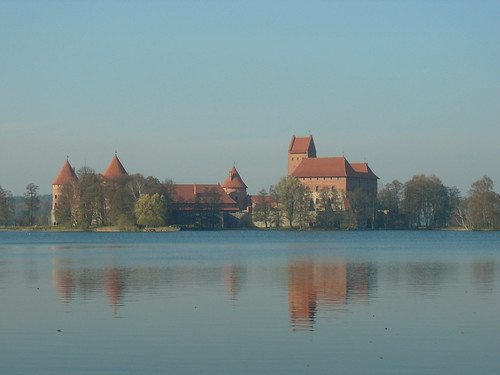
The reconstructed castle at Trakai – Built more in mind to make money from tourists, than to actually reconstruct it how it was. The Lithuanians had a joint empire with the Polish that stretched from the Baltic to the Black seas. The castle is built on a island, with several other islands bridging it to the main land
Tallinn plays up its medieval history, which I found a little tacky. Nevertheless it is a pleasant city, and to give it credit, I never ventured outside of the Old Town (the suburbs, like honestly!). Tartu on the other hand is a university town, and as such has that special dynamic found in any university town: hot chicks. Ho ho. Actually what I mean is a vibrant feel about it. But the chicks were hot as well. Not that I could notice because I was freezing my buttocks off. However I did notice the new construction works, like a huge shopping mall that replaced a beautiful market apparently, and which my friends hate – big ugly, capitalistic buildings.
Riga, like much of Latvia itself, is a beautiful city. Unfortunately, the hostel I stayed out was a crazy party place. It literally killed me. Vilnius is hilarious – for example, my hostel is located in the ‘breakaway republic’ of Uzupis, across the river from the centre of the city. The republic comprises of drunks, artists, and squatters. There is a statue of Frank Zappa (the only one in the world apparently), and a few communist statues that the locals left because they thought they looked pretty (everything else got pulled down – not as pretty I suppose). At the same time, it was chilling, as I visited the Museum of Genocide victims – the former KGB local headquarters and torture chambers today – I am still shaking from the experience.
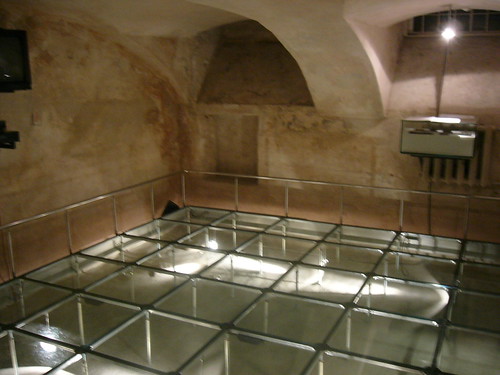
Gas chamber at the KGB Headquarters in Vilnius. Under the glass panels there were items from people that perished here.
Estonians are closely related to the Finns, and more distantly, the Sami (indigenous Laplanders) and Hungarians. Latvians look like and are considered Nordics, evidenced through the strong historical, cultural and religious influences gained over centuries during Germanic and Scandinavian colonisation and settlement.
The Lithuanian ethnos – a Baltic tribe originally – has been influenced by Slavic and Germanic peoples in the past. Genetically Lithuanians are one of tallest peoples in the world (I didn’t notice). One eighth of Lithuanians are immune to HIV which is also one of the highest percentages of immunity in the world (according to wikipedia.org) – whilst Estonia has the highest proportions of people infected with HIV.
Latvians and Lithuanians belong to the Indo-European branch of languages. One thing I found absolutely fascinating, was testing out a theory my grandfather has, which is that the
Lithuanians are linguistically the most similar to the Greek language. Whilst four plus thousand years has created a completely different looking ethnicity for both nations, as well as variation in language from the tribes they both apparently originated from – I could still see a lot of similarities between the language, which was startling as Lithuanian and Greek – despite both Indo-European languages – are completely different sub-categories.
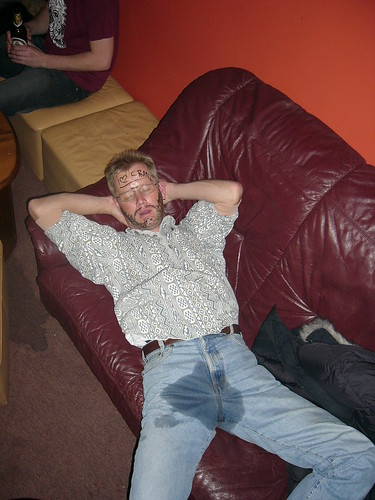
Never leave a drunk German in the same room as me
Some words I found from the Chinese restaurant, and whilst walking in the streets (English – Lithuanian – Greek)…this is incomplete, would appreciate corrections.
Chinese – Kiniskos – Kinezos
Noodle – makaronu – makaronia
salad – salotos – salata
squid – kalmari – kalamari
pepper – paprikomis – paprika
cucumbers – agurkai – agouryia
fried – kepta – kafta
pineapple – ananasais – anana
rice – ryziai – ryzee
And the following signs I saw, I am guessing because of the similarity to Greek.
stomatologijos – in Greek, stoma means mouth, and logos is -ologist. Not sure if there is a Greek equivilant, and what it is in english. Mouth doctor?
Dentist – odontologijos – odontodeatros
Orthodontist – ortodontas – greek?
Photographer – fotografijos – fotografos
chocolate – sokoladu – sokolata
Update 19 December 2005: As shown by a commentator below, I am wrong. And chatting with my father, as to my grqandfathers theory, I apparently misinterpreted him: my gradfather believed the similarity existed due to the grammatical structure of the language, not actual words. Whoops.
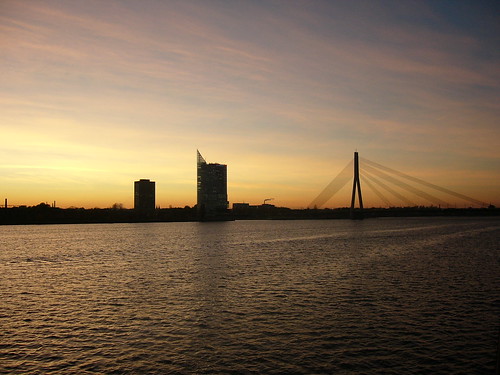
By the river in Riga
There is intense pride in all the people of the Baltic’s that they have independence, as they have a relatively large land mass but a rather small population (Estonia – 1,332,893, Latvia – 2,290,237 , Lithuania – 3,596,617. Source: US Government). The intense pride is because the Baltic three, used to have the Baltic Blues, as there were constantly dominated. With a long history of occupation by their stronger neighbours, they declared independence in 1918, fought independence wars against Germans and Russia’s, and were recognised as independent countries in 1920. Twenty years later, they “elected” to be part of the Soviet Union, something they are still extremely pissed off about.
Estonians, Latvians, and Lithuanians were deported en-masse to Siberia, and the lands were populated with Russians, as part of Stalin’s attempt to eradicate nationalities. The affect in this post-cold war period – is a lot of Russians in the local community, where they are not just sizable minorities, but in the case of Latvia – a majority in all the cities.
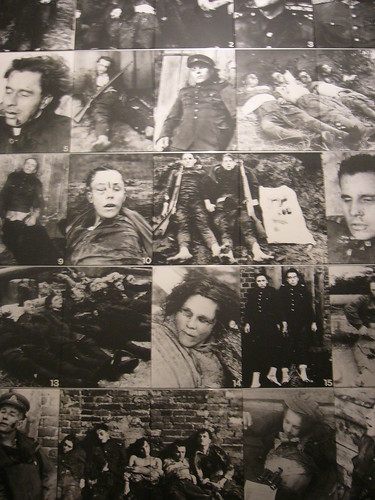
What it looked like on the other side of the Iron Curtain
Now, having just come from Russia, I don’t think this is a bad thing: I like Russians. But apparently, the Russians of the Baltic’s are different from the real Russians. They are the Hispanics of America, the Albanians of Greece and Macedonia, the Moroccans of Western Europe, and the ?¢‚Ǩ?ìAsian?¢‚Ǩ‚Ñ¢s?¢‚Ǩ? of the UK. In other words, the poor, criminal segment of the population. Well, perceived in that way anyway. This problem was exemplified by my bus trip into Estonia.
My bus from St Petersburg to Tallinn, had me sit next to a friendly girl. Anastasia was a 22 year old university student, who was returning home from a semester in St Peterburg. Her English, though not perfect, was decent. Although she calls Estonia home, she can’t speak Estonian beyond a few basic phrases – her English is better than her Estonian. And her parents don’t speak any Estonian. Ethnically she is Russian, and yet despite living outside of Russia, she and her family make not efforts to integrate into the country they live in. They live in Russian neighbourhoods, she went to Russian schools, and parties at Russian clubs. Why bother learning the local language?
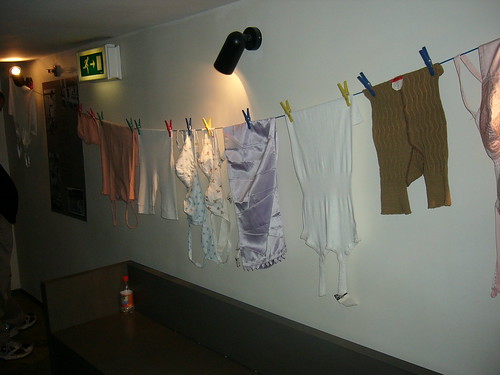
Exhibition at a Tallinn historical museum, just before the Soviet stuff, and just after the medieval traders exhibition. This was the history of women’s undergarments. I left a message in the guestbook demanding equality: where are the men?¢‚Ǩ‚Ñ¢s?
On one of my nights out in Riga, I struck a conversation with a promotions girl trying to get me to buy Finlandia Vodka, but ended up trying to get me to join her at a Latin/Cuban dancing concert the next day. I asked Anna if she was Russian. “Noooo! I am not Russian” in a accent that could only make you smile (or maybe it was the costume they made me smile). Anna, as she told me, does not like the Russians. Anna, also, does not understand why I like Russians. To her, a Russian is an old, arrogant babushka who refuses to integrate into her beautiful country. To me, a Russian is a two metre tall dark-haired but light-eyed supermodel, with more university degrees then I can count.
At another bar, this time in Tallinn, I asked the waitress if she was Estonian or Russian – even though she looked as Scandinavian as they get. She didn’t like that question – I never got that glass of water. Whilst the guy at the Riga tourist office was more informative, not so much with what he said but with the look of disgust on his face: “They Russians. They just cause us trouble”, whilst looking outside at the protest some old Russian’s were making outside of the Town Hall. Apparently, in Latvia 45 percent is Russian speaking (although 29 per cent is ethnically Russian, according to the dude in the office).
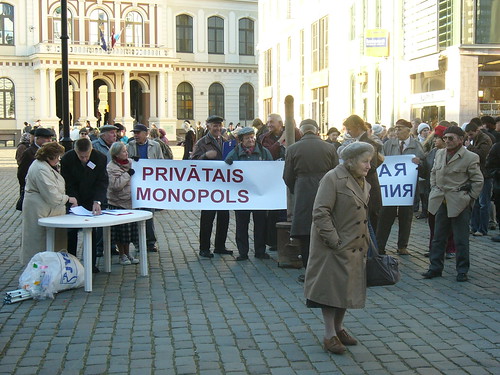
Those damn Russians: protesting at the privitisation of a gas company. This is the image peoples seem to have of the Russian community in the Baltics (the others being thugs on the street, and prostitutes)
With a history of occupation, you would think that now they have their independence, they will resist any pressure to give it up. So said those drunk fellows we met at a pub in Tallinn, who played the tough guy routine, but whom I later sobered up with an arm wrestle (popping someone?¢‚Ǩ‚Ñ¢s ego is one of life’s great pleasures). They don’t like the European Union, because it threatens their sovereignty.
Laura, my friend in Tartu, sees it differently. Slightly more intelligent, and sober, she said that as much as they don’t like it, they have to. It is for their own protection, because their country is simply too small, with extremely large neighbours threatening their existence. I must say, I agree.
Economically, the countries seem to be booming, thanks largely to their recent EU accession. In fact, whilst Western Europe fears Estonian cheap labour for example, it appears that the Estonian economy actually has a skills shortage with the very things the Westerner’s fear will flood their markets: plumbers, electricians, and other basic skills. With a booming economy, also comes booming prices, however wages don’t seem to be moving in line. In 1995, Latvia’s minimum wage was 28 Lats (40 Euros) per month – with the government now deciding to move the current 80 Lats (113 Euros) a month to 90 Lats (128 Euros), which makes Latvia the lowest in the EU. In the mean time, the average wage is about 120 Euros a month (on a 39 hour week). But remember to not let statistics fool you, because ‘average’ means half of all people earn less than that – one of the girls at the hostel in Riga told me, that an average wage is about one Lat an hour (1.4 Euros). I took that to mean, that’s what a smart 20 year old student like her makes.
Latvia has the lowest wages, although I didn’t necessarily find it to be the cheaper country. Lithuania’s average wage is 145 Euros a month, and Estonia’s 158 Euros. In comparison, the UK average wage is 1,160 Euros a month.
Update 23 November 2005: A commentor has brought to my attention that these figures are inaccurate. The source of the figures above is from an article by Sue Birze titled “Another Day, Another Lat”, for the The Baltic Guide (in English about Latvia) September 2005. The article’s figures were sourced from “EIRO, 2004”. Looking into the numbers, they don’t make sense. For example, the article talks about minimum wages and yet the table of wages states ‘average monthly’ wages, when the figures in fact correlate with minimum wages. A little researching into the source confirms that the reporter put the wrong heading on the table. The Estonian Government (PDF)states that the average wage, for example, is actually 8,845 Kroon (565 Euro) for June 2005. These figures give a better overview for wages and the labour force. I am not even going to provide new figures, because of the exponential growth that these countries are experiencing, will mean that the figures will already be out-of-date by the time they are released to the public.
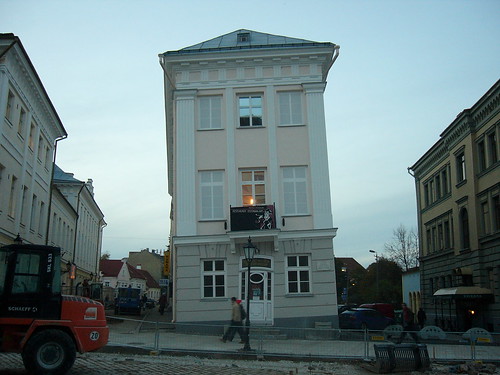
A cultural museum in Tartu. Never trust an Estonian to build your house. Never.
Whilst people whine and moan about the EU becoming too powerful and empire-like, the EU is doing something else in the former Eastern Bloc. With NATO and EU flags proudly flying in the sky, the Baltic three are reorganising their laws, society and infrastructure under the guidance of the EU. The result is that it is giving a new generation of people – my generation and hopefully older- the opportunities their parents were not allowed to have. Freedom.
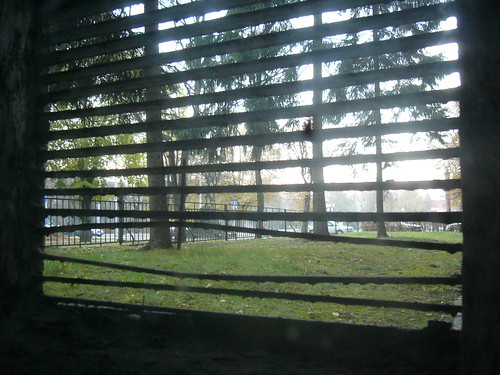
Looking out of a KGB’s guard post, in the HQ in Vilnius. The torture rooms left me shaking.
Hi Elias!
I read your blog with great interest, and am glad that you visited our region as well. But there's a correction I would like to make. Info about our wages is a bit wrong, I would say, they are at least 10 years old. Medium salary in Estonia is about 7500 EEK (1 EUR = 15 EEK) in Tallinn more, in the countryside less. Construction workers and electricians get 2 times more at least, but still there are not enough of them.
The rest of your blog is very good, I guess every balt would be glad to read it (even those who doesn't want to admit that Tallinns old town is starting to look like a theme park)
Hi Elias!
I read your blog with great interest, and am glad that you visited our region as well. But there’s a correction I would like to make. Info about our wages is a bit wrong, I would say, they are at least 10 years old. Medium salary in Estonia is about 7500 EEK (1 EUR = 15 EEK) in Tallinn more, in the countryside less. Construction workers and electricians get 2 times more at least, but still there are not enough of them.
The rest of your blog is very good, I guess every balt would be glad to read it (even those who doesn’t want to admit that Tallinns old town is starting to look like a theme park)
Would apreciate, if you leave a note for others to see on your next posting. Tried to PM you at lonelyplanet why I’m so touchy about it, but you don’t receive PMs anymore.
Hi, Interesting to read another Aussie’s thoughts about the Baltics 🙂
Hey, dear Elias!
“That damn russian� here;) Just wanted to express some thoughts on the point of the situation about russians in Latvia. Well, that’s absolutely true latvians don’t like russians what’s obvious (even if u’ve never been there) from mass media and events which take place. First language question. In 2004 latvian government started opressing russian language in schools saying that teaching in the last forms should be led only in lettish. Taking into account that there’s about 35% etchnically russian population sure that evoked mass-meetings of russian people and protest against that law. Moreover what’s funny there was a statement that the size of the font of russian letters wherever on the billboards or press should have been smaller than lettish ones:) Though on entering the EU they abolished this law (but only about size of font but not about teaching) the language situation is still pretty unclear.
Btw i’ve never heard a fact that people from Baltics were deported to Siberia….i’m not sure that’s true. Well after the war Stalin really wanted russians to get assimilated with original latvian population as Latvia was a part of Soviet Union thus many people were sent there for work and living. Well that didn’t bear forcing character but i suppose people just thought “why not?â€? and settled there. Also those soldiers from the military units based in Latvia stayed there. New factories were built, new jobs appeared so such migration seemed to be ok. Who knew at
that time what would be much later on? And as far as i know the population of Latvia wasn’t
moved anywhere whilst this integration process. Those latvians we have in Russia came here already at the end of the 19th century (mostly military men and peasants). Some arrived in Siberia but for the spread of lutheran ideas.
There’s opinion that russian language is kept down cuz in such a way latvians wanna influence the flow-out or russians from the country. Yeah last year about 10% of russian population left from there….but where?..guess…not to Russia at all…mostly to Western Europe. Heh, though i have lettish roots (father of my grandpa was ethnically latvian) i haven’t visited this nice country yet…cuz as it’s said “russians aren’t welcomed thereâ€?…
Several words about yr linguistic notes and its greek-lithuanian aspect. Though these languages belong to the different groups of the same indo-european family (greek – greek group and lith. – baltic group) u managed to find many coincidences. Well…russian belongs to the eastern sub group of the slavic group of the above mentioned indo-eur. family but u can find pretty similar equivalents as well here…look i made last column in russian:
Noodle – makaronu – makaronia – makaroni
salad – salotos – salata – salat
squid – kalmari – kalamari – kalmari
cucumbers – agurkai – agouryia – ogurets
pineapple – ananasais – anana – ananas
rice – ryziai – ryzee – ris
Photographer – fotografijos – fotografos – fotograf
chocolate – sokoladu – sokolata – shokolad
I hope u have much fun in Budapest (u’r probably there right now)….a big hug from Moscow! Cool bananas!
Daria, I see that retarded people even speak english in Russia. You know, people from the Baltics left to Siberia because we love skiing so much and we didn’t have snow for a few winters, so why not to go to Siberia, it’s fun there!
I’m really keen to know what do you study in history lessons? Especially about 2WW?
Stalin really was a great guy… Hitler as well, because Holocaust never took place, it’s just those damn jews, they always complain. I heard that they were sent to resorts, but since the food was not so good, they made it all out. The same thing with the Balts, Stalin created fun resorts like Kolyma, but since it was too cold and Balts had to stay in their hotelrooms, they made out this horrible story.
We love you, russians!
Hey, Lauri! I’m very sorry, but i didnt mean Stalin mass deportations from Baltic countries in 1941, 43 and 45…and 46th if not mistaken….And sure i know about occupation of three Baltic countries by soviet army and what was going there…I really didnt want to offend anyone, not at all, i just meant that people weren’t sent there to give space to russians who came to Latvia after the war…As russians experienced the same as baltic nations and were deporte to these “resorts” as well. I wanted to say about time after the war, end of the 40th…I’m really really sorry, i noticed my mistake (which makes me ubsolutely cruel and with a lack of education girl) before but thought that hadn’t published my comment cuz wanted to correct it and make my thoughts more clear. But was late so it got published in this view.
Hey, Lauri! To call me retarded let me first explain my point of view. I understand yr sarcasm, cuz see my mistake. Sure i know about mass deportations which took place in Baltic three in 1941 and 45 but due to my age or whatever i didnt know that the same took place even in 1949. Cuz i meant the end of the forties and just wanted to say that people were sent to Siberia not to give space to russians who came to Latvia after the war. Cuz russians experienced the same terror as balt nations. My grandgrandpa was arrested and then killed in jail cuz he was under suspicion as an “anti-soviet” element. Though he was latvian he lived in Moscow and had russian wife. But southands of moscovites were arrested and shot. So do u think i can call Stalin a nice guy? I’m sorry that didn’t correct my comment in time to make the idea more clear….i just meant post war time…that time when russians came to Latvia, nothing more. I’m really very sorry, i didnt want to offend anyone.
Hmm Yeh.. I suggest you learn a bit about history Daria if you think it’s not a fact that the Baltic people were raped by Stalin (and thats putting it very mildly as well as figuratively).
It’s all history (yes it’s true that Balts were deported), how Russians and Baltic people interact now is an entireley different area. If someone discriminates against you because you are Russian then that sucks and is clearly not acceptable.
To say that there is no evidence of deportation is just wrong, ugly wrong. To say that you are not aware of the evidence is an entirely different matter, here is some reading matter for you.
For your consideration:
http://en.wikipedia.org/wiki/Gulag
For years after WWII, a significant minority of the inmates were Balts and Ukrainians from lands newly incorporated into the USSR, as well as Finns, Poles, Romanians and other people from foreign countries “liberated” by the Red Army. POWs, in contrast, were kept in a separate camp system, which was managed by a separate main administration with the NKVD/MVD.
Hmmm, guys, while u atack me i have been trying to publish my explanation for two days but fail all the time due to some server error….i’ve sent it even to Elias to publish but see no result. Ok maybe this attempt is lucky…here was my reply:
Hey, Lauri!
Ohhh what a sarcastic and sharp reply i got….Well i expected that reaction after reread my comment…But to call me retarded let me first explain my point of view. Do u really think i treat Stalin like a nice guy? Yeah, bless him, that my grandgrandpa was first arrested under suspicion of being an “anti-sovietâ€? element and then killed in a jail! Thank him that so many prominent people of great intellect were exiled and died of hunger and humiliation! Yeah, maybe i should worship him cuz my grandgrandma, who was in the gulag gave birth to three daughters who all died of cancer later on?. Sure i know about mass deportations which took place in Baltic three in 1941 and 45 , of the occupation it by the Soviet army and then Nazi regime. But due to my age and lack of knowledge i really didnt know that the same took place even in 1949. Cuz i meant exactly the end of the forties and didnt take war aspect in my comment. I admit my fault, i took the word “deportationsâ€? in a wrong way, first i probably misunderstood Elias and that led to further misunderstanding. I just wanted to say that people were not sent to Siberia for settlement and living IN ORDER to give space to russians who came to Latvia after the war. Instead of “deportationsâ€? i had to write moving or resettlement, migration. Cuz russians experienced the same terror as balt nations and they also were sent to those “hotelsâ€?. I’m sorry that didn’t correct my comment in time to make the idea more clear….i just meant post war time and space..and exclusively social aspect…that time when russians came to Latvia, nothing more. I’m really very sorry, i didnt want to offend anyone.
P.S. As for my lessons of history, i can say we really didnt get the full volume of info in school. Lessons about WW2 just boiled to military actions, nothing more. My bf has an idea, that our textbooks were strictly censoreshipped and stlll stay so. That’s maybe our fault that we (russians) know our own history sometimes much worse than other nations, but our eyes “were closedâ€? for so long time….thanx for opening them to those “damn russians whom u love so muchâ€?!
P.S.2 Btw i’ve read “The Gulag Arhipelago�. And please, don’t think that i have doubt about mass deportations and exiles from Balt countries. I just expressed myself wrongly. Sorry.
Daria (my girlfriend) tried to publish her comment, as she failed I did it for her. I must say I was really surprised by her statements about deportations. To me it was a clear fact that these occurred and I never had a discussion with anyone else about this. Even more surprising is that my girlfriend is very interested in history and I expect her being the last one of making such mistakes.
In extend to the discussion so far I would like to throw up another issue. It might be known to you that in Russia till this day a censorship is going on. And of course history text books are under censorship as well. Russians simply do not learn about deportations and gulags and ethnic cleansing (and so on) in the 20th century of the Russian history. These facts are considered unpatriotic by the Russian government (esp. Putin) and therefore these facts very sensitive to censorship. Imagine a condemnation of ethnic cleansing by the Putin government, while they continue with cleansing in Chechenya, simply impossible. Imagine the Putin (and former) government making Russians critical about there own politics and history…. It just sounds funny to me.
Ignorance about their history is not to blame the Russians themselves. Most Russians are nowadays sparsely informed about the black periods of the 20th century by documentaries and newspapers. But hardly anyone ever heard it at school.
I am afraid the Russian black-out of the worst dictator in history willcontinue for many years there, while the rest of the world knows pretty well what it is all about.
For further reading about censorships in Russia have a go at these publications:
One
Two
Sincerely,
Victor Calado
The Netherlands.
Wow! Settle guys and girl! First of all thank you for your comments, you’ve added some interesting points. However some things need to be addressed:
1) Comments. I put some software in that makes posting comments more difficult, to avoid spam comments. My blog over the last few months was bombarded by computer generated spam, and I put in a quick and easy solution, which pretty much suspects anyone as being a spammer. When you post a comment, look at the address bar: If it has any word regarding spam or spam karma, it means your comment has been posted, but is being held in moderation (you get a page saying there is an internal server error). If you don’t see the comment approved within a few days, e-mail me to get off my lazy arse. Usually however, the comment does get posted. I do get around to the housekeeping eventually, so don’t fret.
2) Facts and figures. I stupidly did not include my source about the wages, which comes from a Latvian newspaper.
Deeply buried in my backpack, I am sure I will find it, and I will add the reference. As you may have noticed, I have not had time to update my blog – I currently have another three countries to catch up on! However as for the numbers, I am leaving them because even though they might be wrong, they are consistently wrong with all the countries discussed (ie, they were selected from similar time periods, with I presume a consistent methdology of sampling). This at least helps for comparative purposes, which is why the figures are used. Using averages is fairly useless unless you know the standard deviations, and “median” incomes is a much more accurate figure – as Lauri provides. Nevertheless, growth in this part of Europe is exponential, and Lauri, I will include the information you have pointed me too. However people should be aware that this month’s figures, although more recent, are already out of date!
3) About Daria. I personally know Daria, and I can assure you she is a good natured, and intelligent woman. I don’t appreciate the personal attacks. She is a product of her environment, and she genuinely was having trouble posting a comment earlier to correct what she said. Please argue, but keep it dignified and have respect for each other. It’s emotive outbursts like this, grounded in history and memory, that have lead to the current problems that will seed future wars.
4) Censorship. Daria, like me, has grown up in a post-communist world. Everything I know about communism, has been from my active research and experience in the region’s formally affected. I never knew any of the stuff I have written, before this trip, and I come from a strong democracy, and a schooling that involved a lot of history. We were all ignorant at some stage. Education, through school or travel, helps break that.
I noticed, when in Russia, that the people I talked to were slightly less informed about general politics in Russia (I met many people) than an informed outsider, and I attribute this to Putin’s clampdown on the independent media and the nationalism he is trying to revive. An example is the brutality occuring or had occured in Chechnya by Russian forces. I met some intelligent Russian’s – but just like I have met intelligent American’s – their views are very much shaped by their media. But let me leave that point there, and save it for a chat over a beer.
The fact that Daria is in my generation, and lives in a country that has every reason to promote the good and forget the bad, means I would be more shocked if Daria did know about the Baltic brutality than if she didn’t know.
Daria, I’m sorry for what I said. I see there is still hope for Russia:)
Thanks for the report. That was great as usual. I’ve been to Lithuania once. I was in 1989. I was amazed by a number of cafés and restaurants in each house. And I also visited Trakai and must say I’ve never seen anything similar. I have some photos and keep them in my album, but anyway.
Having read your story about traveling in Russia, I have no doubts left that your attitude to the things is a 100% objective and independent. Therefore, this sort of disproportion concerning the information in your comments about the horrors of the KGB in the Baltic States is apparently the result of their anti-Russian policy.
The great difference from Russia that I see is that we have here both kinds of memorials, dedicated to makers and victims of the October Revolution, victims of Hitler (SS) and Stalin (KGB), whereas in the Baltic States they regard (and slightly exaggerate) only one KGB’s part of crimes. So, I’d like to counterbalance the situation a little.
Here in Russia we have appropriate legislation that rehabilitates the repressed and allots them some kind of pension. Law No 1107-I of 24 Apr 1991 condemns the actions against the repressed and affirms them to be criminal. The memorial to the repressed, the Solovetsky Stone, lies in place of the former Dzerzhinsky monument in the very center of Moscow, right in front of the main FSB (former KGB) office. The Russian government has recently contributed to the reinterment of the White Guard general Denikin.
At the same time, I do not know if the Baltic States will ever tell you that in these countries they had slaughtered over 1/4 million Jews during WWII, which is higher that everywhere in the world. They also introduced a very rational approach how to urge execution of the Jews. In a trench they had the first row of Jews knelt on the bottom. Then the gunners shot them down and the next row got into the trench and knelt on the dead bodies of those killed. Then the turn for the next row came and so on. In a very short while the pit was filled up with killed Jews, about 500 persons in each trench. In order to reach Jews everywhere on the territory, they formed special mobile squads. The so-called auxiliary security militia at the head of which was Viktor Arais killed about 50 thousand Jews. (See Dr. Altman. HOLACAUST AND THE JEWISH RESISTENCE IN THE OCCUPIED TERRITORY OF THE USSR.
So I wonder why don’t they have such a memorial or if they have one why does nearly no one know about its existence? Why at the beginning of the 21st century do they unveil an SS memorial?
Well, I may draw a conclusion that the Baltic States pursue the Soviet principals as well, which means not to reveal the whole truth. Actually, I can’t realize why the West looks upon an issue of that kind as if everyone had one eye missing there.
A few more links:
http://www.wpb.be/icm/00en/seminar/LatviaRubiks.htm
http://www.jewishgen.org/Belarus/newsletter/AltmanReview.htm
Thanks again.
In 1934 there was 4434 jews living in Estonia. In 1941 those who had not left (1700) were all killed. Estonia became judenfrei… (wikipedia) we know that. You wrote –
The great difference from Russia that I see is that we have here both kinds of memorials, dedicated to makers and victims of the October Revolution, victims of Hitler (SS) and Stalin (KGB), whereas in the Baltic States they regard (and slightly exaggerate) only one KGB’s part of crimes. So, I’d like to counterbalance the situation a little.
So you have Stalins statues, you’ve got Dzerzhinskys monument, and you call it normal. That’s the way it should be? Here we have monuments to victims mostly, but some, that are very precious to our russian friends, are not for the victims, but for the winners. There is a great difference and I hope Tallinns new city council will remove it. I really hope so, because as Germans have apologised to jews, and they really feel bad about what happened in the history, russians, at least Putin and fellows, say that we have already apologised 15 years ago, what do you want more, balts? There is absolutely no feel of guilt. To me and others it’s very insulting.
I checked your links as well. Since the first one was already wrong in the beginning (Ulmanis being a fascist) I didn’t bother to read more. I went to school in the Soviet time, so I kind of knew what it says.
The problem of russians (among all others) is that they seem to call everyone, who are against them, fascists. But you, as an intelligent person know, that nationalism is not fascism. Ulmanis was not a fascist as wastnt our President Päts. They were against Soviet Russia, that’s it. And that was the right way, as future showed us, nothing good came out of it. I’m happy to see that young russians in estonia can look at those things with both eyes opened and the latest news, that Putin calls all russians from the ex-soviet counties home, makes them only laugh.
Actually, I didn’t want to point out that “we know that�. All that I wanted to do was to counterbalance a bit the negative information in Elias’ report. I didn’t want to disprove the information in the report, nor did I want to prove my own position is right. I found a lack in the information provided and as long as I have a right to leave comments I took it to fill that gap. What’s wrong in it? I reckon my task is done outright.
At the same time, if you’ve brought up some questions I think I can answers then too. Well, you say “So you have Stalins statues, you’ve got Dzerzhinskys monument, and you call it normal. That’s the way it should be?� No, it’s not. Now the more and more Stalin’s memorials are being destroyed and more and more new memorials to tsars and White-Guard generals are being constructed. In the Baltic States it’s not like old memorials are being restored, but new memorials to monsters of cruelty are arising. What for? Is that a kind of threat? Well, that’s the main difference I’d like to underline: by degree Russia gets rid of memorials to the cruel, whereas in the Baltic States they are constructing these from scratch. From scratch, you know, although the SS were condemned by the Nuremberg tribunal. Someone could say it’s not fascism. Doing so was typical for the Soviet Union, so for an extra time I say I think the Baltic policy has not gone much far from it.
Now then. First of all, Putin never said “what do you want more, balts?â€? Where did you get that, after all? And you say it’s insulting when Putin attracts your attention to the first apology given 15 years ago. Not only Putin, you know, but Gorbachev, too, says so. Gorbachev is the Nobel laureate. I think you cannot ignore the fact of official affirmation he‘s contributed a lot into our planet. So, it seems to me that insulting is not driving you to the apology done, but neglecting any apologies a state presents. How come that Russia has to apologize twice for the same deeds? Isn’t it odd? Is that a goal to leave Russia in an awkward position? Well, you say there’s no feel of guilt? But wait a minute; the Baltic States don’t express feelings of guilt either, when rearing monuments to those who slaughtered the Jews. Germans, who in your words feel bad about the Jews, do not construct new memorials to fascists. And how to explain the fact that before the Baltic joined to the EU they had introduced enough and more laws which contradicted the Human Rights Declaration? Hatred based on the Soviet style of governing? Looking for the common enemy? Hunting for witches? And now I hear they are unwilling to carry out Strasburg’s decisions. I wonder what might it demonstrate – willingness not to obey legislation for the sake of puncturing Russia for an extra time?
The fact you didn’t bother to read the links just underscores that you would rather close your eyes upon the problem and that you won’t get ready to discuss it. But in some way, it gives me a clue to understanding why having denied that 15-year-back apology the Baltic countries want it again. I don’t have to be a prophet in order to see that the Baltic countries are intending to deny any further apologies (if these are ever brought up) and reiterate newer demands of apologies again and again. Why? Maybe the purpose is to keep Russia apologizing all over the time and thereby to disgrace the country or, maybe, in order to shake out a kind of reparation form Russia, I don’t know.
Hello!
This time i won’t touch upon the questions of history but will evolve a bit a topic of monuments. Well, living in Moscow i can “be responsible� only for this city. The monument to Dzerzhinsky, mentioned by Mikhail was dismantled in august 1991 and removed from Lubianka Square to the park of sculptures near “the central House of Artists�.
pic of the dismantling: http://www.mitrohin.ru/index.phtml?id=9
park: http://www.novayagazeta.spb.ru/?y=2002&n=73&id=3
Later on in october1991 appeared an official regulation of Moscow authorities to remove the monuments to the USSR political figures and members of the Central Commitee of CPSU. Thus there in this park (we call a part of it the “park of fallen idols� among guides nowdays) u can also find replaced monuments to Lenin, Brezhnev, Kosigin and such communist figures as Sverdlov and Kalinin. And the only Stalin i have seen in Moscow is also in this “company�. Here it is: http://www.flickr.com/photos/china1/61984649/
But unfortunately in 1998 an idea to return back that monument to Dzerzhinsky appeared on the initiative of the former KGB officer and leader of the country party Haritonov. State Duma, the lower chamber of the Parliament started discussion of this question. And everybody would have forgotten about that if in 2002 the mayor of Moscow Yury Luzhkov didn’t suggest that the monument to “Iron Felix�should occupy the central part of Lubianka Square again. Well, i have no idea what pushed our pretty reasonable mayor to this step, but that surely evoked many arguments. At the beginning of 2003 the Moscow Commision of the Monumental Art closed the discussion having said that such an action as return of this monument would symbolize terror.
Thus the central part of the square right in front of the FSB building stays empty: http://www.rosfoto.ru/show/photo-33927.htm
There’s an idea to put a monument to russian general-adjutant Skobelev whose monument was dismantled in 1918 from Tverskaya Square, but i doubt it will be interesting for u to discuss it here so just several links:
http://www.vor.ru/English/whims/whims_018.html
http://www.all-photo.ru/empire/index.en.html?kk=c7defd6b93&img=5910&big=on
Several words about the monuments to Lenin in Moscow. For the years of the soviet regime about 80 monuments were put in Moscow, 68 memorial plaques and countless amount of busts created. In 1991 a special commission discussed a question of removing all those monuments. It was decided to leave untouched only those which are of the great artistic value. Have no idea how many are left by now but i very often come across monumental images of Lenin here and there:
http://photo.tetstudio.ru/view_big/103/
As for the monuments dedicated to the victims of Stalin’s purges and political repressions here’s the list of them on the territory of the former USSR.
http://www.sakharov-center.ru/asfcd/pam/list.xtmpl (it’s in russian)
drawing yr attention, Lauri, to the monuments devoted to Balts, almost all to lithuanians. They were created mostly on the initiative of lithuanians themselves though:
http://www.sakharov-center.ru/asfcd/pam/pam_card.xtmpl?id=296
http://www.sakharov-center.ru/asfcd/pam/pam_card.xtmpl?id=393
http://www.sakharov-center.ru/asfcd/pam/pam_card.xtmpl?id=394
http://www.sakharov-center.ru/asfcd/pam/pam_card.xtmpl?id=648
http://www.sakharov-center.ru/asfcd/pam/pam_card.xtmpl?id=736
http://www.sakharov-center.ru/asfcd/pam/pam_card.xtmpl?id=906
http://www.sakharov-center.ru/asfcd/pam/pam_card.xtmpl?id=908
http://www.sakharov-center.ru/asfcd/pam/pam_card.xtmpl?id=909
A very troubling question is a problem of preserving of all these monuments cuz u know what frequently happens to them – defilement:
http://www.novayagazeta.spb.ru/?y=2002&n=73&id=3
True, Lauri, some people call it normal the existence of monuments to Stalin or Dzerzhinsky for e.g., but from some point of view they are also right. Their argument is that that’s a part of history and it has right to exist whether it’s horrible or not as along with the victims were those who caused those victims. Thus if we remove all monuments reminding us of totalitarian regime then next generations will learn history only in pictures. I think it was a good decision to gather them in one place in Moscow not destroying.
P.S. Sorry in case some links don’t work, but me myself could open all of them.
Sincerely yrs, Daria.
Hello!
This time i won’t touch upon the questions of history but will evolve a bit a topic of monuments. Well, living in Moscow i can “be responsible� only for this city. The monument to Dzerzhinsky, mentioned by Mikhail was dismantled in august 1991 and removed from Lubianka Square to the park of sculptures near “the central House of Artists�.
pic of the dismantling: http://www.mitrohin.ru/index.phtml?id=9
park: http://www.novayagazeta.spb.ru/?y=2002&n=73&id=3
Later on in october1991 appeared an official regulation of Moscow authorities to remove the monuments to the USSR political figures and members of the Central Commitee of CPSU. Thus there in this park (we call a part of it the “park of fallen idols� among guides nowdays) u can also find replaced monuments to Lenin, Brezhnev, Kosigin and such communist figures as Sverdlov and Kalinin. And the only Stalin i have seen in Moscow is also in this “company�. Here it is: http://www.flickr.com/photos/china1/61984649/
But unfortunately in 1998 an idea to return back that monument to Dzerzhinsky appeared on the initiative of the former KGB officer and leader of the country party Haritonov. State Duma, the lower chamber of the Parliament started discussion of this question. And everybody would have forgotten about that if in 2002 the mayor of Moscow Yury Luzhkov didn’t suggest that the monument to “Iron Felix�should occupy the central part of Lubianka Square again. Well, i have no idea what pushed our pretty reasonable mayor to this step, but that surely evoked many arguments. At the beginning of 2003 the Moscow Commision of the Monumental Art closed the discussion having said that such an action as return of this monument would symbolize terror.
Thus the central part of the square right in front of the FSB building stays empty: http://www.rosfoto.ru/show/photo-33927.htm
There’s an idea to put a monument to russian general-adjutant Skobelev whose monument was dismantled in 1918 from Tverskaya Square, but i doubt it will be interesting for u to discuss it here so just several links:
http://www.vor.ru/English/whims/whims_018.html
http://www.all-photo.ru/empire/index.en.html?kk=c7defd6b93&img=5910&big=on
Several words about the monuments to Lenin in Moscow. For the years of the soviet regime about 80 monuments were put in Moscow, 68 memorial plaques and countless amount of busts created. In 1991 a special commission discussed a question of removing all those monuments. It was decided to leave untouched only those which are of the great artistic value. Have no idea how many are left by now but i very often come across monumental images of Lenin here and there:
http://photo.tetstudio.ru/view_big/103/
As for the monuments dedicated to the victims of Stalin’s purges and political repressions here’s the list of them on the territory of the former USSR.
http://www.sakharov-center.ru/asfcd/pam/list.xtmpl (it’s in russian)
drawing yr attention, Lauri, to the monuments devoted to Balts, almost all to lithuanians. They were created mostly on the initiative of lithuanians themselves though:
http://www.sakharov-center.ru/asfcd/pam/pam_card.xtmpl?id=296
http://www.sakharov-center.ru/asfcd/pam/pam_card.xtmpl?id=393
http://www.sakharov-center.ru/asfcd/pam/pam_card.xtmpl?id=394
http://www.sakharov-center.ru/asfcd/pam/pam_card.xtmpl?id=648
http://www.sakharov-center.ru/asfcd/pam/pam_card.xtmpl?id=736
http://www.sakharov-center.ru/asfcd/pam/pam_card.xtmpl?id=906
http://www.sakharov-center.ru/asfcd/pam/pam_card.xtmpl?id=908
http://www.sakharov-center.ru/asfcd/pam/pam_card.xtmpl?id=909
A very troubling question is a problem of preserving of all these monuments cuz u know what frequently happens to them – defilement:
http://www.novayagazeta.spb.ru/?y=2002&n=73&id=3
True, Lauri, some people call it normal the existence of monuments to Stalin or Dzerzhinsky for e.g., but from some point of view they are also right. Their argument is that that’s a part of history and it has right to exist whether it’s horrible or not as along with the victims were those who caused those victims. Thus if we remove all monuments reminding us of totalitarian regime then next generations will learn history only in pictures. I think it was a good decision to gather them in one place in Moscow not destroying.
P.S. Sorry in case some links don’t work, but me myself could open all of them.
Sincerely yrs, Daria.
Hello!
This time i won’t touch upon the questions of history but will evolve a bit a topic of monuments. Well, living in Moscow i can “be responsible� only for this city. The monument to Dzerzhinsky, mentioned by Mikhail was dismantled in august 1991 and removed from Lubianka Square to the park of sculptures near “the central House of Artists�.
pic of the dismantling: http://www.mitrohin.ru/index.phtml?id=9
park: http://www.novayagazeta.spb.ru/?y=2002&n=73&id=3
Later on in october1991 appeared an official regulation of Moscow authorities to remove the monuments to the USSR political figures and members of the Central Commitee of CPSU. Thus there in this park (we call a part of it the “park of fallen idols� among guides nowdays) u can also find replaced monuments to Lenin, Brezhnev, Kosigin and such communist figures as Sverdlov and Kalinin. And the only Stalin i have seen in Moscow is also in this “company�. Here it is: http://www.flickr.com/photos/china1/61984649/
But unfortunately in 1998 an idea to return back that monument to Dzerzhinsky appeared on the initiative of the former KGB officer and leader of the country party Haritonov. State Duma, the lower chamber of the Parliament started discussion of this question. And everybody would have forgotten about that if in 2002 the mayor of Moscow Yury Luzhkov didn’t suggest that the monument to “Iron Felix�should occupy the central part of Lubianka Square again. Well, i have no idea what pushed our pretty reasonable mayor to this step, but that surely evoked many arguments. At the beginning of 2003 the Moscow Commision of the Monumental Art closed the discussion having said that such an action as return of this monument would symbolize terror.
Thus the central part of the square right in front of the FSB building stays empty: http://www.rosfoto.ru/show/photo-33927.htm
There’s an idea to put a monument to russian general-adjutant Skobelev whose monument was dismantled in 1918 from Tverskaya Square, but i doubt it will be interesting for u to discuss it here so just several links:
http://www.vor.ru/English/whims/whims_018.html
http://www.all-photo.ru/empire/index.en.html?kk=c7defd6b93&img=5910&big=on
Several words about the monuments to Lenin in Moscow. For the years of the soviet regime about 80 monuments were put in Moscow, 68 memorial plaques and countless amount of busts created. In 1991 a special commission discussed a question of removing all those monuments. It was decided to leave untouched only those which are of the great artistic value. Have no idea how many are left by now but i very often come across monumental images of Lenin here and there:
http://photo.tetstudio.ru/view_big/103/
As for the monuments dedicated to the victims of Stalin’s purges and political repressions here’s the list of them on the territory of the former USSR.
http://www.sakharov-center.ru/asfcd/pam/list.xtmpl (it’s in russian)
drawing yr attention, Lauri, to the monuments devoted to Balts, almost all to lithuanians. They were created mostly on the initiative of lithuanians themselves though:
http://www.sakharov-center.ru/asfcd/pam/pam_card.xtmpl?id=296
http://www.sakharov-center.ru/asfcd/pam/pam_card.xtmpl?id=393
http://www.sakharov-center.ru/asfcd/pam/pam_card.xtmpl?id=394
http://www.sakharov-center.ru/asfcd/pam/pam_card.xtmpl?id=648
http://www.sakharov-center.ru/asfcd/pam/pam_card.xtmpl?id=736
http://www.sakharov-center.ru/asfcd/pam/pam_card.xtmpl?id=906
http://www.sakharov-center.ru/asfcd/pam/pam_card.xtmpl?id=908
http://www.sakharov-center.ru/asfcd/pam/pam_card.xtmpl?id=909
A very troubling question is a problem of preserving of all these monuments cuz u know what frequently happens to them – defilement:
http://www.novayagazeta.spb.ru/?y=2002&n=73&id=3
True, Lauri, some people call it normal the existence of monuments to Stalin or Dzerzhinsky for e.g., but from some point of view they are also right. Their argument is that that’s a part of history and it has right to exist whether it’s horrible or not as along with the victims were those who caused those victims. Thus if we remove all monuments reminding us of totalitarian regime then next generations will learn history only in pictures. I think it was a good decision to gather them in one place in Moscow not destroying.
P.S. Sorry in case some links don’t work, but me myself could open all of them.
Sincerely yrs, Daria.
Hello!
This time i won’t touch upon the questions of history but will evolve a bit a topic of monuments. Well, living in Moscow i can “be responsible� only for this city. The monument to Dzerzhinsky, mentioned by Mikhail was dismantled in august 1991 and removed from Lubianka Square to the park of sculptures near “the central House of Artists�.
pic of the dismantling: http://www.mitrohin.ru/index.phtml?id=9
park: http://www.novayagazeta.spb.ru/?y=2002&n=73&id=3
Later on in october1991 appeared an official regulation of Moscow authorities to remove the monuments to the USSR political figures and members of the Central Commitee of CPSU. Thus there in this park (we call a part of it the “park of fallen idols� among guides nowdays) u can also find replaced monuments to Lenin, Brezhnev, Kosigin and such communist figures as Sverdlov and Kalinin. And the only Stalin i have seen in Moscow is also in this “company�. Here it is: http://www.flickr.com/photos/china1/61984649/
But unfortunately in 1998 an idea to return back that monument to Dzerzhinsky appeared on the initiative of the former KGB officer and leader of the country party Haritonov. State Duma, the lower chamber of the Parliament started discussion of this question. And everybody would have forgotten about that if in 2002 the mayor of Moscow Yury Luzhkov didn’t suggest that the monument to “Iron Felix�should occupy the central part of Lubianka Square again. Well, i have no idea what pushed our pretty reasonable mayor to this step, but that surely evoked many arguments. At the beginning of 2003 the Moscow Commision of the Monumental Art closed the discussion having said that such an action as return of this monument would symbolize terror.
Thus the central part of the square right in front of the FSB building stays empty: http://www.rosfoto.ru/show/photo-33927.htm
There’s an idea to put a monument to russian general-adjutant Skobelev whose monument was dismantled in 1918 from Tverskaya Square, but i doubt it will be interesting for u to discuss it here so just several links:
http://www.vor.ru/English/whims/whims_018.html
http://www.all-photo.ru/empire/index.en.html?kk=c7defd6b93&img=5910&big=on
Several words about the monuments to Lenin in Moscow. For the years of the soviet regime about 80 monuments were put in Moscow, 68 memorial plaques and countless amount of busts created. In 1991 a special commission discussed a question of removing all those monuments. It was decided to leave untouched only those which are of the great artistic value. Have no idea how many are left by now but i very often come across monumental images of Lenin here and there:
http://photo.tetstudio.ru/view_big/103/
As for the monuments dedicated to the victims of Stalin’s purges and political repressions here’s the list of them on the territory of the former USSR.
http://www.sakharov-center.ru/asfcd/pam/list.xtmpl (it’s in russian)
drawing yr attention, Lauri, to the monuments devoted to Balts, almost all to lithuanians. They were created mostly on the initiative of lithuanians themselves though:
http://www.sakharov-center.ru/asfcd/pam/pam_card.xtmpl?id=296
http://www.sakharov-center.ru/asfcd/pam/pam_card.xtmpl?id=393
http://www.sakharov-center.ru/asfcd/pam/pam_card.xtmpl?id=394
http://www.sakharov-center.ru/asfcd/pam/pam_card.xtmpl?id=648
http://www.sakharov-center.ru/asfcd/pam/pam_card.xtmpl?id=736
http://www.sakharov-center.ru/asfcd/pam/pam_card.xtmpl?id=906
http://www.sakharov-center.ru/asfcd/pam/pam_card.xtmpl?id=908
http://www.sakharov-center.ru/asfcd/pam/pam_card.xtmpl?id=909
A very troubling question is a problem of preserving of all these monuments cuz u know what frequently happens to them – defilement:
http://www.novayagazeta.spb.ru/?y=2002&n=73&id=3
True, Lauri, some people call it normal the existence of monuments to Stalin or Dzerzhinsky for e.g., but from some point of view they are also right. Their argument is that that’s a part of history and it has right to exist whether it’s horrible or not as along with the victims were those who caused those victims. Thus if we remove all monuments reminding us of totalitarian regime then next generations will learn history only in pictures. I think it was a good decision to gather them in one place in Moscow not destroying.
P.S. Sorry in case some links don’t work, but me myself could open all of them.
Sincerely yrs, Daria.
Hello!
This time i won’t touch upon the questions of history but will evolve a bit a topic of monuments. Well, living in Moscow i can “be responsible� only for this city. The monument to Dzerzhinsky, mentioned by Mikhail was dismantled in august 1991 and removed from Lubianka Square to the park of sculptures near “the central House of Artists�.
pic of the dismantling: http://www.mitrohin.ru/index.phtml?id=9
park: http://www.novayagazeta.spb.ru/?y=2002&n=73&id=3
Later on in october1991 appeared an official regulation of Moscow authorities to remove the monuments to the USSR political figures and members of the Central Commitee of CPSU. Thus there in this park (we call a part of it the “park of fallen idols� among guides nowdays) u can also find replaced monuments to Lenin, Brezhnev, Kosigin and such communist figures as Sverdlov and Kalinin. And the only Stalin i have seen in Moscow is also in this “company�. Here it is: http://www.flickr.com/photos/china1/61984649/
But unfortunately in 1998 an idea to return back that monument to Dzerzhinsky appeared on the initiative of the former KGB officer and leader of the country party Haritonov. State Duma, the lower chamber of the Parliament started discussion of this question. And everybody would have forgotten about that if in 2002 the mayor of Moscow Yury Luzhkov didn’t suggest that the monument to “Iron Felix�should occupy the central part of Lubianka Square again. Well, i have no idea what pushed our pretty reasonable mayor to this step, but that surely evoked many arguments. At the beginning of 2003 the Moscow Commision of the Monumental Art closed the discussion having said that such an action as return of this monument would symbolize terror.
Thus the central part of the square right in front of the FSB building stays empty: http://www.rosfoto.ru/show/photo-33927.htm
There’s an idea to put a monument to russian general-adjutant Skobelev whose monument was dismantled in 1918 from Tverskaya Square, but i doubt it will be interesting for u to discuss it here so just several links:
http://www.vor.ru/English/whims/whims_018.html
http://www.all-photo.ru/empire/index.en.html?kk=c7defd6b93&img=5910&big=on
Several words about the monuments to Lenin in Moscow. For the years of the soviet regime about 80 monuments were put in Moscow, 68 memorial plaques and countless amount of busts created. In 1991 a special commission discussed a question of removing all those monuments. It was decided to leave untouched only those which are of the great artistic value. Have no idea how many are left by now but i very often come across monumental images of Lenin here and there:
http://photo.tetstudio.ru/view_big/103/
As for the monuments dedicated to the victims of Stalin’s purges and political repressions here’s the list of them on the territory of the former USSR.
http://www.sakharov-center.ru/asfcd/pam/list.xtmpl (it’s in russian)
drawing yr attention, Lauri, to the monuments devoted to Balts, almost all to lithuanians. They were created mostly on the initiative of lithuanians themselves though:
http://www.sakharov-center.ru/asfcd/pam/pam_card.xtmpl?id=296
http://www.sakharov-center.ru/asfcd/pam/pam_card.xtmpl?id=393
http://www.sakharov-center.ru/asfcd/pam/pam_card.xtmpl?id=394
http://www.sakharov-center.ru/asfcd/pam/pam_card.xtmpl?id=648
http://www.sakharov-center.ru/asfcd/pam/pam_card.xtmpl?id=736
http://www.sakharov-center.ru/asfcd/pam/pam_card.xtmpl?id=906
http://www.sakharov-center.ru/asfcd/pam/pam_card.xtmpl?id=908
http://www.sakharov-center.ru/asfcd/pam/pam_card.xtmpl?id=909
A very troubling question is a problem of preserving of all these monuments cuz u know what frequently happens to them – defilement:
http://www.novayagazeta.spb.ru/?y=2002&n=73&id=3
True, Lauri, some people call it normal the existence of monuments to Stalin or Dzerzhinsky for e.g., but from some point of view they are also right. Their argument is that that’s a part of history and it has right to exist whether it’s horrible or not as along with the victims were those who caused those victims. Thus if we remove all monuments reminding us of totalitarian regime then next generations will learn history only in pictures. I think it was a good decision to gather them in one place in Moscow not destroying.
P.S. Sorry in case some links don’t work, but me myself could open all of them.
Sincerely yrs, Daria.
Hi Daria, hello Mikhail! First of all the Nurenberg trials – this is not my text but I couldn’t but it better anyway. I feel compelled to clarify a very common mistake in discussions about
WW2. The letters "SS" have terrible associations and people use it often
inaccurately to denote "evil" in a broad sense. Then they associate any
Nazi organization with these letters with Nazi terror. This generates
a fuzzy and inaccurate view of history. Such an instance is the above
quotation from which everybody who is not knowledgable in WW2 history would
conclude that Estonians and Latvians must have been bad guys. I am not
trying to say that there were not bad guys among Estonians and Latvians,
(or Lithuanians for that matter).  But these were not members of the
Estonian and Latvian SS divisions. The latter units belonged to the
"Waffen SS" which was a combat organization (in fact, a second army).
In the Nurenberg trials the "Waffen SS" was exonerated in the sense that
membership in that organization was not considered to be an indication
for criminal activity (unlike, for instance the Nazi party or the SS). On top
of that the foreign SS Divisions (there were over 20 of those) were by the
Germans considered only as "associate" to the Waffen SS. The connection of
the Latvian and Estonian SS divisions with the notorious political
organization called "SS" is only by these letters, not by administration,
nor duties.  War crimes by foreigners in German occupied countries were
committed by other units, usually specially established for these purposes
under other names such as "police units", "guard units" and, of course,
SD units and the proper SS itself.  But again, the fact that a unit
was under German command does not necessarily mean that it committed crimes.
The Lithuanian statistics quoted by Mr. Paskauskas confirms this, as many
Lithuanians were serving just in such units, as did about one half
of all Latvian conscripts.
Aivars Celmins
About sorrys. Sometimes even to say sorry for 10 times is not enough. You ofcourse know Willy Brandt. When he visited a ghetto in Warsaw, 1971, he went down on his knees. This gesture, even Brant himself participated in resistance to Hitler, showed, how great man he is, how great country Germany is. Was Brandt guilty in anything that Hitler did?Our statue just shows our hopelessness – tell me honestly, what can we do against Russias propaganda? Are local russians really feeling that bad? Are human rights being violated in any way? That those with grey passports can’t vote? Is it hard to get a blue passport? I guess not many russians want to come back to Russia, otherwise they would have done so already.  The monument is meant for those (now it’s removed ofcourse) who protected estonian independence during WW2. Yes, the uniform was german, not all of us were happy about it, but there are not any real proof that our batallions slaughtered jews, not serious proof anyway. KGB is powerful enough to prove anything, ofcourse, that’s why I don’t take seriously much of the history sites that end with .ru, plus the soviet generation of historians has not completely changed yet in Russia, which means, I read the same stuff I can read from the books published in the 60ies/70ies. Have you read the story already, that estonian neo-nazis attended that rumble in France, busloads of them? It is pathetic what your press can make out and that is the reason, why we have negative feelings for Russia, (but not all russians)Now let’s get to something fresh. What do you think about things happening in Baku?/en.wikipedia.org/wiki/20th_Waffen_Grenadier_Division_of_the_SS_(1st_Estonian)
Arrests and executions continued as the Germans, with the assistance of local collaborators, advanced through Estonia. About 75% of Estonia’s Jewish community, aware of the fate that otherwise awaited them, managed to escape to the Soviet Union; virtually all the remainder (between 950 and 1000 men, women and children) were killed before the end of 1941. Less than a dozen Estonian Jews are known to have survived the war in Estonia. The Nazi regime also established 22 concentration and labor camps in Estonia for foreign Jews, the largest, Vaivara, had 20,000 Jewish prisoners pass through its gates, and several thousand foreign Jews were killed at the Kalevi Liiva camp.Despite the German refusal to recognize Estonia’s sovereignty, many Estonians heeded the call to fight the Soviets, especially in 1944 when, with the Allied victory over Germany becoming certain, the only option to save Estonia’s independence was to stave off a new Soviet invasion of Estonia until Germany’s capitulation. The initial formation of a volunteer SS Estonian legion was eventually to become in 1944 a full-sized Waffen SS volunteer division, the 20th Waffen Grenadier Division of the SS (1st Estonian). The Estonian units saw action defending the Narva line throughout 1944.
Now please note when were the jews killed, and when these men, who we have got a (ex) statue for, faught. Estonians weren’t taken to the German army before it strated going down (and the jews were killed)Â We were not pure arians! As for collaborators, you can find them everywhere, everytime.
after all, I’m quite happy to notice how people in the Balkans are not of the worst kind at all (like I thought) =]
Hello Lauri (and all of course),I understand the reason you’re unwilling to walk among .ru sources, but I’m sure you make your views definitely narrower. Believe it or not, here are no bears walking down streets with balalaikas. Anyway, it’s up to you whether to read Russian domains. To me, I’m always trying to fetch information from different sources beginning with gazeta.ru and ending on Washingtonpost.com and many others (BBC and the Guardian are not forgotten), what gives me an opportunity to have my own opinion formed rather objectively. And I am strongly convinced that it’s not right springing under the wing of one tyrant to fight another.  Inasmuch as you write this:
I can’t help providing these lines correspondingly. And I don’t know why some historians think otherwise than you. http://www.spartacus.schoolnet.co.uk/GERwaffen.htm(The Waffen SS had a reputation for committing war crimes in occupied territory. At the Nuremberg War Crimes Trial a large number of its leaders were executed.)  Then since you say this:
  I think you ought to read this: http://www.historyplace.com/worldwar2/holocaust/h-warsaw.htm(On Monday, April 19, 1943, the Jewish feast of Passover, over 2000 Waffen SS soldiers under the command of SS General Jürgen Stroop attacked with tanks, artillery and flame throwers.) By the way, if the Baltic States create memorials to the “combat organizationâ€?, then, please, do not complain that in Russia memorials to crime fighters (such as Dzerzhinsky) and fascism defeaters (Stalin) are restored, too. The previous sentence, although respectively overturned, I threw up on a Russian forum and it caused plenty of angry exclamations, similar to yours. Many people here prove to think of communist monsters likewise in the Baltic States people think of monsters from the “Waffen SSâ€?, that is to say, positively. In that Russian forum most of the participants, predominantly youngsters, wrote “We’re fed up with constant mentions of the repressed; besides, most of the repressed are dead now and nobody knows a lot about them. So there’s no reason to raise this issue again. Stalin and Dzerzhinsky are well known and will be heroes for ever. They brought order into the countryâ€?. And another guy wrote this: “I was born and live in the town of Dzerzhinsk. Hands off Dzerzhinsky! He’s the symbol of my town!â€? That’s how the things are arranged. I myself don’t love double standards. So I don’t like any adherents of both ideologies. Moreover, I consider the two to be the same. That’s why I reckon the Baltic States are reviving the pro-Soviet/pro-Nazi style. They merely crossed to the opposite bank of still the same river, that’s all. Here is the plan (Ost) that Waffen-SS were supposed to figure out along with their ‘freedom’.http://en.wikipedia.org/wiki/Generalplan_Ost
The plan envisaged differing percentages of the various conquered nations undergoing Germanisation, expulsion into the depths of Russia, and other gruesome fates, the net effect of which would be to ensure that the conquered territories would take on an irrevocably German character. In ten years time, the plan called for the extermination of most or all Slavs still living behind the front line.)
Thanks for attention.
Hi Mikhail! It’s been a good long discussion here. No estonian was convicted in Nurenberg. In fact, members of the Estonian units, who managed to escape and surrender to U.S forces, started military service in U.S army (again, special, nation based units were created) after they were released from the camps. Hitler is not seen as a hero, but a person who protected his home, even in a wrong uniform, is. And that’s how simple it is.Good night to all!P.S!Getting these monuments, Daria, to one palce is a very good idea, I now in lithuania they have something similar.And Elias, it’s been already a month, it’s time to update your blog!
Wow, interesting discussion since I last checked here 🙂
Haven’t read the whole page but I will point out that Lithuania does indeed have a very nice collection of Soviet statues.
The place is called ‘Gruto Parkas’ and it’s 150kms from Vilnius, it’s a park you pay to walk around and has a museum, restaraunt, tourist shop, the whole experience. Definitely worth a trip for a Westerner like me 🙂
    Of course, I’m not a linguist but words like these seem to reside in every European language. Such a language as Esperanto is just based on these words, as people say.
     Stomatologijos – Stomatolog (in Russian) – stoma (mouth)+ logy (examine/study) – a mouth examiner
     Odontologijos – odontolog – odont(tooth)+logy (examine) – a tooth examiner
     Ortodontas – Ortodontolog – ortho (straighten)+odont(tooth) – a tooth straightener (an examiner of straigness of teeth)
     Photographer – photo(light) + graph (write/record) – a light recorder
mylohyoid sulcus of mandible – sulcus mylohyoideus (mandibulae)
greater palatine sulcus of maxilla – sulcus palatinus major maxillae
these might be borrowed from Latine, I suppose.
I can’t exclude the fact that these words could be artifically formed by scientists from different countries.
“I met some intelligent Russian’s – but just like I have met intelligent American’s – their views are very much shaped by their media.”
That may be one of the most ignorant — as well as stupid — comments I have read. America has many different media outlets since we have a freedom of the press and all. Also, you stated that you have grown up in a, and I might be paraphrasing here, very democratic environment. You do realize that Australia is VERY similar to America in many aspects and has been on that course for some time now — i.e., on that course for sometime now, like as in catching up. Russia and America used to be the 2 superpowers in the world, but that is where the comparison should end. Or, wait, maybe the media has been telling me what to do my whole life. Oh, that’s right, we can tune into foreign media outlets all over the world — even Al Jazir(I know I seplled that wrong, obvioulsy I don’t watch). Please, keep your American hatred pithy, as Elias has done, but don’t opine about things of which you apparently aren’t well informed about.
Dude – calm down! This isn’t a penis contest saying my media and country is bigger and better than yours. In fact, I’ve long been a critic of Australia’s media – I even started a publication at university with the specific aim of trying to create some independent journalism. (Great intentions, but didn’t get too far, because you need money to pay the bills.)
Let’s also remember that I wrote that in 2005 – a lot has changed in the last two years with news (Al-Jazeera didn’t have an English version back then). Even today, this ‘multi-medium access from everywhere’ comment of yours falls hollow when a large amount of people still don’t even use the internet. An individual like you is not representative of an entire population (and funny how you even state you don’t watch it – I’ll get to that point later).
I find Fox News offensive to watch – and yet that is one of the biggest news outlets in the US. To me, the war in Iraq is the best example of how the media in America manipulated information. People are now getting fatigue from the war, and are realising it was corruption, not good intentions, that had the US get involved. And yet the hype leading up to the war was amazing. And don’t get started about me criticising US policy – I am not talking about your troops, or that Saddam was not a bad man, or being “un-American” (I love the place in fact). But the justification – the lead up – was bullshit. And the media, led by Fox, were the biggest cheerleaders.
I am also a product of my media environment – the fact I actively read news from multiple sources is how I combat bias. But sometimes I don’t have time – and I rely on the mass media. Intelligent as well as dumb-arse people can have uneducated views, because their perceptions are shaped by other people. People don’t have time to research everything, so they rely on the mass media by default. More access to news, doesn’t mean people will actualy use it. In fact too much choice, can be just as bad as too little choice.
So how that is the stupidest comment you have ever read, I am not sure. But your response sounds very much like a knee-jerk reaction, as if I poked a fragile ego.
You do realize that Fox News in the largest CABLE news company, which is still WAY behind the regular news channels of which most people get their news from. I said it may be one of the most ignorant comments not that is was THE most — yes, it’s semantics, but let’s try to get things straight here. Also, yes, I realized when I wrote it that me saying I didn’t watch the Al-Jazeera network might be construed by you as meaning I have never seen it or considered; however, it’s quite the contrary.
What you say about the lead-up to the war and the media is definately correct. It should also be noted that many other key intelligence agencies had it wrong as well. For example, Brittain and Russia both provided intelligence of possible WMDs. Although this was never the point of my post.
The point was how you compared the American media with the Russian media. If you really think that ALL Americans, or for that matter the majority of Americans, get their news from soley FOX News then you’re wrong. On the other hand, yes you are somewhat correct with your assumption that Americans have many media outlets. How is this such a large problem oh Mr. great one, Elias? Please, tell me all your answers to world problems. First, start with solving USA and all of our terrible problems.
Fragile ego? That’s funny, but yeah, think what you want. If it makes you feel better about yourself then go right ahead. I was merely correcting a blatant, ignorant comment.
I spent close to 4 1/2 years in theatre — Middle East, mostly Afghanistan and Iraq — so I’ve seen first hand both the atrocities of the previous dictator and the short-coming of our own “occupation”. I’m trying to be euro friendly here, since through my travels I’ve discovered that EVERYONE and I do mean EVERYONE hates U.S. policy, no matter what we do. We could save the world from exploding and people would find a way to blame us.
Anyway, back to the ego thing. I’m a United States Marine. USMC does not have fragile egos. Please, continue your passivist hatred. I just wanted to point out to you that you might not want to make too many comparisons with Communism and Capitalism. They are quite different.
An American, so hated by all, but of course when “all” is in imminent danger the attidude changes, but it’s still hatred just hidden hatred,
Nate
Oh, and you do realize that 29% means that 71% do have internet. Which is the higher number? It’s ok, I’m majoring in Finance so I can figure it out — more of a rhetorical question. Of these 29%, how many do you suppose are elderly? How many are poor? Oh, and an individual like yourself IS a representitive of Russia and U.S. policies, procedures, law, freedoms, liberties, opinion, and so on?
I think you are the one in need of an ego check. I bet you were the fat kid at school that got sent to “football camp”. Oh, wait, you all play that gay-ass football. Be a man. And yes, my penis is larger since you wanted to bring that into the equation. I’ll give you a good 12 inches of throbbing hard cock if you want to lose some weight, grow a pussy–err wait, you probably already have one, and make dem titties lactate. My titties is out, puta.
I can’t wait to get a response. You do realize since you brought the penis size out that you opened pandora’s box. If Americans can do one thing well, it’s definately talkin’ shit. You all sound like such pussies when you try to talk shit. It’s so funny to hear. Too bad I can’t hear your faggot-ass accent.
Hah. Your so gonna be like America, you’re a bigot, everyone in America are such asses. Then one day, your country will get invaded and you’ll be like: “Oh my god, I’ll suck some American cock if them Marines will come ashore.”
Va fan culo!
Mi pinga es mas gordo y largo que tu pinga.
Wow, great post Elias. My fathers side comes from Lithuania and I spent 3 weeks in the region 2.5 years ago now. Amazing place and really changing after 15 years of independence.
I must say that I found Latvia to have the most beautiful women in Europe, if not the world. Although I may have just been fortunate. (see that I didn’t say lucky).
Here’s some pics of me in the ‘mother country’;
http://www.flickr.com/photos/adwentures/sets/1638335/
Cheers,
Nate – your first response to my comment made yesterday – I read it and thought you could be a decent guy. I was going to be nice and say I respect you are a marine, and that I think you bring up some good points, which we could have resolved if we dropped the personal attacks and talked like mature intelligent humans. I was wrong to say you had an ego problem, and I should have responded with a bit more consideration.
But reading your next comment straight after – you’ve just proved what you really are; your words speak for themselves. I know there is a lot of antagonism against Americans, which is over the top, but when someone like you writes what they just did – it’s little wonder how perceptions like that have come into being.
Thanks Mick.
And Latvia was something else – you are lucky in the sense that you have seen the light – it was definately not a one off!
But before you crown the Latvians, give the Russian’s and Serbs a chance. I’ve met guys who went to Belgrade and Moscow, and it’s always a similar type of conversation: we can’t explain it, and can’t find the words, but we always end by shaking our heads in understanding! Ridiculous is the only word I can come to describe it!
Elias, I couldn’t agree more.