The core activity of Twitter compels its users to act in ways that makes them forget about what they are really doing.
When I first came to accept that lifelogging was an upcoming trend, I thought how the hell would people allow that to happen? Lifelogging (or lifestreaming as I prefer to call it) is a constant stream of your life, in a way that is reminiscent of the Truman Show. Put yourself in the mindset of someone in 1995, 2000 or even 2005 – and imagine if someone said: "One day, you will make public your inner most thoughts about the world". What would your response be? I would have probably laughed in disbelief.
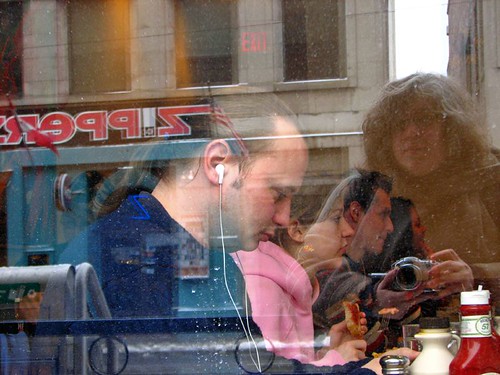
How people get caught into the river of lifestreaming
The Facebook homescreen (which came to life in late 2006), certainly gave the lifestreaming concept a big jump forward by forcing it on their users. Arguably, you could say blogs started it all – but it’s not quite the same as what Twitter is creating.
With Twitter, people usually start hesitantly and confused. They send messages, and drop a few personal insights into their life, because they realise that’s what other people are doing. As they acquire followers, they develop a more persistent relationship with their service. They realise the value of connecting with new people, which happens as they develop their social melebrity status. There is a sense of status in the fact hundreds of people willingly follow you – with status being a core human aspiration. They get hungry: they want more followers.
How a race distracts from the behaviour you then permit
What Aston Kutcher did is typical of what all Twitter users do, albeit on a smaller scale (ie, increase their following). The fascinating thing about this, is that people forget that they are now chasing an endless tail, which further entrenches them into the lifestreaming phenomenon.
Twitter requires people to explicitly share. The focus on this core activity, makes people attempt to create a witty message or one that people value. They get caught up in participating in lifestreaming, completely forgetting and then accepting (if confronted) what they’ve lost.
That being, we’ve now given up the thing people most freak out about in electronic communications: our anonymity and privacy in the world.
As more and more people get onto Twitter, and as more celebrities get caught up in it which will bring the non-tech world into the fold – watch this phenomenon. The natural cycle of a Twitter user, which eventuates in follower acquisition to increase their sense of status, is actually opening up a world I never thought would actually happen.
One where we share our inner most thoughts and details in life, because psychologically, we feel compelled to.
Think about that last sentence for a bit. That’s kind of crazy.
Except…we are not motivated by number of followers (at least most of us aren’t – that’s mostly a sideshow game). We follow ppl who are funny/ interesting/ different. We actually come to care for some of the ppl we follow. I’m also not sure there is much sharing of ‘inner thoughts’. Just me.
Well with inner thoughts, you have to admit people say some fairly private things. Simple things like “I’m awake now”, “at xyz”, “eating abc”. Before I posted this entry, I actually looked at my stream and counted a quarter of them to reveal things about their lives that quite frankly didn’t need to get revealed.
As for not being motivated by followers, I have to say neither am I. But I do know for a fact people adapt their behaviour to gain them – like just yesterday, a friend told me his strategy of gaining more followers was by replying a lot to people (and so other people would notice that).
I’d be interested to know how long you have been using Twitter and how active you are.
I’d argue that we’ve always been compelled to share our thoughts, it’s only now that the tools are catching up to it. The main difference the new tools have to older forms – reach.
I’d also point out that most Twitterers don’t use it like the early adopters. The numbers they follow and are followed by is much smaller compared to those that have been on the service for 2-3 yrs now. That might change given time, but I doubt it. Early adopters had the advantage of belonging to a small community with a common interest (speaking very generally). That doesn’t hold true for newer users. Will be interesting to see the usage trends from now.
Interesting article – and thanks for using my photo. It would be nice, however, if you could include credits for the photos you use!
Cheers!
As I said to Jon privately, this is my approach.
I provide a link directly back to the source photo’s location, in the absence of someone not directly mentioning how they want attribution (which is consistent with the creative commons default approach). If you would like direct attribution on my blog post under the image I use, let me know how you want it and I will reflect that accordingly.