 Google has announced a new technology that is arguably the boldest invention and most innovative idea to come out in recent years for the Internet (full announcement here).
It has the potential to replace email, instant messenging, and create a new technical category for collaboration and interactivity in the broadest sense. However hidden in the details, is a dirty little secret about the practicality of this project.
Google Wave is transformative, but it also is a technical challenge. If adopted, it will entrench cloud computing and ultimately Google’s fate as the most dominant company in the world.
The challenge in its development
For the last two years, the Google Sydney office has been working on a “secret project”. It got to the stage where the office – which runs the Google Maps product (another Sydney invention) – was competing for resources and had half the office dedicated to developing it. So secret was the project, that only the highest level of Google’s management team in Mountain View knew about it. Googler’s in other parts of the world either didn’t know about it, or people like me in the local tech scene, knew it was something big but didn’t know what exactly.
However although I didn’t know what exactly it was, I was aware of the challenge. And basically, it boils down to this: it’s a difficult engineering feat to pull off. The real time collaboration, which is at the core of what this technology provides, requires computationally a huge amount of resources for it to work.
It needs everyone to use it
Although we are all digging into the details, one thing I know for a fact, is that Google wants to make this as open as possible. It wants competitors like Microsoft, Yahoo and the entire development community to not just use it – but be a big driver in its adoption. For collaboration to work, you need people – and it makes little sense to restrict it to only a segment of the Internet population (much the same like email). Google’s openness isn’t being driven out of charity, but pure economic sense: it needs broad-based market adoption for this to work.
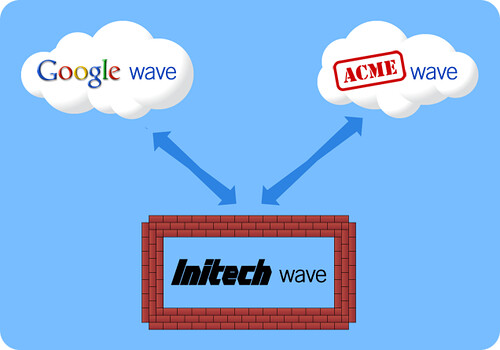
Only few can do it
However, with lots of people using it comes another fact: only those with massive cloud computing capabilities will be able to do this. Google practically invented and popularised the most important trend in computing right now. A trend where the industrial age’s economies of scale has come to play – reminding us that there are aspects of the Information Economy that are not entirely different from the past. What Google’s Wave technology does, is give a practical application that relies on cloud computing for its execution. And if the Wave protocol becomes as ubiquitous as email and Instant Messaging – and goes further to become core to global communications – then we will see the final innings to who now runs this world.
Wave is an amazing technology, and I am excited to see it evolve. But mark my words: this open technology requires a very expensive setup behind the scenes. And those that will meet this setup, will be our masters of tomorrow. Google has come to own us due to its innovation in information management – now watch Act II as it does the same for communications.

Tangler?
The Tangler team certainly has this vision, but they didn’t have the focus to execute specifically on this regard. But interesting point, especially given they are both Sydney efforts and the community is fairly small.
As soon as I saw the demo I thought of Tangler.
Also in the demo they didn’t mention anything about integration with email. It’d be great if you could just convert your Gmail account to a Wave account. That way you’d have all your email history in one place.
It isn’t clear as well if you’ll be able to send emails from Wave but I’m assuming that you will be able to otherwise it will just replicate the frustration of Facebook where you can’t contact people who aren’t in the “walled garden”.
Agree with you Elias about the size of the computation resource on the scale that google want to deliver this. A lot of this comes down to the use of a technology called Operational Transformation – this brings a functional programming approach to state management versus the traditional “data structures” approach – what this means is that the current state at any point in time is a series of functions executed in order to calculate the required state at that point in time. It would be interesting to see how much of this state is calculated each time or most likely just a set of snap shot’s where calculates from that point in time are just applied to pre-cal’d snap shots – either way, its serious stuff. Also, it will be interesting to see how easily the use of operational transformation is exposed to developers – is there a change required in the way applications are developed or does wave just make this happen for you.
As others have also said – it looks a lot like Lotus Notes refactored for everyone (instead of a document database in the back end , its this store of operations/functions that capture state – maybe that was the bit lotus needed – and the fact that notes was invented in an era where computers didn’t even have proper networking.).