Frequent thinker, occasional writer, constant smart-arse

Category: Internet (Page 2 of 8)

Bitcoin makes sense for the future

Bitcoin fascinates me. Whether it’s the future of currency itself I don’t know, but it will pave the way for the future so it’s worth studying.

There are two reasons that people claim make Bitcoin flawed.

The first is that it’s based on ECDSA (Elliptic Curve Digital Signature Algorithmwhich consists of a private key (a secret number known only to the person that generated it), a public key (a number that corresponds to a private key which is calculated from the private key but that is very difficult with current computing to reverse engineer to predict a private key), and a signature (a number that proves an operation took place that  used a hash and the private key). Values can be determined without the private key ever being disclosed, so that a bitcoin can correspond to a public ledger to prove the authenticited of ownership — for example, an algorithm can determine with the public key on a signature to determine it was produced by a hash and the private key, without needing to know the private key.

And so the critique goes, if someone can build a sufficiently powerful quantum computer, Shor’s algorithm will enable someone to steal bitcoin’s at will as they can crack the secret of someone’s private key. But basically, it’s practically impossible for this to happen. I’m not crypto expert, but I’ll leave this for others to digest further.

The second critique is due to the known limitation that bitcoin will one day cap at 21 million units. If bitcoins go missing, we will never be able to replace them — such is the case with physical currency today which goes out of circulation (but a central authority issuing it can reprint them). And inherently, Bitcoin is considered to be deflationary — the problem with deflation is the decreased price level of goods and services. Meaning, because it’s got a future guaranteed scarcity it will get scarcer and lead to deflation so therefore it’s doomed.

This is what I want to explore further because it’s worth clarifying some fundamental assumptions about the world.

What is value?
Let’s start with a functional definition of value. “Value is energy applied to resources where the perceived utility of the output is more than the inputs.” That definition implies there are three sources of value in the world: energy, resources, and outputs that have used the application of energy on resources and becomes a transformation. And the utility of a transformation, is different from say energy and the resources that went into it, simply due to perception of it. Basically, value is at core about utility.

Resources are finite: we only have a limited amount on earth that we can use. And most of it is not usable, as we don’t have the capacity to extract the resources in a usable way. Energy on the other hand, by the human definition, is unlimited — the sun sends 1.KW for every square metre of the earth surface for free. But what limits energy is the ability to capture it, store it and transport it — so therefore energy has value. We need energy to function: animal and plant life need it to function, and we need it to extract resources as well as apply it to transform resource into new products.

Is energy in itself valuable? Well, only if we use it: if a plant sits in the sun, it’s free — as does a human who will get Vitamin D that helps it function. Just because it’s free though doesn’t mean it doesn’t have value: it’s just the price is low. Humans also need other vitamins to survive, and it requires the expenditure of energy to acquire future sources of energy — that energy could be valued as time to hunt down animals for example.

Do resources have value? If it’s utilised, it has value — and the more it’s used, the scarcer it becomes for other uses which is why it gets regulated by price when there are competing seekers of the resource. Like energy, the question isn’t if there is value: the issue is what is the price of that value. It’s how to price that utility to regulate its usage.

Theoretically, you could say the current available energy in the world that can be used and the current available resources are what is value in the world, as well as the products created through the transformation of resources with energy. Value is what the total utility in the world is. And if there are no competing uses of those pieces of value, then prices are practically nil: but once there is competing needs for limited pieces of value like resources, that’s when we see the price increase.

And that is, why fundamentally, all value is tied to scarcity: the scarcer the value (supply) and the higher the demand, the higher the price.  This is fundamental economic theory which is the study of how to best allocate limited resources in an world that is based on the assumption of unlimited wants — which theoretically, makes sense. What breaks down is that interpretation of the theory.

For example, it’s fine to say there are unlimited wants in the world — but that’s a assumption that says there will always be competing demands for resources so therefore everything needs a price. Which again, is fine: it’s just this assumption of an assumption needs to assume a more fundamental assumption: a price of zero doesn’t make something less valuable than the same resource which has a price of more than zero. If you can buy a diamond for $1 but it normally would be valued $1000, that doesn’t mean it’s less valuable fundamentally: it just has less competition and so therefore less cost to acquire.

What is currency?
Arguably, you could say the sum of value in the world is all the stored energy, available resources, and transformations in the world which has utility. The world’s currency system should be tied to that: if you could exchange all the value in the world, it should be equal that.

Currency should be a way to store value and transport it. The energy I applied with my time which created more perceived value than the energy itself in the form of knowledge,  I want to store for a future use where I can exchange that for something of similar value. Therefore, a currency needs to have a consistent form of pricing (to make value comparable) and it ideally has a stable means of being valued (ie, storing it a year ago should theoretically be valued as the same as storing it today).

But the hard thing about utility  is that it’s hard to measure at the one point in time –even though we know there is a fundamental fixed amount that can be used in the world. But that’s why the assumption that a currency should have a fixed supply makes perfect sense: the price mechanism of currency adjusts for changes in utility (assuming the supply of currency doesn’t degrade, which is another factor why modern day currency can adjust in value).

Bitcoin’s fixed supply
Which brings us to the question: does Bitcoin having a fixed supply make sense? Yes.

But what about the risk of “deflation” in the world due to a fixed supply? Well, it’s not that value in the world goes does — it’s just the pricing of that value might go down.

The above discussion I hope answers those questions.

And what about if there are missing bitcoin’s in the world, which creates a supply constraint on this new currency? Bitcoin’s are divisible up to 8 decimal places which means one bitcoin has 100 million components (yes, they have a name: called a “Satoshi”). Ignoring the clear economic incentive to not lose Bitcoin’s, lost coins get lost in the noise and this divisibility allows it to adapt. With 21 million final bitcoin’s divisible by 100 million, that means 2.1 quadrillion units of currency or Satoshi’s. To put that in comparison, in 2009 there was approximately 8.3 trillion US dollars in the world or 0.0083 quadrillion cents. If one cent was one Satoshi, that would be 2100 trillion US cents or 21 trillion US dollars.

Some say the value of the US economy to be 188 trillion dollars (different from GDP, which simply accounts for   spending in one year). Assuming the US economy in 2009 accounted for one quarter fo the world economy (based on GDP), we can assume the world has a price on the value in the world of about 750 trillion US dollars or 0.8 quandrillion.

If the total *value* of available Satoshi’s in the world one day equals that amount (One Satoshi equals 0.35714285714 US cents  or 750 trillion divided by 2.1 quadrillion) — then who cares if a few bitcoin’s get lost along the way. What we have now is a currency that does what currency is meant to do: store value for the exchange of value in society.

Fixing government with the Internet

” We hold these truths to be self-evident, that all men are created equal, that they are endowed by their Creator with certain unalienable Rights, that among these are Life, Liberty and the pursuit of Happiness.–That to secure these rights, Governments are instituted among Men, deriving their just powers from the consent of the governed, —That whenever any Form of Government becomes destructive of these ends, it is the Right of the People to alter or to abolish it, and to institute new Government, laying its foundation on such principles and organizing its powers in such form, as to them shall seem most likely to effect their Safety and Happiness

— Declaration of Independence by Thomas Jefferson

One of the most interesting innovations in the evolution of democracy, is the concept of representative democracy: whereby a few are elected to make decisions on behalf of the population. The lower house of the Westminster System typically has representatives from electorates which are  groups of people clustered in geographies that form a critical mass, whereas the upper house represents a different class: in England, a plutocracy but in America, it was revised to give each of the states an equal vote (though, in is still a plutocracy with just a more accountable way of election).

Overall, I think this is a good model to keep. But with the growth of the party system around the world (which has become the way government is done, a critical function that ironically not defined in most constitutions), it has become broken: using America as the case in point, the Republican control of the lower house during Obama’s first term (and Democrat control of the Senate) had politics get in the way and risked the future of the country at a time when unity was needed the most. As Jefferson said, when a government becomes destructive of the ends, it’s the right of the people to alter or abolish it. The party system is failing our democracy.

The Pirates

A lot has changed in the last 10 years, let alone 100 and 1000 years when a lot of our democratic tradition has been written. In particular, the Internet has become a new force in our society that has transformed every industry that comes in its way. It will only be a matter of time when the government gets its own shake up and that time may becoming. Gregory Ferenstein wrote an interesting post recently on innovations thanks to the Internet, with the most interesting one below:

Pirate Party

They’re less fun than a boat full of drunken sailors, but more influential in Germany than many third parties are in the United States. After winning 15 parliamentary seats in Germany, the Pirate Party has developed an intriguing crowdsourced platform of decision-making known as “liquid feedback.” The trust-based voting system permits members to leave decision-making to those they know are more knowledgeable, while preserving the inclusiveness of direct democracy. The Pirate Party is currently expanding its ranks throughout the globe.

The liquid feedback platform may be the most powerful way to fix the current system of government. Imagine that we all have equal votes, but you trusted my views on the economy more than your own views — you could allocate your vote to me, where I could make it for you. Now let’s say I came to trust an economist on matters of policy, so I would allocate my vote, which includes yours, to that economist when she makes decisions (so in effect, her votes also counts on your and my vote). And so on: what we have here is representative democracy in it’s most beautiful form. It’s only now with the Internet can we allow a system like this to exist.

This is a system that could be built into the current governance of our society. And even better, it it doesn’t need to be written into the constitution, for it to have an impact: it could be done in parallel. A shadow government could emerge where people could nominate their votes to people who end up becoming super delegates on issues. The influence these delegates could be so powerful that it could trigger a vote of confidence on our elected leaders, not to mention additional accountability on their decisions as they are compared to a benchmark by the populace. Maybe even our elected representatives in the legislature could take inspiration for their decisions not by the party they are a part of, but by what the super delegates vote.

And perhaps, this could be the way we fix our democracy. Not by changing the system laid out by the constitution of great democracies in the world like America and Australia, but by changing the way our representatives organise their votes. No more liberal, labor, democrat and republican — but a liquid party, where the people who we elect into government under this banner promise to follow the direction of the population through the votes of the super delegates. Delegates determined by the liquid democracy platform that we all have access to anytime we want to vote on an issue.

The changing dynamics of news

In the recent controversy that has erupted due to the firing of Michael Arrington from TechCrunch, I believe it represents an era in innovation led by TechCrunch that we’re only starting to appreciate.

To start on this thought experiment, consider how four years ago (meaning, things haven’t changed) I wrote about the two kinds of content that exist: data like breaking news or archived news; and culture which includes analysis like editorials and entertainment such as satire.

UnderstandingI argue that each content form has unique characteristics that needs to be exploited in different ways. Think about that before digesting this blog post, because understanding the product (such as news) impacts the way the market will operate.

Some trends of the past
Over the last two decades, we’ve seen the form (and costs) of news be disrupted dramatically.

It started with hypertext systems that helped humans share knowledge (with the most successful hyperterxt implementation, the world wide web 20 years ago forever changing the world); search engines helping us find information easier (with Google transforming the world 10 years ago), and content management systems helping people reduce the costs of publishing to practically zero (with Moveable Type and especially WordPress driving this).

While the sourcing of news still requires unique relationships that journalists can extract to the world, even that’s changed due to social media that’s created a distributed ‘citizen journalism’ world. Related to this is a movement Julian Assange calls “scientific journalism” where the sourcing of news is now democratised and exposed in its raw form.

Some observations of the present
With that, I’ve noticed two interesting things about the tech news ecosystem, who are are helping shape the trends in news more broadly: tech bloggers kill themselves to break stories, to the point where blogs like TechCrunch have become cults for those that work there; separately, the rise of the news aggregators like TechMeme and HackerNews (or Slashdot and Digg before them) have built the audiences who have been overwhelmed by information overload and crave a filter from a quality editorial voice (the latter being why news personalisation technologies cannot work on their own).

The big secret (that’s not particularly secret due to the abundance of ‘share this’ buttons on webpages) about the news ecosystem is that it’s the aggregators who drive traffic to news outlets that report the news. When you understand that point, a lot of other things become clearer.

Content Aggregation infographic

On the other hand, tech entrepreneurs break their backs for the hope of getting written about on the Tech blogs. The reasons vary from getting credibility so they can recruit talent; exposure so they raise money; and a belief that they can acquire customers (the whole point of building a startup).

Which leads me to think despite all these random observations I’ve listed above, there is a fundamental efficiency evolving in news reporting that may give an insight into the future.

Let’s keep thinking. Other things to consider include:

  • The audience starts with the aggregators for news and the articles whereby the better headlines tend to perform better
  • News in its barest form is making awareness of an event (data); anything additional is analysis (cultural) which is to shape understanding around the event
  • The rise of ‘scientific journalism’ and social media allows society to discover and share information without a third party (due to technology tools).
  • Press releases are an invention to communicate a message so reporters can base their writing on, who often just copy and paste the words.

Some thinking about the future
News should be stripped to its barest form: a description of the event. It should be what we consider currently a “headline”, with preferably a link to the source material. Therefore professional journalists, bloggers, and the rest of the world should be competing to break news not on who can write the best prose but who can share a one line summary based on their ability to extract that information (either by being accidentally at the event or having exclusive relationships with the event maker). The cost of breaking the news should be simply a matter of who can share a link the quickest.

News Article - Wichita Falls Record News

Editorial, which is effectively analysis (or entertainment in some cases) and what blogging has become, should be left to what we now consider as “comments”. Readers get to have the “news” coloured, based on a managed curation of the top commentators.

Tying this together: Imagine a world where anyone could submit “news” and anyone could provide “editorial”? A rolling river of news of submitted headlines and links, and discussions roaring underneath the item reflecting the interpretation of the masses.

You could argue Twitter has become the first true example of that where most content is in full public view but with a restricted output (140 characters); people can share links with their comments; and the top stories tend to get retweeted which further gains exposure. Things could be similarly said about Digg, Reddit and Hacker News. But these services, along with Twitter (and Facebook) are simply an insight into a future that’s already begun. I think they are just early pioneers before the real solution comes, similar to how Tim Berners-Lee created a hypertext system in a saturated market that then became the standard; Google created a search engine in a saturated market that then became the standard; and WordPress created a blogging platform in a saturated market that then become the standard. Lots of people have tried to innovate in the news ecosystem, but I still don’t think the nut’s been cracked.

News has a lot of value, but there is different value based on who breaks it and who interprets it. For example, when I fire up some of my favourite aggregators, I tend to not click on the original headline but on brands I like so as to read their take on the event (though when I’m deeply looking into something, I dig for the source material). But the problem with news now, is there is a fundamental disruption on the cost structures supporting it: the economics favour those who break the news, with those that interpret news suffering as traditionally both these roles were considered the one function. Something’s going on and the answer is cheaper production, faster distribution and more of a decentralised effort across society and not the self-appointed curators.

While the newspaper industry is collapsing, something more fundamental is happening with news and we’re simply in the eye of the storm. Stay tuned.

Why ICANN’s changes to TLD matter

ICANN two months ago made an announcement that domain names can now be extended beyond the generic TLD’s set (they also are allowing the use of non-Latin characters such as Cyrillic, Arabic, Chinese, etc). Meaning, instead of everyone competing to get a “.com”, people can buy “.yourbrand” and create websites off that. I think it’s brilliant — Ester Dyson, the founding chairperson of ICANN, doesn’t agree.

As someone that’s developed multiple online properties, organisations (both for-profit and not-for-profit) and had people try to rip-off several brands I’ve created, I’ve experienced enough to welcome this as a huge step forward — and here’s why.

ICANN’s strategy originally wanted to disrupt a market place player, which is why they assigned these generic TLD’s like .org and .net (.com was controlled by a corporation). But what matters now is not the historical reasons but what will benefit the world based on historical experience (and failed strategy). That benefit is better consumer protection and reduced costs of business.

Let’s rethink this
Consider the following:
(1) The purpose of a trademark is to allow customers the ability to distinguish what they are buying. It’s for the customer’s protection first.
(2) A domain name is simply a human-intelligent way to to access ip address. Whether it’s apple.com or apple.eats.microsoft — the point isn’t one of branding, but for humans to be able to identify a resource they seek.
(3) While there are plenty of domain names available, good ones no longer exist. There is a bias to having a “.com” and it’s why many companies from the web2.0 era had to resort to creative domains like del.icio.us and missing vowels like flickr.com

What the historical DNS system has done is create an unnecessary scarcity where domain name registrars and brokers of ‘premium’ domain names benefit. Having a company own the name space like “.IBM” makes perfect sense because “.com”, “.org”, and “.net” have lost their original meaning of distinguishing “commercial” businesses over “non-profits” and the like.

What matters more is that when a consumer wants the comfort of the company they seek, they can do it with the assurance it’s correct. “.paypal” for example could have huge implications for fraud detection for consumers (some fraud is done due to misspelled domains similar to the target or switching .com with another TLD). Better still, it actually decreases the cost of businesses for companies because they no longer need to chase the unlimited TLD variations of their name to protect their brand — which they only did so, so they wouldn’t lose customers confused by confusing branding.

ICANN’s changes are a radical change, but they are perfectly in line with the original intent of trademark law. Sorry Ester, but you’re wrong on this one.

Veokami is an awesome new concert video curating service

I’ve been in America now two years (wow!) and one of the best things that’s happened to me since moving here is being involved in the Aussie community of entrepreneurs in Silicon Valley (which actually is filled with New Zealander’s as well!). I don’t know all the Aussies, but the ones I do know have entirely justified the life-changing decision I made to move to America: the combined economic impact this group have had and will have in the next decade on the Australian, Kiwi and US economy really is amazing.

So it’s exciting to see one of my good friends and upcoming entrepreneur’s in the group Brett Welch strike it out on his own with his startup Veokami. Chris Hartley and Brett have built this funky piece of technology that aggregates all the video taken from a concert. For example, hundreds of people will record a show with their camera phones now and some upload it to youtube. Veokami synthesises all these videos and puts them in a timeline, so that it not only will organise the songs in a timeseries order, but will put them parallel to the timeline with videos shown from a different perspective. It’s like watching a TV recording of the concert, with you being able to switch camera angles…except the difference is, all this video is automatically organised and the video comes from hundreds of amateur footage shared by the Internet.

Check the video below for a sneak peak. And please vote for them on the hacklolla challenge as I’d love to see this service get integrated into concerts around the world, which further enables the power of the Internet and computing to transform our lives. It’s tools like this that put more power in the hands of the consumer and that alone is a reason why we should be supporting startups like this.

The potential of this technology really is interesting when you consider any public organisation of people — from political rallies to conferences to parties — the ubiquity of mobile camera’s now is unleashing a new collective intelligence in our world and Veokami helps stitch that intelligence together in a curated way.

There’s something about you turntable.fm

Three weeks ago, Turntable.fm became the hype in the echo chamber. Like I do with everything, I’m been observing and reflecting on how it’s being used by other people and myself. In short, I like it. It’s such a simple idea that could further disrupt the traditional radio business.

What it is
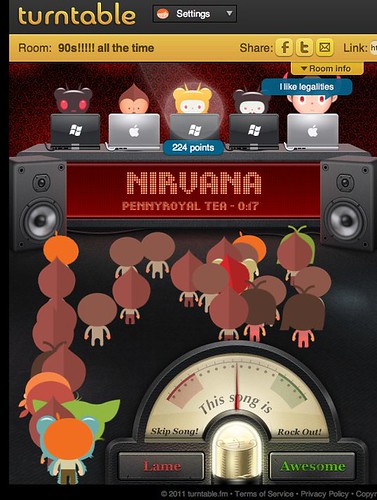
For the uninitiated, it’s an an Internet radio station, with a quirky web page that people interact in. People either sit in the room bopping their heads (approving the music) or people put themselves in the DJ chair and compete against another 4 DJ’s for the best tunes according to the room theme.

Turntable: room

My first observation: Spotify will kill it. Or not.
While they appear to be completely different, I keep thinking about my Spotify experience a year ago when I was in Europe: I was hooked. And it was for the same reason — I could subscribe to a friends playlist (turntable I can follow a friend and hear when they play). The benefit is that I can get filtered serendipity and discovery, like how radio has done for decades. (For example, you may love a particular kind of music but have no idea what the latest tracks are or the time to curate playlists — but you have friends who do so would rather follow their enthusiasm.)

Turntable’s cool, but I keep thinking it’s Myspace and Spotify is Facebook. When Spotify launches in the US (rumoured to finally be this month), then turntable’s core value in providing this discovery will be replaced as Spotify is just an amazing service. But I’m not so sure about that now, as actually it might be away where playlists in Spotify get generated so it’s completely complementary.

My second observation: it’s competitive curation
In this explosion of social media, people are starting to appreciate the role editors played in the traditional media. Curated content is a skill that algorithms still can’t beat humans at (and actually, the best kinds are based off existing human preferences).

With Turntable, you select a room and sit there listening to the music. People compete for the “DJ” spot at the table (of which there are a maximum of 5). A chat room allows people in the room to chat like the old days of IRC and give direct feedback to the DJ’s or discuss music. The vote meter helps regulate the quality of music as high votes not only impact the DJ’s rating but down votes can cut the song being played and move onto the next DJ’s track.

This motivation to please the crowd means there is an active effort to curate the playlists into something worthwhile. That’s an interesting concept to consider, as playlists in past have tended to be done by people along without real consideration of others listening to it (or at least, real time feedback to consider it).

My third observation: it’s social, like the Athenian assembly social
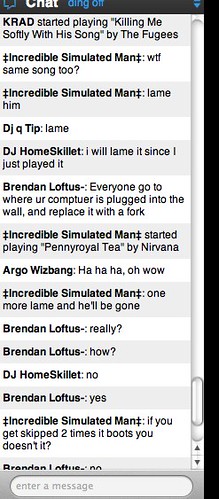
Turntable: chatroom

I don’t fully understand why yet, but the chat room aspect is the most powerful component of the experience despite being the most subtle. While the voting mentioned in my second observation creates a motivation to enhance their DJ reputation by playing good music, the chatroom makes this curation directly in touch with the audience.

It’s like a democracy, where those representing and controlling the room’s music are actually completely dependent on the goodwill of the audience. The voting is the main way this is enforced, but the chatroom is where people will negotiate. Games will be determined where certain patterns in music will be played; feedback of bad songs will be given to DJ’s; and requests will be sent. It’s like a radio station completely accountable to its audience.

Like Twitter, the service will evolve based on these discussions. Some of Twitter’s most useful features like @ replying (which turned it into a communications tool) and hashtags (which turned into into a information resource) were invented and popularised by their most passionate users. Turntable.fm offers a similar utility around music and I think will evolve in a similar way. Like any startup, it’s hard to know where turntable.fm will be in six months time, but one things for sure: it’s sticky and it’s only going to get better.

Platform growth over user privacy

Facebook announced that data about yourself (like your phone number) would now be shared with applications. Since the announcement, they’ve backed down (and good work to ReadWriteWeb for raising awareness of this).

I’ve been quoted in RWW and other places as saying the following:

“Users should have the ability to decide upfront what data they permit, not after the handshake has been made where both Facebook and the app developer take advantage of the fact most users don’t know how to manage application privacy or revoke individual permissions,” Bizannes told the website. “Data Portability is about privacy-respecting interoperability and Facebook has failed in this regard.”

Let me explain what I mean by that:

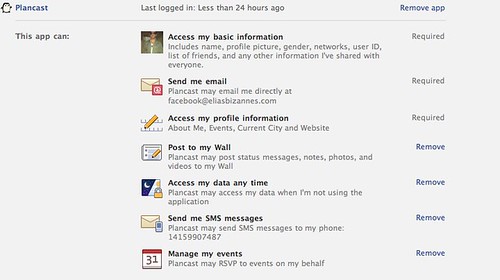
This first screenshot is what users can do with applications. Facebook offers you the ability to manage your privacy, where you even have the ability to revoke individual data authorisations that are not considered necessary. Not as granular as I’d like it (my “basic information” is not something I share equally with “everyone”, such as apps who can show that data outside of Facebook where “everyone” actually is “everyone”), but it’s a nice start.

http:__www.facebook.com_settings_?tab=applications

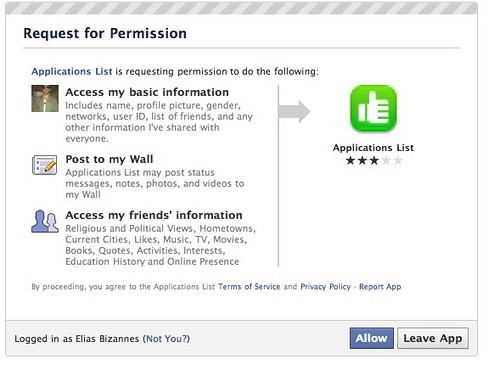
This second screenshot, is what it looks like when you initiate the relationship with the application. Again, it’s great because of the disclosure and communicates a lot very simply.
Request for Permission

But what the problem is, is that the first screenshot should be what you see in place of the second screenshot. While Facebook is giving you the ability to manage your privacy, it is actually paying lipservice to it. Not many people are aware that they can manage their application privacy, as it’s buried in a part of the site people seldom use.

The reason why Facebook doesn’t offer this ability upfront is for a very simple reason: people wouldn’t accept apps. When given a yes or no option, users think “screw it” and hit yes. But what if they did this handshake, they were able to tick off what data they allowed or didn’t allow? Why are all these permissions required upfront, when I can later deactivate certain permissions?

Don’t worry, its not that hard to answer. User privacy doesn’t help with revenue revenue growth in as much as application growth which creates engagement. Being a company, I can’t blame Facebook for pursuing this approach. But I do blame them when they pay lipservice to the world and they rightfully should be called out for it.

Quora will give stock options to celebrities, reject a Google acquisition

It’s a private company so we may never know. But one thing that’s clear, is that the circumstances surrounding its growth are mimicking things we’ve seen in the last few years. The below are some specific thoughts on where I see Quora heading in 2011 and beyond.

1) Its growth will be driven by celebrities
A year ago, I asked if Twitter gave stock options to celebrities, which would explain the bizarre trend that had celebrities embrace the service. I’m willing to bet money they did.

Steve Case, the billionaire founder of AOL, recently has been actively answering questions on Quora, and it is awesome to see the responses. Now imagine if this domain knowledge in tech was expanded to people asking questions about celebrities? Let’s not forget Twitter started as a tech industry thing (I was told in May 2007, when I first started networking in the Sydney scene, that it was the ‘thing’ I had to have to have credibility) — it was a way to network in tech and track interesting people. Thinking back, it was transformative because successful people in tech were now accessible to new upstarts like me. In the years to follow, we saw Ashton Kutcher’s CNN race for one million followers combined with the Oprah moment, that suddenly saw it become mainstream, transformed into a way to track your favourite celebrities which is what drives its growth now.

So imagine if Quora gave stock options to all the interesting people of the world and they started answering questions? Imagine it being a direct way to interact with elected officials? Keep reading, this is not the first time we’ve seen this.

2)It will break news and information
Quora did something interesting a few months ago: it helped unravel some big news in the industry. It will do this again.

Its recognition in the mainstream (give it 2 years at least) will be if two things can occur: a massive tragedy occurs that uses Quora as a form of distributing reporting and citizen journalism; and the 2012 presidential candidates use it as a way to engage with voters. Who knows, maybe 2012 is too soon but like Twitter, it will be those two kinds of events that will make it mainstream. (For context on this, read my post from two years ago which explains the origins and rise of social media.) The service is perfectly setup to cater for both situations in a way that exceeds both the ability of Facebook and Twitter, its cousins in the social media world that is driving this broader trend in the world.

3) Google will try to buy them
Quora’s “social” competency complements Google’s lack in that area. Which ironically, is because both founders were early and senior employees of Facebook…the same reason I believe the Obama campaign led to him becoming the first social media president (as another early employee and “co-founder” of Facebook, Chris Hughes, was responsible for Obama’s Internet strategy).

Google is trying really hard to catchup on social, an area Facebook dominates and what will lead to Google losing its leadership in the industry. Despite all the rumours of its internal social networking initiatives, the numerous products launched so far have all been ordinary. And it’s for good reason: Google doesn’t get social. It can’t, it’s not in its DNA.

Google has an engineering culture where decisions are made based on data. Google’s former top designer quit because of “a design philosophy that lives or dies strictly by the sword of data”. Rather than trust the talent of its designers, it instead would over-rule decisions based on user metrics — which in a conversion business, makes sense. But the thing about user experience, its about shaping new behaviours rather than relying on existing patterns.

Which interestingly, is what Quora is excelling at: its user experience is inspiring the entire industry (like the Angel List crew, who in turn are inspiring an entire industry). That’s an impressive thing to do as a startup, and shows innovation in an area that is key to engagement — engagement that Google can’t seem to get.

4) They will decline a Google acquisition and do a licensing deal instead
Quora has very rich content, the stuff that make Google searches a lot more interesting. Google validated it is interested in the social search area with the $50 million acquisition of Aardvark. Quora in my eyes, would be a perfect fit for the same goal Google has but due to a different approach.

Google makes its money on specific types of searches, which are transactional searches — when you are looking to buy something (say a flight) as opposed to informational (like what’s the capital of Australia). But it’s always been the informational searches that drive usage of the Google search engine, as Google is a one-stop-shop for answers. Quora is like the structured blogging equivalent of Wikipedia, which is gold in the eyes of Google.

Which is why I believe they will go down the path of Twitter, which successfully played off both Google and Bing (Microsoft) with a licensing agreement to show Tweets in searches, a functionality that allowed the search engines to claim they were now “real time”. They will want to do this with Quora, because the questions on Quora mimic searches people make and the answers offer a treasure trove of curated answered by real people.

Conclusion
I could be wrong. Regardless, even if it doesn’t succeed like how I think it will, expect the startup to make a lot more noise in 2011 beyond the current cries of people saying this last week has seen a tipping point. The big blogs will continue to talk about it, and new journalists are now discovering it, only to compound my original complaint of lazy journalism.

That’s impressive and which will guarantee the noise through to 2011. That’s because all communication innovations tend to do so, and Quora is the new kid on the block that will drive that disruption.

Why blogs are turning into newspapers and Quora is the future of journalism

MG Siegler wrote a post following our exchange on Twitter. I called him out because for the second time that day, I had logged into Quora only to see minutes later a TechCrunch post being Tweeted that was rehashing the original Quora discussion. Is this the future of journalism?

Blogging 3.0
Siegler wrote an eloquent post expanding on my original jibe that he was practicing blogging 3.0 (I called it that as over the years Marshall Kirkpatrick would constantly joke Twitter is what paid his rent). Now don’t get me wrong: Quora is one of my favourite websites right now, and Siegler (as well as Kirkpatrick) are two of the more talented writers in the blogosphere. But it made me wonder: what’s the role of the journalist in the world, and by implication, the news blogger?

For the bloggers out there who receive bonuses by getting headlines on Techmeme — what’s stopping Gabe Rivera (Techmeme’s founder) from simply importing the RSS feed of Quora posts and having its human editors headline the best answer? As Siegler points out, he (worryingly) already has. Given Quora responses are like blog posts and get aggregated into a community wiki-like answer summary, I can’t see why this won’t become a new input source for Techmeme, completely bypassing the traditional blogs.

And while we are on the topic: Julian Assange of Wikileaks argues that they are pioneering a new form of journalism, which he recently argued in an editorial for The Australian, as “Scientific journalism“. Scientific because you can read the source of the material in its naked form or accompanying an article that discusses the source.

Source material is democratised
Journalists, it is said, are becoming curators of information. Siegler claims he has retrieved information from an obscure source, amplified it, which in turn will be broadcasted by a bigger publisher like CNN. But if Quora democratices the source gathering — it’s so obscure that everyone in Silicon Valley is on it, include billionaires like Steve Chase who founded AOL and Mark Zuckerberg of Facebook — what’s stopping me from “breaking” the apparent news? Or Rivera from doing a direct RSS import of the top answers, direct to his audience of thousands?

If the big blogs are traffic hungry that have them reliant on the aggregators like Techmeme to feed their pageviews….And if this trend to scientific journalism is being promoted, where journalistic bias adds colour to a source only if you want (rather then the bias being the source of your information consumption) — then one has to ponder. That the evolution of journalism will come not from changes in journalistic style, but by changes in technology — an evolution where every single one of us can talk openly about the world and in an applied way.

Siegler says this is business as usual for the bloggers, but I think it’s business as usual for the disruption technology is generating for the news making business. Disruption that will continue to favour those who tease out the source of news (like Quora, Twitter and Wikileaks has) and those who curate it into an efficient way to consume (like aggregators such as Techmeme, Google News and Digg).

The future of journalism resides with those that create the originating value: traffic or content
Before the Internet, newspapers were the sole source of information and so had an elevated role in society. Now they are being relegated to just one of the many sources of news; once considered a horror if they disappeared, they would not impact the world if they went bankrupt today (as there are plenty of online mastheads to replace their value). As social media technologies continue to be refined — where the participants curate the source material themselves — blogs will not disappear like how newspapers won’t disappear. But their position in the world is far from guaranteed, as the audience curation is being done better by the aggregators and the source material is now no longer proprietary to a journalist.

The new magazine

The Facebook homescreen is a remarkable thing. I just saw a video of a friend throwing food at birds; relatives taking pictures of themselves in a hot tub; a link to a mind-expanding article; and a status message that made me laugh. It made me think: the homescreen is the new magazine.

Sure, we can be simplistic with this and say lots of pictures and content makes thee a magazine. But what strikes me as fascinating is how much personal content is shared. People’s thoughts, insight into their lives, and the real-time autobiographical dictation by our “friends”. It makes me think of the fascination people have with celebrities, and how gossip magazines are some of the highest grossing of their kind. The same phenomenon is being exploited here — which is people want to know more about people they know. While with celebrities you could potentially say people do it due to a fixation on celebrity status and looks, I would argue the reason gossip magazines are so popular is due to the curiousity into the lives of people who are familiar. People would be equally fascinated with a magazine about celebrities as a magazine of their neighbours, if it was practical.

It’s almost like Facebook’s homescreen is the new media version of a publication. But of your friends. And like a glossy magazine. Of original content from otherwise hard-to-obtain situations.

Or more practically speaking, like a gossip magazine of your neighbours.

« Older posts Newer posts »