Frequent thinker, occasional writer, constant smart-arse

Category: Internet (Page 7 of 8)

On the future of search

Robert Scoble has put together a video presentation on how Techmeme, Facebook and Mahalo will kill Google in four years time. His basic premise is that SEO’s who game Google’s algorithm are as bad as spam (and there are some pissed SEO experts waking up today!). People like the ideas he introduces about social filtering, but on the whole – people are a bit more skeptical on his world domination theory.

There are a few good posts like Muhammad‘s on why the combo won’t prevail, but on the whole, I think everyone is missing the real issue: the whole concept of relevant results.

Relevance is personal

When I search, I am looking for answers. Scoble uses the example of searching for HDTV and makes note of the top manufacturers as something he would expect at the top of the results. For him – that’s probably what he wants to see – but for me, I want to be reading about the technology behind it. What I am trying to illustrate here is that relevance is personal.

The argument for social filtering, is that it makes it more relevant. For example, by having a bunch of my friends associated with me on my Facebook account, an inference engine can determine that if my friend called A is also friends with person B, who is friends with person C – than something I like must also be something that person C likes. When it comes to search results, that sort of social/collaborative filtering doesn’t work because relevance is complicated. The only value a social network can provide is if the content is spam or not – a yes or no type of answer – which is assuming if someone in my network has come across this content. Just because my social network can (potentially) help filter out spam, doesn’t make the search results higher quality. It just means less spam results. There is plenty of content that may be on-topic but may as well be classed as spam.

Google’s algorithm essentially works on the popularity of links, which is how it determines relevance. People can game this algorithm, because someone can make a website popular to manipulate rankings through linking from fake sites and other optimisations. But Google’s pagerank algorithm is assuming that relevant results are, at their core, purely about popularity. The innovation the Google guys brought to the world of search is something to be applauded for, but the extreme lack of innovation in this area since just shows how hard it is to come up with new ways of making something relevant. Popularity is a smart way of determining relevance (because most people would like it) – but since that can be gamed, it no longer is.

The semantic web

I still don’t quite understand why people don’t realise the potential for the semantic web, something I go on about over and over again (maybe not on this blog – maybe it’s time I did). But if it is something that is going to change search, it will be that – because the semantic web will structure data – moving away from the document approach that webpages represent and more towards the data approach that resembles a database table. It may not be able to make results more relevant to your personal interests, but it will better understand the sources of data that make up the search results, and can match it up to whatever constructs you present it.

Like Google’s page rank, the semantic web will require human’s to structure data, which a machine will then make inferences – similar to how Pagerank makes inferences based on what links people make. However Scoble’s claim that humans can overtake a machine is silly – yes humans have a much higher intellect and are better at filtering, but they in no way can match the speed and power of a machine. Once the semantic web gets into full gear a few years from now, humans will have trained the machine to think – and it can then do the filtering for us.

Human intelligence will be crucial for the future of search – but not in the way Mahalo does it which is like manually categorising pieces of paper into a file cabinet – which is not sustainable. A bit like how when the painters of the Sydney harbour bridge finish painting it, they have to start all over again because the other side is already starting to rust again. Once we can train a machine that for example, a dog is an animal, that has four legs and makes a sound like “woof” – the machine can then act on our behalf, like a trained animal, and go fetch what we want; how those paper documents are stored will now be irrelevant and the machine can do the sorting for us.

The Google killer of the future will be the people that can convert the knowledge on the world wide web into information readeable by computers, to create this (weak) form of artificial intelligence. Now that’s where it gets interesting.

Google: the ultimate ontology

A big issue with the semantic web is ontologies – the use of consistent definitions to concepts. For those that don’t understand what I’m talking about – essentially, the next evolution of the web is about making content readable by not just humans but also machines. However for a machine to understand something it reads, it needs consistent definitions. Human’s for example, are intelligent – they understand that the word “friend” is also related to the word “acquaintance”, but a computer would treat them to mean two different things. Or do they?

Just casually looking at some of my web analytics, I noticed some people landed on my site by doing a google search for how many acquaintances do people have, which took them to a popular posting of mine about how many friends people have on facebook. I’ve had a lot of visitors because of this posting, and its been an interesting case study for me on how search engines work. However today was something different from other times: I found the word acquaintance weird. I know I didn’t use that word in my posting – and when I went to the Google cache I realised something interesting: because someone linked to me using that word, the search engine replaced the word ‘friend’ with ‘acquaintances’.

acquaintances

Google’s linking mechanism is one powerful ontology generator.

Facebook poll: how many friends do you have?

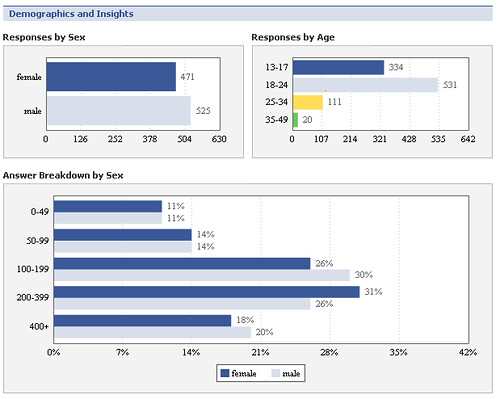
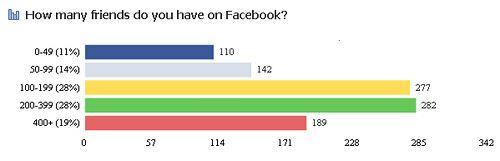
One of Facebook‘s new features is the ability to create surveys, targeted to certain groups of people within the community site. One caught my eye today, which asked 1,000 random people “How many friends do you have?”. Although I am not sure of the conditions this poll was conducted under (ie, did only Australian’s see it?), 1,000 random people should theoretically be a fairly representative sample of the entire population.

Whilst the results immediately show some interesting information on the typical size of a person’s network (which is a discussion in itself), I am equally fascinated by the specific genders and age breakdown of people who answered the poll and the correlation with their network size. One theory I have of why people spend so much time on the site, is because people ‘collect’ friends. They are constantly discovering old friends through mutual friends – a friend’s list leads a person to another profile where they may discover someone they have lost touch with. Check the results first, before I continue:

Poll on

Facebook poll breakdown

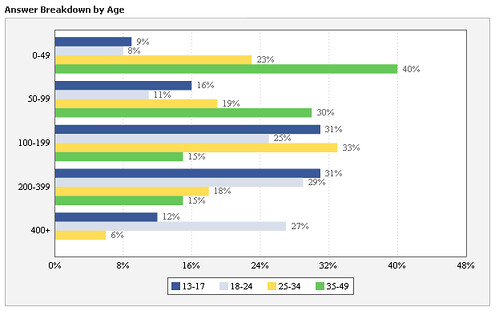
Facebook poll breakdown by age

Some of my interpretations of the results

  • Despite being open to anyone since late last year, university students still dominate the site as over half the survey was answered by people in the 18-24 age bracket
  • About 46% of males and 49% of females have over 200+ people. It’s impossible to have 200 ‘friends’ – no one can physically see 200 friends on a regular basis This tells me Facebook is now more about ‘contacts’ and keeping in touch with people you know. This makes it more than just a closed network of your close friends and more of a networking tool – validating what some commentators have been saying of late. I could spend a whole blog post explaining the implications of this, but basically, this means facebook is ‘the’ social networking site now and it’s only going to get more entrenched due to the law of cumulative advantage.
  • Of people aged 35 and above, 70% have under 99 friends – which is only the case of 41% of people aged 25-34, and 19% of 18-24. This is interesting, because the people in the 24+ age group didn’t have facebook when they were at university (which is why 18-24 is so dominant in this regard). Over time, you would expect the age groups to be fairly synchronised – in fact older people would have much larger networks. This tells me despite all the hype, Facebook is still not mainstream – there is a heck of a lot more growth to occur.
  • …and leading off where I started the blog posting: the fact that more males answered the poll (53%) – despite women generally outnumbering men in Western countries – implies men are more interested in knowing how many friends people have. So if you tie that with my ‘friend collector’ theory means more men spend time ‘collecting’…in other words, men stalk more!

Australia as Silicon Beach

In January, David Bolliger coined the term “Sillicon Beach” to refer to a bunch of Sydney based start-ups – continuing an international trend of regionalising hotspots of tech innovation that aspire to be like Sillicon Valley (my other favourite is New York as Sillicon Alley). Although it’s not the first time the term has been used, everyone from Perth, Melbourne, Newscastle, Brisbane, and the rest are claiming they are the real silicon beach.

So seeing as our population is only 20 million, and we are one big island continent anyway – I think I am going to settle with calling Australia’s tech industry as a whole as “Silicon Beach”.

Tangler

This is the second post in a series – wizards of oz – which is to highlight the innovation we have down under, and how the business community needs to wake up and realise the opportunities. I review Tangler, a Sydney-based start-up that has recently released their application to the world as a public beta.

Tangler is a web-service that enables discussions over a network. Think of discussions with the immediacy of Instant Messaging (it’s easy), but with the persistency of a forum (messages are permanently stored). Discussions are arranged into communities of interest (groups), which are further broken down into topic areas. Click here to see a video overview.

Value

1) It’s a network application. Although it’s got a great design, and looks like a funky website, the real power of this web service is what it’s working towards: discussions over a network. Imagine a little widget with the topic “What do you think of Elias Bizannes?” placed on my (external) personal blog, my internal work blog, my myspace/facebook/social networking page, as well as it’s own dedicated forum on the Tangler site. A centralised discussion, in a decentralised manner. That’s big.

2) It’s community has great DNA. Communities are not easy things to build – my own experience on a getting-bigger-by-the-day internal project has shown that it is a complex science, touching everything from understand motivational theory to encouraging the right kind of behaviours (policing without policing). My usage on the site has shown to me that the active community building currently occuring, is on the right track. Anyone can hire a code monkey, wack on some flashy front-end, and say they have a great product. But not anyone can build a strong community – even Google struggles on this (the acquisition of YouTube happened largely because of community, because the YouTube community beat Google’s own service). Tangler’s community is already turning into a powerful asset – the DNA is there – now it just needs exposure, and the law of cumulative advantage will kick in.

3) The founder and staff are responsive to its community. I posted a question on the feedback forum, to prove this point: I got a response in an hour, on a Saturday. The staff at Tangler are super responsive – which in part, is due to the real-time discussion ability of the software – but also because of their commitment. As I state above – the value of Tangler is the community of users it builds – this type of responsiveness is crucial to keep its users satisfied to come back, because it makes them feel valued. Additionally, the community is driving the evolution of the application, and that’s the most powerful way to create something (adapting to where there is a need by the people that use it)

4) It’s a platform. What makes Tangler powerful, is that it encourages discussions around niche content areas. Make that niche content, being created for free. Low cost to produce + highly targeted content = an advertisers dream. Link it with a distributed network across the entire Internet (see 1 above), and you’ve got something special.

Conclusion

Social networks, which is what Tangler is, are characterised by:
1) the existence of a repository of user-generated content and
2) the need of members to communicate.

Tangler’s user-generated content and communications web make them an interesting fit for both media conglomerates and telecommunication companies (but for different reasons). I see a Tangler acquisition as a no-brainer for the big Telco’s. Integrating a social network like Tangler into Telstra, builds on the synergy between the communication needs of social network users and the communications expertise and service infrastructure of the communication companies. Unlike voice calls that are a commodity now, the Telco’s need to take advantage of their network infrastructure and accommodate for text-based discussions, which can be monetised for as long as the content exists (with advertising).

The challenge for Tangler however – as with any other Internet property – is that the scale of the audience of social networks determines the nature of the relationship with a communications company. Micro-sized social networks are not interesting to communication companies. Massive social networks are, but history has shown they would rather be partners than be acquired. To be attractive to the big end of town, Tangler needs to show to have a scale large enough to grow as a business but not too large to dictate the terms of the business.

My observations conclude me to think that they will be a hit once they open up their application to external developers, which will relieve the development bottleneck faced by their resource and time constrained team. However they shouldn’t rush this, as I still think their performance issues are not completely ironed out yet. An open API would be taken up by its enthusiastic community who are technologically orientated. Not too mention the strong relationships the CEO and CMO have forged with the local web entrepreneurial and development community in Australia.

My boss is currently doing a secondment as acting Finance Director at Sensis, Telstra’s media arm. Maybe I need to organise a catch-up with him, before these guys get snatched up by some US conglomerate!

Faraday Media – Particls

This series of blog posts – wizards of oz – is to highlight the innovation we have down under. So I begin with Faraday media, a Brisbane based start-up that launched their keynote product today,

Particls is an engine that learns what you are interested in, and alerts you when content on the internet becomes available – through a desktop ‘ticker’ or pop-up alerts.

Value
1) It’s targeted. Particls is an attention engine – it learns what you want to read, and then goes and finds relevant information. That’s a powerful tool, for those of us drowning in information overload, and who don’t have time to read.

2) It catches your attention. Particls is based on the concept of ‘alerts’ – information trickles across your screen seemlesly as you do your work, like a news ticker. For the things that matter, an alert will pop-up. The way you deal with information overload is not by shutting yourself out – it’s by adjusting the volume on things that you value more than other things.

3) The founders understand privacy. They started the APML standard – a workgroup I joined because it’s the best attempt I have seen yet that tackles the issue of privacy on the internet. For example, I can see what the Particls attention engine uses to determine my preferences – lists of people and subjects with “relevance scores”. And better yet – it’s stored on my hard-disk.

4) It’s simple. RSS is a huge innovation on the web, that only a minority of users on the internet understand. The problem with RSS (Real Simple Syndication), is that it’s not simple. Particles makes it dead simple to add RSS and track that content.

Conclusion

Why the hell doesn’t Fairfax acquire the start-up, rather than wasting time creating yet another publication (incidently in the same city) that we don’t have time to read. In my usage of the product, I have been introduced to content that I am interested in, that I never would have realised had existed on the web. In my trials, I have mainly used it to keep track of my research interests, and despite my skepticism about how ‘good’ the the attention engine is, it has absolutely blown me away.

And it’s not just in the consumer space – a colleague (who happens to hold a lot of influence in enterprise architecture of our 140,000 person firm) was blasting RSS one day on an internal blog – saying how we don’t yet have the technology to ‘filter’ information. I told him about Particls – he’s now in love. If a guy like him, who shapes IT strategy for a $20 billion consulting firm, can get that excited – that’s got to tell you something.

Pricks

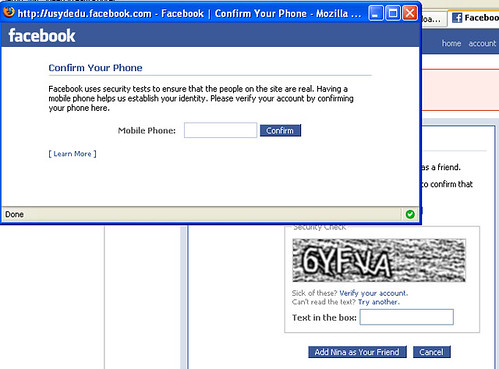
If you don’t have a valid e-mail, Facebook forces you to verify it, before it removes those annoying CAPTCHA boxes.It’s a pretty standard thing for websites to do this.

Now, it’s telling me, I have to verify my mobile phone number – even though I have been regularly using the service for eight months.

bastards

This is not about verifying my identity – it’s about forcing me to give up my personal information. Bastards.

The Wizards of Oz

The Internet has enabled a new world-order, causing people from the CEO down in almost every industry, an amazing amount of grief. The music industry, the newspaper industry, the telecommunications industry – heck, even tangible non-digital products like books – have been challenged at the core. However what these CEO’s have begun to realise, is that the Digital Age is no longer a threat, but a vehicle for growth.

Innovation is a key source of competitive advantage. And if you are an established company, innovation is hard. What takes six months of trying to convince the right people, jumping through hoops to keep internal stakeholders happy, and then finally releasing a half-baked product that is dramatically cut down from your vision – could be done by a bunch of college students in a garage over a weekend. Economies of scale is no longer an advantage in the Information Age – small, agile teams are.

In America – Google, Yahoo, Microsoft, News Corp, IAC and the rest – rely on acquisitions to fuel their innovation. An amazing amount of innovation is occurring on the web at the moment – not just new products but new business models. And the above mentioned companies have realised that acquiring a start-up early on, is a cheap way to innovate – as well as a great way to recruit.
But what about Australia?

Like America, we have a strong Internet industry with some clever entrepreneurs. But unlike America – no one is acquiring them. Could it be executives of this country’s leading companies just don’t know how much talent is available onshore? Well working in a professional services company that advises these companies, I am sure of it. Even a tech-savvy person like me is still discovering the amazing amount of talent and potential in my city, let alone country.

So here is to educating – both you and me – as I begin to start profiling innovation in Australia To make a suggestion for me to review on my blog, post it here

Have you tried to implement enterprise blogging?

Martianus: Hey guys, I think the earth goes around the sun.

Establishment: Don’t be ridiculous – everything revolves around the earth. Your idea sucks. Get back to work and let us take care of astrology, because we know best.

Nicholas: Dudes – seriously. It doesn’t make sense. Why don’t we take a different approach?

Establishment (between themselves): We’ve got a problem. These kids think that the earth moves and goes around the sun – as if someone was sitting in a car still, and the earth and trees walked and moved! Ridiculous!

Galileo: Hey I’ve been speaking to a lot of people, and everyone reckons the earth orbits the sun. It’s so painfully obvious. Can we please update our textbooks?

Establishment: Excuse me? Have you not looked at Psalm 93:1, Psalm 96:10, and Chronicles 16:30 that state “the world is firmly established, it cannot be moved.” It’s how we’ve always said it. We can’t let you challenge the Holy Book. The Holy Book is law, and only we can interpret it.

Galileo: What’s the big deal? I mean, I’m just saying something that makes sense. Look – everyone else is saying it. It’s not like I’m suggesting we need to implement blogging within our enterprise, to unlock our potential. Now that would be ridiculous!

Establishment: Listen – there is no point changing our world view. If we started telling people that, could you imagine? A famine would start, and nineteen percent of people would get a heart-attack because of the dangers of thinking like that – we can’t take that risk. The father almighty in his wrath would shake our flat earth, and ruin our existence. Even if it were true, why change? It’s not like it would make any difference. Now scram.

Galileo: You guys don’t get it – it could really help people, and it’s not a big deal. I can’t believe the fuss.

Establishment (between themselves): I don’t get what this kid is on. Let go and tell his superiors to have a word with him. We can’t have this type of thing happening again.

Two hundred years later
Establishment: Yes thank you – we are the pioneers. Our team took some risky moves to experiment with a new way of doing things early on – we often forget that it was us, the establishment, that started all this. If it wasn’t for us realising things needed to change, so much innovation would never have occurred. Just think – Einstein never would have worked out the theory of relativity. Thank God for the establishment and the foresight we continue to have this day.

The power of feedback

Validation of a persons self-worth is a key aspect of being human. Why do we like praise, but not criticism? Because the former validates our self-esteem, the latter contradicts it. Insecure people tend to seek more validation from other peoples opinions – because they need other peoples opinions to validate their self-esteem. Wonder why the modest don’t boast? It’s because their validation is not derived from having to tell you so that you know. They already know you know, and if you don’t agree, they don’t care – they’re self validated.

However no matter how secure you are with yourself, everyone loves a bit of validation – it’s just some people need it more than others, or possibly, we all have different ways in how we validate ourselves. Some fish for compliments on their looks; others validate themselves through great achievements. Validation of who we are, is what drives almost everything we do. That’s why an atheist should never bag out religion to a believer – the argument about whether God exists is irrelevant; what is relevant, is that by criticising the existance of a religious establishment, you are actually criticising a person’s self-identity that has been built on that establishment, by effectively de-validating their belief system.

Motivation systems are complex, and I by no means claim to be an expert – but I do know, that the power of feedback is one of the most effective ways of motivating an individual, especially when it comes to content creation. In the context of web-services, recognition and validation are key: people will stick around on your site, if they feel a greater sense of self-worth because of it.

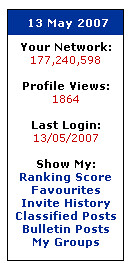
There are two ways people feel validated on online communities: analytics and responses. Analytics in the sense of statistics: page and profile views, unique visitors, popular content. Most bloggers arn’t really making money out of their blog – so why is software that provides statistics on their readership so popular? Because knowing people read your blog, is a form of validation. A bit like how an insecure teenage girl feels validated by the attention she myspace profilegets from sleazy older men. Right now, I am writing this blog entry because a reader asked if I could write more about the interaction between psychology and successful web start-ups. His comment validated my opinions, spurring me to write more on the subject.

Likewise, Myspace users will post a “Thanks for adding me” comment on a new friend. Why? Because it means more people will visit their profile. The reason I can say there are ulterior motives to just thank someone, is because they could have said “thanks for adding me” as a private message. So it then begs the question of why do they want more people to visit their profile? Because people get an ego boost seeing their page count go up.

Statistics to something you’ve created, are a quiet form of feedback. The more views, the more validated you feel by that. Popularity is a great feeling!

A second type of validation, is a bit more direct: it’s through the interactions with people. When people create content – photos, blog postings, whatever – nothing is more satisfying for them than a comment.

Features like Flickr’s recent activity are also apparently, what makes it so addictive. Again – it’s a form of validation. By responding to something someone has created, you are giving value to that creation – that feedback can make someone justify the effort, by providing recognition.

Sometimes the most powerful way a boss can keep their employees satisfied, is by a simple “thank you”. Recognition for effort expended by someone, can sometimes be all that someone needs to keep going.

Think you have a killer web2.0 app? You might. But unless a user feels like they are getting feedback on their existance and content creation, their first visit will likely also be their last. Feedback feels good. People want to feel good. So go and make them feel good about themselves.

« Older posts Newer posts »