Monthly Archive for January, 2009

Semanticising Twitter for a revenue model

Twitter It was interesting to read the 11 business models for Twitter. Here's one that I rarely see ever get mentioned: semantic conversations.

The assumptions.
Before I jump into it, some context as to why I think this is a solid approach.

- advertising sucks in the traditional sense. Showing ad's blindly, is like throwing pamphlets over the Amazon hoping that your target market catches some of them. Or another example: if you're looking for some relief, do you walk down the main street of your city with your pants down yelling out "I want sexy time"? Sure, some people will approach you - but it certainly is not the most efficient way.

- search advertising is the window into the future of advertising. The reason why Google does so well is because when a user searches they are flagging their intent. No more blind guessing - now it's just a matter of accurately matching that intent to something. To extend the analogy using sex, this is like going to a single swingers party - you know everyone there is hungry, so to speak.

- Word of mouth marketing beats any other form. Imagine you're at a nightclub with your best friend. A model stops in front of the two of you - looks at your friend - and asks what cologne he's wearing. He replies, she smiles - and then walks off giving him a wink.
You tell your little brother the next day about the incident who's just run out of cologne. Next thing you know, he's at the department store calling you and asking what's that cologne's name. Unlikely story? Have a think about the last time you bought something - we tend to rely on people we trust to guide our decisions.

- Affiliate marketing is one of the most successful ways of making money on the web. My friends at Tjoos.com, help people find coupons - and they make a stupid amount of money because of affiliate deals. Affiliate marketing is rooted in a traditional concept for selling - there are suppliers like a manufacturer, and there are the retailers who onsell the supply like we see with clothing shops. With affiliate marketing, you act as a store pushing a product - and you get a cut of the final transaction if successful.

- On Twitter people talk and share The use cases of Twitter are a different topic in itself, but let's think of one of the most common: people share links with other people. As a case in point, monitor this search query I just constructed. Within minutes, you will see hundreds of new results returned. That's a lot of links been shared.

Semantic conversations explained
Let's say I just suggested that people read the book "Growth Fetish". People that follow me know me well enough to look into it as a legit thing. Perhaps some even trust my judgement to blindly buy the book (like I do with some people I know).

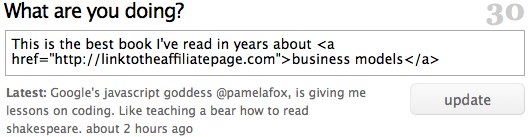
Now imagine, if instead of just saying the name of the book or pointing to the authors website - I had an easy way to embed Amazon affiliates. When people read I liked a book or a product, and they see a link - two things happen: they likely will follow the link to see what the fuss is about, and after reading up they will potentially make a purchase depending on how impressed or how much they trust me. Because the link tracks that I was the person recommending it, it connects the sale of that product by that person to me. And they don't need to make the purchase right there - it can happen up to 45 days later and I still get recognised for it (as is the case with most affiliate programs).
Twitter affiliated

Implementation
It's going to take a bit of thinking on how to implement this easily. For example, it needs to be drop dead easy for people to find the correct link and embed it. Twitter should tweak its system so that it recognises true hyperlinks that have words aliased, rather than just raw addresses. A way of guessing what the person is promoting and matching it to a Amazon code would be ideal (ie, "findbook:growth fetish" will have Twitter make a suggestion to link it to).

It would have to be a revenue share program, meaning Twitter and the user get a cut. That's a good thing, because everyone's interests are aligned. But it also means it needs to be thought out as it's an art to get the right progressive scale between motivating and killing.

Good luck Twitter: I'm counting on you and Facebook to work out a monetisation model, as you will drive the next wave of growth which builds the industry (like Google did post the dotcom years).

The change brought by the Internet is a correction

I was sitting at a restaurant with Mick Liubinskas of Pollenizer the other week, who I regard as one of the best minds in the Australian tech scene. Mick in a previous life used to run marketing at Kazaa, which was the music-industry's anti-Christ during the early 2000s. Kazaa was one of the higher profile peer-to-peer technologies that made the distribution of music so widespread on the Internet.

I said to Mick how one of the things that plagues my thinking is trying to work out the future business models for content. Naturally, we ended up talking about the music industry and he explained to me the concept of Soft DRM which he thought was one avenue for the future but which the record labels rejected at the time.

DRM

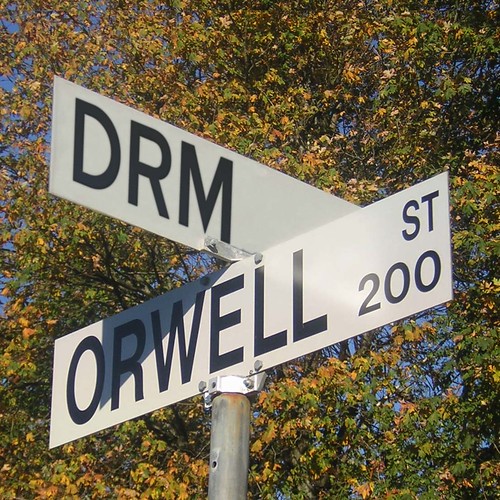
DRM or Digital Rights Management is the attempt by companies to control the distribution of digital content. Hard DRM places control over access, copying and distribution - while soft DRM does not prohibit unauthorised actions but merely monitors a user’s interaction with the content.

The basic difference, is that Hard DRM protects copyrights by preventing unauthorised actions before the fact, while Soft DRM protects copyrights by giving copyright owners information about infringing uses after the fact.

As I questioned Mick on this, he compared it to us sitting in that restaurant. What's stopping either of us from getting up and not paying the bill? The restaurant let's us sit, serves us food - and only at the end do we pay for the service.

Hard DRM is not congruent with our society
Part of the music industry's problem is that they've focused too much on Hard DRM. And that's wrong. They could get away with it in the past because that's how the world worked with controlled distribution lines, but now that world no longer exists with the uncontrollable Internet.

In a restaurant, like any other service industry, the risk that you don't get paid is real but not big enough to prevent it from operating. Our social conventions are what make us pay that bill, even though we have the ability to avoid it.

To insist on the Hard DRM approach, is going against how the rest of the western world works. Our society is philosophically based on the principle of innocent until proven guilty. Likewise, you pay after a service has been rendered - and you pay for something that has unique value (only scarcity is rewarded). What existed with the media world was unique over any other industry, but unique purely due to technological limitations, not because it was genuinely better.

The record companies (not the artists) are hurting
Artists practically sell their soul to get a record deal, and make little money from the actual albums themselves. This change for music is really a threat to the century-old record company model, of which the Internet has broken their distribution power and their marketing ability is now dwarfed by the potential of social media.

Instead of reinventing themselves, they wasted time by persisting with an old model that worked in the industrial age. They should have been reflecting on what value people will pay for, and working out the things that are better than free. Unfortunately, the entire content business - movies, television, radio, magazines, newspapers, books and the rest - have made similar mistakes.

The Internet is transforming our world and every object in our lives one day will be connected. In some ways, the great change brought about by the Internet is actually a step back to how things used to be (like it is for music where the record model was an anomaly in our history). Even the concept of a "nation state" is a 20th century experiment pushed after the first world war, where for our entire history prior to that, our world was governed by independent cities or empires that governed multiple ethnic nations - the Internet is breaking down the nation-state concept and good riddance because its complicated our lives.

Future

We need to clear the white board and start fresh. The Internet is only going to get more entrenched in our world, so we must re-engineer our views of the world to embrace it. With content, distribution was one of the biggest barriers to those industries to get into, and now it has been obliterated. Business models can no longer rely on that.

We should not let the old world drive our strategies for business because the dynamics have changed completely. If you are looking to defend yourself against an oncoming army - stop polishing the sword and start looking for the bullets to put in the machine gun.

Information age companies losing out due to industrial age thinking

Last weekend, I participated at the Sydney Startup camp Sydney II, which had been a straight 24 hour hackathon to build and launch a product (in my case Activity Horizon). Ross Dawson has written a good post about the camp you are interested in that.

activity horizon
It's been a great experience (still going - send us your feedback!) and I've learned a lot. But something really strikes me which I think should be shared. It's how little has changed since the last start-up camp and how stupid companies are - but first, some background.

The above mentioned product we launched, is a service that allows people to discover events and activities that they would be interested in. We have a lot of thoughts on how to grow this - and I know for a fact, finding new things to do in a complex city environment as time-poor adults, is a genuine issue people complain often about. As Mick Liubinskas said "Matching events with motivation is one of the Holy Grails of online businesses" and we're building tools to allow people to filter events with minimal effort.

ActivityHorizon Team

So as "entrepreneurs" looking to create value under an artificial petri dish, we recognised that existing events services didn't do enough to filter events with user experience in mind. By pulling data from other websites, we have created a derivative product that creates value without necessarily hurting anyone. Our value proposition comes from the user experience in simplicity (more in the works once the core technology is set-up) and we are more than happy to access data from other providers in the information value chain on the terms they want.

The problem is that they have no terms! The concept of an API is one of the core aspects of the mashup world we live in, firmly entrenched within the web's culture and ecosystem. It's something that I believe is a dramatic way forward for the evolution of the news media and it's a complementary trend that is building the vision of the semantic web. However nearly all the data we have hasn't been done through an API which can regulate the way we use the data; instead, we've had to scrape it.

Scraping is a method of telling a computer how data is structured on a web page, which you then 'scape' data from that template presentation on a website. A bit like highlighting words in a word document with a certain characteristic and pulling all the words you highlighted into your own database. Scraping has a negative connotation as people are perceived to be stealing content and re-using it as their own. The truth of the matter is, additional value gets generated when people 'steal' information products: data is an object, and by connecting it with other objects - those relationships - are what create information. The potential to created unique relationships with different data sets, means no two derivative information products are the same.

So why are companies stupid
Let's take for example a site that sells tickets and lists information about them. If you are not versed in the economics of data portability (which we are trying to do with the DataPortability Project), you'd think that if Activity Horizon is scraping 'their' data, that's a bad thing as we are stealing their value.

WRONG!

Their revenue model is based on people buying tickets through their site. So by us reusing their data and creating new information products, we are actually creating more traffic, more demand, more potential sales. By opening up their data silo, they've actually opened up more revenue for themselves. And by opening up their data silo, they not only control the derivatives better but they can reduce the overall cost of business for everyone.

Let's use another example: a site that aggregates tickets and doesn't actually sell them (ie, their revenue model isn't through transactions but attention). Activity Horizon could appear to be a competitor right? Not really - because we are pulling information from them (like they are pulling information from the ticket providers). We've extracted and created a derivative product, that brings a potential audience to their own website. It's repurposing information in another way, to a different audience.

The business case for open data is something I could spend hours talking about. But it all boils down to this: data are not like physical objects. Scarcity does not determine the value of data like it does with physical goods. Value out of data and information comes through reuse. The easier you make it for others to resuse your data, the more success you will have.