In the half century since the Internet was created – and the 20 years that the web was invented – a lot has changed. More recently, we’ve seen the Dot Com bubble and the web2.0 craze drive new innovations forward. But as I’ve postulated before, those eras are now over. So what’s next?
Well, ubiquity of course.

Huh?
Let’s work backwards with some questions to help you understand.
Why do we now need ubiquity, and what exactly that means, requires us to think of another two questions. The changes brought by the Internet are not one big hit, but a gradual evolution. For example, “Open” has existed since the first days of the Internet in culture: it wasn’t a web2.0 invention. But “openess” was recognised by the masses only in web2.0 as a new way of doing things. This “open” culture had profound consequences: it led to the mass socialisation around content, and recognition of the power that is social media.
As the Internet’s permeation in our society continues, it will generate externalities that affect us (and that are not predictable). But the core trend can be identifiable, which is what I hope to explain in this post. And by understanding this core trend, we can comfortably understand where things are heading.
So let’s look at these two questions:
1) What is the longer term trend, that things like “open” are a part of?
2) What are aspects of this trend yet to be fully developed?
The longer term trend
The explanation can be found into why the Internet and the web were created in the first place. The short answer: interoperability and connectivity. The long answer – keep reading.
Without going deep into the history, the reason why the Internet was created was so that it could connect computers. Computers were machines that enabled better computation (hence the name). As they had better storage and querying capacities than humans, they became the way the US government (and large corporations) would store information. Clusters of these computers would be created (called networks) – and the ARPANET was built as a way of building connections between these computers and networks by the US government. More specifically, in the event of a nuclear war and if one of these computing networks were eliminated – the decentralised design of the Internet would allow the US defense network to rebound easily (an important design decision to remember).
The web has a related but slightly different reason for its creation. Hypertext was conceptualised in the 1960s by a philosopher and scientist, as a way of harnessing computers to better connect human knowledge. These men were partly inspired by an essay written in the the 1940s called “As We May Think“, where the chief scientist of the United States stated his vision whereby all knowledge could be stored on neatly categorised microfirm (the information storage technology at the time), and in moments, any knowledge could be retrieved. Several decades of experimentation in hypertext occurred, and finally a renegade scientist created the World Wide Web. He broke some of the conventions of what the ideal hypertext system would look like, and created a functional system that solved his problem. That being, connecting all these distributed scientists around the world and their knowledge.
So as it is clearly evident, computers have been used as a way of storing and manipulating information. The Internet was invented to connect computing systems around the world; and the Web did the same thing for the people who used this network. Two parallel innovative technologies (Internet and hypertext) used a common modern marvel (the computer) to connect the communication and information sharing abilities of machines and humans alike. With machines and the information they process, it’s called interoperability. With humans, it’s called being connected.
But before we move on, it’s worth noting that the inventor of the Web has now spent a decade advocating for his complete vision: a semantic web. What’s that? Well if we consider the Web as the sum of human knowledge accessible by humans, the Semantic Web is about allowing computers to be able to understand what the humans are reading. Not quite a Terminator scenario, but so computers can become even more useful for humans (as currently, computers are completely dependent on humans for interpretation).
What aspects of the trend haven’t happened yet?
Borders have been broken down that previously restrained us. The Internet and Hyptertext are enabling connectivity with humans and interoperability for computer systems that store information. Computers in turn, are enabling humans to process tasks that could not be done before. If the longer term trend is connecting and bridging systems, then the demon to be demolished are the borders that create division.
So with that in mind, we can now ask another question: “what borders exist that need to be broken down?” What it all comes down to is “access”. Or more specifically, access to data, access to connectivity, and access to computing. Which brings us back to the word ubiquity: we now need to strive to bridge the gap in those three domains and make them omnipresent. Information accessible from anywhere, by anyone.
Let’s now look at this in a bit more detail
– Ubiquitous data: We need a world where data can travel without borders. We need to unlock all the data in our world, and have it accessible by all where possible. Connecting data is how we create information: the more data at our hands, the more information we can generate. Data needs to break free – detached from the published form and atomised for reuse.
– Ubiquitous connectivity: If the Internet is a global network that connects the world, we need to ensure we can connect to that network irregardless of where we are. The value of our interconnected world can only achieve its optimum if we can connect wherever with whatever. At home on your laptop, at work on your desktop, on the streets with your mobile phone. No matter where you are, you should be able to connect to the Internet.
– Ubiquitous computing: Computers need to become a direct tool available for our mind to use. They need to become an extension of ourselves, as a “sixth sense”. The border that prevents this, is the non-assimilation of computing into our lives (and bodies!). Information processing needs to become thoroughly integrated into everyday objects and activities.
Examples of when we have ubiquity
My good friend Andrew Aho over the weekend showed me something that he bought at the local office supplies shop. It was a special pen that, well, did everything.
– He wrote something on paper, and then through his USB, could transfer an exact replica to his computer in his original handwriting.
– He could perform a search on his computer to find a word in his digitised handwritten notes
– He was able to pass the pen over a pre-written bit of text, and it would replay the sounds in the room when he wrote that word (as in the position on the paper, not the time sequence)
– Passing the pen over the word also allowed it to be translated into several other languages
– He could punch out a query with the drawn out calculator, to compute a function
– and a lot more. The company has now created an open API on top of its platform – meaning anyone can now create additional features that build on this technology. It has the equivalent opportunity to when the Web was created as a platform, and anyone was allowed to build on top of it.
The pen wasn’t all that bulky, and it did this simply by having a camera attached, a microphone and special dotted paper that allowed the pen to recognise its position. Imagine if this pen could connect to the Internet, with access to any data, and the cloud computing resources for more advanced queries?
Now watch this TED video to the end, which shows the power when we allow computers to be our sixth sense. Let your imagination run wild as you watch it – and while it does, just think about ubiquitous data, connectivity, and computation which are the pillars for such a future.
Trends right now enabling ubiquity
So from the 10,000 feet view that I’ve just shown you, let’s now zoom down and look at trends occurring right now. Trends that are heading towards this ever growing force towards ubiquity.
From the data standpoint, and where I believe this next wave of innovation will centre on, we need to see two things: Syntactic Interoperability and Semantic Interoperability. Syntactic interoperability is when two or more systems can communicate with each other – so for example, having Facebook being able to communicate with MySpace (say, with people sending messages to each other). Semantic interoperability is the ability to automatically interpret the information exchanged meaningingfully – so when I Google Paris Hilton, the search engine understands that I want a hotel in a city in Europe, not a celebrity.
The Semantic Web and Linked Data is one key trend that is enabling this. It’s interlinking all the information out there, in a way that makes it accessible for humans and machines alike to reuse. Data portability is similarly another trend (of which I try to focus my efforts), where the industry is fast moving to enable us to move our identities, media and other meta data wherever we want to.
As Chris Messina recently said:
…the whole point of working on open building blocks for the social web is much bigger than just creating more social networks: our challenge is to build technologies that enhance the network and serve people so that they in turn can go and contribute to building better and richer societies…I can think of few other endeavors that might result in more lasting and widespread benefits than making the raw materials of human connection and knowledge sharing a basic and fundamental property of the web.
The DiSo Project that Chris leads is an umbrella effort that is spearheading a series of technologies, that will lay the infrastructure for when social networking will become “like air“, as Charlene Li has been saying for the last two years.
One of the most popular open source pieces of software (Drupal) has now for a while been innovating on the data side rather than on other features. More recently, we’ve seen Google announce it will cater better for websites that markup in more structured formats, giving an economic incentive for people to participate in the Semantic Web. API‘s (ways for external entities to access a website’s data and technology) are now flourishing, and are providing a new basis for companies to innovate and allow mashups (like newspapers).
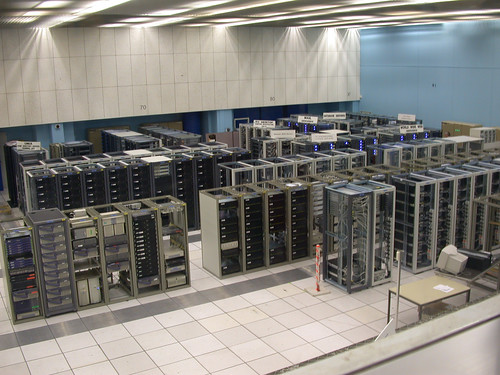
As for computing and connectivity, these are more hardware issues, which will see innovation at a different pace and scale to the data domain. Cloud computing has long been understood as a long term shift, and which aligns with the move to ubiquitous computing. Theoretically, all you will need is an Internet connection, and with the cloud, be able to have computing resources at your disposal.
On the connectivity side, we are seeing governments around the world make broadband access a top priority (like the Australian governments recent proposal to create a national broadband network unlike anything else in the world). The more evident trend in this area however, will be the mobile phone – which since the iPhone, has completely transformed our perception of what we can done with this portable computing device. The mobile phone, when connected to the cloud carrying all that data, unleashes the power that is ubiquity.
And then?
Along this journey, we are going to see some unintended impacts, like how we are currently seeing social media replacing the need for a mass media. Spin-off trends will occur which any reasonable person will not be able to predict, and externalities (both positive and negative) will emerge as we drive towards this longer term trend of everything and everyone being connected. (The latest, for example, being the real time web and the social distribution network powering it).
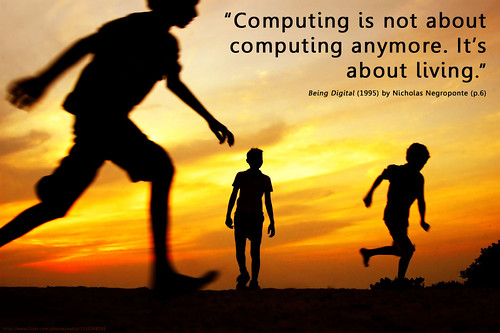
It’s going to challenge conventions in our society and the way we go about our lives – and that’s something that we can’t predict but just expect. For now, however, the trend is pointing to how do we get ubiquity. Once we reach that, then we can ask the question of what happens after it – that being: what happens when everything is connected. But until then, we’ve got to work out on how do we get everything connected in the first place.