Archive for December, 2008

Blog posts on Liako.Biz for 2008

I launched this blog in March 2005 as a travel blog. People would flood me with e-mails about my travels, and it made me realise how powerful blogging can be (not to mention fun). I re-started this blog in March 2007 as a "career" blog (whatever that's supposed to mean). It's probably best now to describe it as my "passions" blog which evolves as I progress through life and think about things.

What I love about blogging is that it forces me to think; forces me to research and learn; forces me to challenge my ideas by interacting with other people. All the good stuff in life - I hope to give a bit more attention next year.

I also thought it would be good if I summarised what I wrote about this year. Heck - let's go right back to 2005. This will be the first in a series of three blog posts progressively released - starting with 2008 today, then 2007 tomorrow and finally 2005 two days later. For those that may post comments, bear with me as I have literally 24 hours of New Year's concerts to attend to (get home at 6am from Shore Thing, ready for Field day at 11am). It may take me some time to recover and get back on a computer!

I've given you a brief summary to guide you on whether you should make the great leap and click. I was going to rank my articles with a simple "good, poor, average" and I ended up getting stuck reading some and think 90% are more or less the same style (so I am either consistently crap or consistently good).

Enjoy!

December 2008

  • A milestone year in my life: Basically, a mini biography of my career. The decisions I made and the experiences I've had that will determine where I will be heading
  • The evolution of news and the bootstrapping of the Semantic Web: Highlighting how the New York Times is making available news data in the form of API's. The significance of this in my eyes is a huge shift in the evolution of the news media, and separately, I mention that this might make the vision of the Semantic Web a reality in an unintended way
  • Thank you 2008, you finally gave New Media a name: I indicate how 2008 was the tipping point for the Information Age's Social Media to finally trump the Industrial Age's Mass Media. I researched the history of the concept of Social Media, explained what "media" really is, and how the term "Social Media" is the perfect term to describe what we've been calling these evolving communication trends.
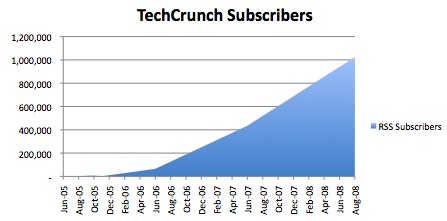
  • The makings of a media mogul: Michael Arrington of TechCrunch: A detailed analysis of how a nobody became one of the most influential men in the world as a New Media pioneer. Mr Arrington even thanked me!
  • The future of journalism and media: A look at the Watergate scandal as well as my own personal experience with a university publication, to understand the core dynamic of the media. I argue that what made the mass media tick in the past was a marketplace, and it's one that can be applied to digital media going forward.
  • So open it’s closed: I make an argument that the term "Open" is being abused and has lost its meaning. We need better guidelines on what constitutes an "Open Standard" before it becomes too late.
  • Social media and that whole “friend” thing: A post about how there is pressure to subscribe to peoples content on various services, even when you don't want to receive their content. The result is an unusable service. I reflect on how Google Readers friends option is a simple but more effective way of social media, as it removes this pressure.

November 2008

  • The broken business model of newspapers: An analysis of problems with the newspaper industry - too much detail in articles create extra cost, changes to the news cycle has changed their relevance, and incentives and structures are not aligned with what their strategic goals should be
  • Online advertising - a bubble: Long detailed analysis on why advertising is basically screwed in the long term (thanks to the Internet)
  • Liako is everywhere…but not here: Some links to content I have been creating elsewhere, as this blog had been neglected!
  • The Rudd Filter: I wrote an e-mail to every senator of the Australian parliament on the proposed Internet censorship laws. As a postscript, it made an impact as I got responses from the key people who are the balance of power in the Senate :)
  • You don’t nor need to own your data: We live in an economy now where you don't need "ownership" to live your life. This will certainly make you think!

October 2008

  • The mobile 3D future - as clear as mud: Recounting my experience from iPhone 1G to Nokia N96 back to the iPhone (3G). I conclude that the reason we never got the vision of the mobile web in the past, is because the interface has been the missing link for so long

September 2008

July 2008

  • Silicon Beach Australia - the movie!: An announcement post for the Silicon Beach Australia community which exploded in interest after I created it
  • The DataPortability governance framework: a template: An update, history and recognition post of the many months of hard work for the team that created the governance and workflow model for the DataPortability Project. It was a challenge because existing models aren't designed for an online virtual world that we operate as.
  • Internet censorship in Australia: The responses from the Federal government on my letter six months earlier protesting against the proposed Internet censorship regime

June 2008

May 2008

April 2008

March 2008

February 2008

A milestone year in my life

I try to avoid writing about personal stuff on my blog (even my travel writing is like a tour guide talking, as opposed to a description of my day-to-day activities). However I thought I'd share this as you will understand both my past experience and future direction better - as after all, this blog is a conversation between you and me right? And I'm going to do it in one hit, because you won't hear me navel gazing like this again for another ten years!

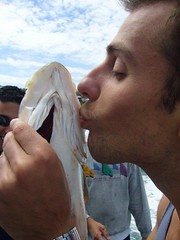
elias fish kiss

Basically, I've hit a milestone in my life in whatever way you look at it. I completed the two-year postgraduate diploma which has had me locked in a room; completed the three-years mentored work experience that accompanies the diploma; and completed my formal education goals, which if you count my three-year undergraduate degree, has taken six years (seven if you count the year I took off to travel). At 17, I made the decision to go down this path (well one of them) and now as a 24-year-old, I have finally made it.

So this is an explanation of what I've been doing and why. How things are evolving in my career are quite random. Hopefully this will have you understand how my background experiences lead me to where I am now.

A career in business - the undergraduate degree
At about the age of 15, I had decided to pursue a career in business in some way - don't for a minute think I had any idea what that meant, but my dad suggested a Bachelor of Commerce which was about as broad as they get, so it seemed like a plan (I like vague and broad - allows flexibility). However in the next few years, I experimented with student media and based on the amazing feedback I received from everyone (my folks complained at parent teacher interviews, all they talked about was the newspaper and not my academic performance), I seriously contemplated a career as a journalist. Worried about what path to take, my father gave me some advice which sealed the deal and which was passed down from my grandfather's experience who was a newspaper editor: "You will never be your own boss, kid". The thought of me being paid terrible money and forever hostage to a superior authority, made me decide I can always write for fun but it would better to invest in an education that you can't pick up easily without formal study. So business it was.

I received an okay mark in my final year of school (93.10%) and was accepted into the university and course of my choosing - a Bachelor of Commerce at the University of Sydney (you needed 93.00% - with my education, I seem to have a magic touch for doing just enough but not too much work). My eldest half-sister, a banker with JP Morgan at the time, told me her biggest regret was not becoming a Chartered Accountant. She told me to steer away from the subjects girls flock to, like marketing, and to do the more 'hard' subjects like accounting and finance. Even though I didn't even do maths in my final year of school (all humanities, mostly history), I decided to pursue this path despite it not being something I was naturally good at. In retrospect, I decided finance was not for me in terms of a career choice and I regret not doing marketing. But I went along with the accounting thing - I could understand value in that if I wanted to become an executive one day.

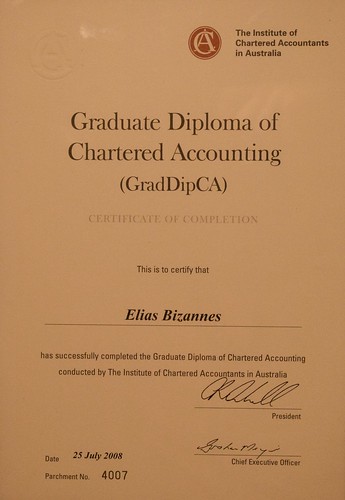
GradDipCA
My undergraduate degree was simply a prerequisite to get into this course which I would start in 2006 and finish in 2008. I'm still in shock that I finally got through it

A career in media - the second curricula
I didn't ignore my interest in journalism however. Six months in, I decided I wanted to start a newspaper because the crap on campus was exactly that. I also wanted to take aim at the mainstream media whose bias was repeatedly distorting our world. It turned out James Fraser, a guy I went to high-school with, wanted to do the same thing. My partner-in-crime approached this as a business venture, but I pushed for a society because I knew in 2.5 years I would be out of university and my motivation was to learn (not profit). And so we shook hands later in 2002 and created the Sydney University Journalists Society which grew to over 200 members.

In early 2003 after all the admin had been finalised, we went about creating our first product: "idMag". Between the two of us, we did everything. I focused on the editorial and James more on the design, which we did at night. During the day, we would walk into small businesses and try to sell them advertising space based on a double-sided rate paper (ie, thin air delivered by two pimple-faced kids in suits). Of the dozens (hundreds?) of businesses we talked to, I would talk and James would give me immediate feedback on how to improve my sales pitch. I also tried calling the big companies (I think it was Vodafone), and will never forget getting absolutely roasted by a company's advertising agency, who with her hard questions purposely demolished me to prove I was wasting her time (and perhaps intended, she taught me a valuable lesson about media). Nevertheless, we raised enough money to fund 4000 semi-colour 24 page magazines. I then learned one of my biggest lessons in the media world: distribution is key.

The magazine was a flop because without a distribution strategy, you don't have an audience, and without an audience, you won't have advertisers spending money on you again that second time around (so I assumed, I didn't have the guts to re-approach our advertisers). During this time, I played with Microsoft Frontpage with blinking text and other cool (!) Frontpage features to create a website for the magazine, and after we published it, I decided to devote more attention to building it. It was in 2003 that I realised the future of media was on the Internet as the barriers to distribution were removed (so I thought, new barriers now exist -but sweet baby cheeses it was cheaper!). We experimented with a few other things that year, but I got distracted by an election to be voted on the campus newspaper I detested. I paraded around university telling people to "think outside of the box". We didn't get on, but I developed an awesome suntan.

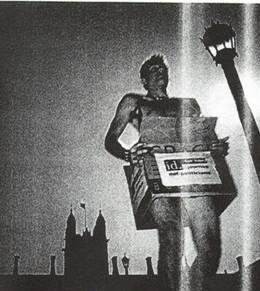
"Think outside of the box"

It's funny to trawl through my online footprint because up until then I was a tech savvy consumer, but that's all I was, because at the age of 13 I made a conscious decision to unhook my interest in computers to not become a "geek" (ie, learning how to code) and instead became a jock of sorts. Now in 2003, I invested some time in the Kuro5hin.org community, which had me learn the potential of online media communities. When I finally got an article approved, I moved on - I had enough of the trolls. But in my quest to build a new media organisation, I actively reached out and had to learn about things like registering & resolving a domain name, hosting a website, and teaching myself CSS to get that Drupal installation looking how I wanted. It was amateur stuff that seems stupidly basic now, but that's how I learned.

In 2004 one of the products we launched, which was a weekly news digest, became an absolute hit (as I recently wrote about). When the year ended, I ended my tenure as President and got the green light that all subjects had been passed. But before I end this chapter, I will share that in November 2003 before my corporate finance exam, I had a Eureka moment that newspapers in the future would be printed using e-ink technology (probably from something I came across my favourite blog at the time, PaidContent.org). I researched the idea and in the process of doing this ended up putting together a business case to apply for the Yellow Pages business grant (my idea had evolved to an innovative model for advertising, which to this day, I am still thinking about as it overlaps with the VRM Project). I didn't get the grant (or even make the finals) - but boy, when you do things like that, it opens your eyes up to things.

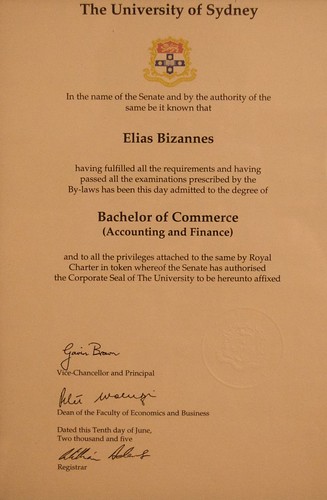
USYD Degree

I left university with not just a degree in business, but a realisation that although I may never become a journalist, I was passionate about having a career in the business of media. And that the Internet was where it was at. It's not something you will find on my undergraduate degree certificate, but it's what I walked out of university thinking.

The corporate world
PricewaterhouseCoopers offered me a graduate job, following an early 2003 summer internship (60 positions, 1000 applicants). Having spent the last few years at a restaurant as a waiter, my discussions with the backpackers that came through the place made me itch to do a big trip overseas. And so in 2005, I managed to defer my contract (I got it in March 2004; deferred for up to two years) and went travelling for nine months (which is how this blog came into creation). I had always wanted to blog but never did because I didn't want to keep an online diary - a travel blog seemed like the perfect opportunity to experiment with this form of media.

I returned from my trip and started as a graduate in December 2005 in the assurance practice (external audit), specialising in media & technology companies (our clients are Cisco, IBM, VeriSign, Getty Images, and a whole alphabet soup of that kind). However I couldn't help myself with ideas that were flowing through my mind. And in April 2006, on a train, I wrote a to-do list note on my phone: "start a wiki at PwC". It seemed stupidly obvious that the world's biggest knowledge firm didn't have a wiki (which was another experiment during my time at the Journalists Society that I thought was massive). Unfortunately, to get technologies like that switched on is not quite what you think. People that have been through the pain of creating change or innovating within a large organisation know exactly what I mean - and I was a nobody trying to influence people 15-30 years older than me in senior management.

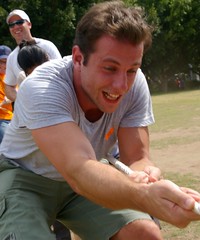
tug of war

I pitched the idea to my manager in May 2006, and she must have been having a bad day, because she ripped it to shreds. Slightly taken aback, I dropped it, but it stayed at the back of my mind. Then, after a nasty month of work in August, I repitched it to her with recent experience as examples and using the language she shot me down with ("I don't know what you said differently, and I know it's the same idea, but I like it now!). She gave me advice which I ended up ignoring, and went about determining a strategy to pitch it to the partners after my exam. Preparing for my first CA exam in October, I randomly came across Charlie Perry who it turns out had been wanting to set up a wiki at the firm as well. We met up, decided to "join forces", and rolled. What happened next I would never have imagined.

We pitched the idea to a group that had recently formed, and who were called "Service Innovation". It turned out there was a big problem in the firm that the boss of Service Innovation had to solve on order of the CEO. Fed with information, I wrote a formal business case for how Social Media could fix this problem. The idea was approved right up to the CEO level and I then went about implementing it which is a story in itself but not one I can publicly share :) .

The tech industry
Just after we got the pilot approved, Charlie randomly flicked across an e-mail. We ended up getting in contact with Marty Wells who ran Dinner 2.0 and would invite us (I think he thought he could wrangle sponsorship money out of PwC!), and in February 2007 I started mingling with investors, entrepreneurs and other people in what was an exclusive Sydney networking event. Talking to Marty that night, I told him and others I had a business idea I wanted to work on. "Well there are going to be a lot of developers at Barcamp". So I went to Barcamp, restarted this blog, and joined the APML workgroup which I thought was a brilliant solution to advertising. (Remember that business idea of mine at university? Things you research, "fail" in, and move on come back to haunt you in a good way).

I attended more events, made more friends, started building a presence. I gave Chris Saad from the APML workgroup introductions and advice on his product, and in return, he introduced me to more people - which is how I was invited to explore the concept of a workgroup around data portability so early on. In January 2008, that workgroup exploded in attention and I suddenly was working daily with people across all the different continents. Separately, my involvement in the local community made me passionate about it, and quite randomly actually, I created something that has been played up that I am some kind of Big Deal when in fact I've done nothing other than moderate spam messages, host some drinks and create some podcasts.

December 2008
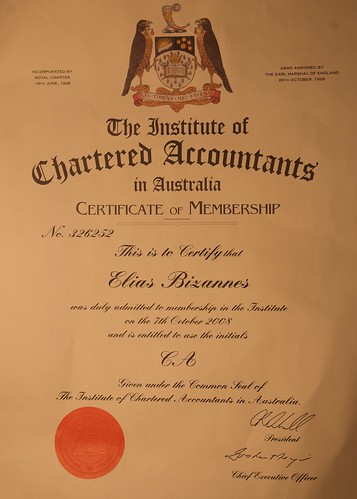
My official certificate recognising admission into the Institute of Chartered Accountants
So here I am. Milestones and goals achieved. At this age, all I hoped to achieve was to become a CA (which I was formally admitted earlier this month). In the process I've done things I never would have imagined.

As you can see, accounting is simply a stepping stone to what I really want to do: build and run companies. It's great having a goal, but now I've got to work out what comes next! I've got some ideas - like plucking myself out of my comfortable life here and living in Silicon Valley in the midst of raw innovation - but who knows. The only thing I do know is that you need to meet as many people as possible and genuinely build a relationship with them with no desire to get anything out of it. They will open doors for you when you least expect it - keep giving (it feels good anyway) and they will hit you on the head back with something one day. And secondly, when you have an idea, just do it. Expose yourself to random experiences - just participate and the dots will connect one day.

So in 2009, I'm going to jump and see where that leads me. Wish me luck!

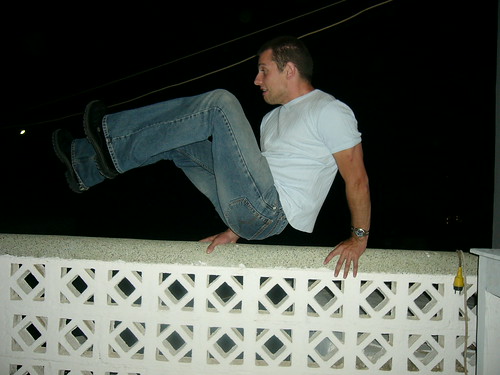
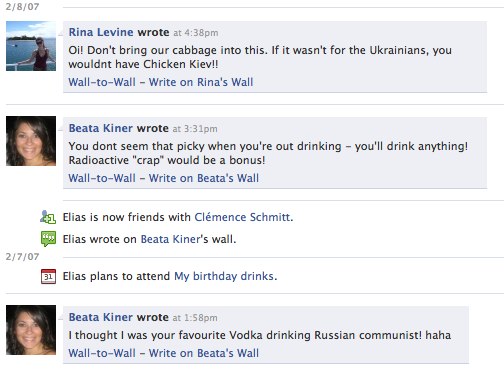
Why you shouldn't give me alcohol #4

The evolution of news and the bootstrapping of the Semantic Web

The other month (as in, the ones where I am working 16 hour days and don't have time to blog), I read in amazement a stunning move made by the New York Times. It was the announcement of its first API, where you could query campaign finance data. It turns out this wasn't an isolated incident, as evidenced by yet another API release, this time for movies, with plenty more to come.

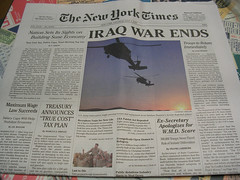
Fake New York Times newspaper That is massive! Basically, using the same data people will be able to create completely different information products.

I doubt the journalists toiling away at the Times have any idea what this will do to their antiquated craft (validating that to get the future of media you need to track technology). As the switched on Marshall Kirkpatrick said in the above linked article for Read Write Web "We believe that steps like this are going to prove key if big media is to thrive in the future."

Hell yeah. The web has now evolved beyond 'destination' sites as a business model. News organisations need to harness the two emerging business models - platforms and networks. Whilst we've seen lots of people trying the platform model (as aggregators - after all, that is what a traditional newspaper has been in society), this is the first real example I have seen of the heritage media doing the network model. The network model means your business thrives by people using *other* peoples' sites and services. It sounds counter intuitive but it's the evolution of the information value chain.

This will certainly make Sir Tim Berners-Lee happy. The Semantic Web is a vision that information on the web is machine readable so that computers can truly unleash their power. However this vision is gaining traction very slowly. We will get there, but I am wondering whether the way we get there is not how we expect.

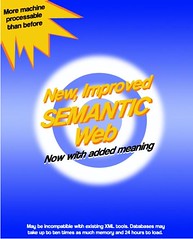
The New Improve Semantic Web: now with added meaning!

These API's that allow web services to reuse their data in a structured way may just be what the Semantic Web needs to bootstrap it. There's an assumption with the vision, which is that for it to work, all data needs to be open and publicly accessible. The economics are just not there yet for companies to unlock their data and my work this year with the DataPortability Project has made me realise to get value out of your data you simply need access to it (which doesn't necessarily mean public data).

Either way, for me this was one of the biggest news events of the year, and one that very quietly has moved on. This will certainly be something worth tracking in 2009 as we see the evolution of not just the Semantic Web, but also Social Media.